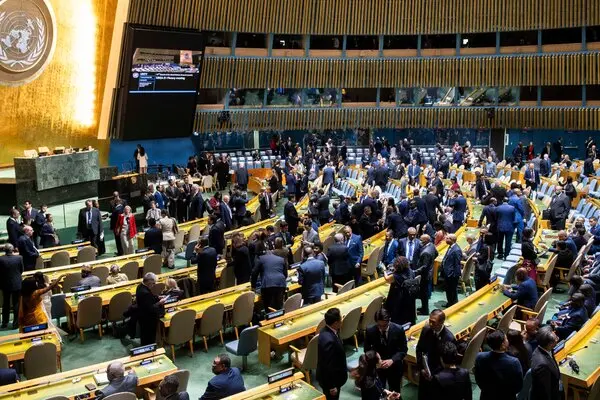

NEW YORK: President Donald Trump used his address to the United Nations General Assembly on Tuesday to present a vision of American power in which military strength, economic advantage and the president’s own decisions take precedence over traditional international restraints.
Speaking before the organisation established to prevent future wars, Trump threatened to destroy Iran’s Islamic republic if its leaders failed to reach an agreement with Washington. He also defended American claims over Venezuela’s oil reserves following the removal of the country’s leader by US forces, invoking the principle that the spoils of conflict belong to the victor.
The remarks highlighted Trump’s approach to foreign policy at a time when the United States remains involved in a war with Iran that has lasted considerably longer than he initially expected.
Trump Threatens Iran as War Continues
During his speech, Trump warned Tehran that failure to reach an agreement could lead to the annihilation of the Islamic republic.
His comments placed the prospect of further military escalation alongside the possibility of a negotiated settlement, with the American president presenting both outcomes as dependent on his decision.
The warning came amid continued uncertainty over efforts to end the US-Iran conflict.
Although Trump’s language suggested a willingness to intensify military pressure, it may also have been intended to strengthen Washington’s position ahead of negotiations.
Later that morning, American officials quietly met Iranian representatives who were also in New York for the opening of the General Assembly.
It remained unclear whether the discussions produced any progress or whether Trump would personally meet senior Iranian officials.
Venezuela Remarks Reflect a Different Approach to International Power
Trump also used the UN platform to justify American claims involving Venezuela’s oil reserves after US forces removed the country’s leader.
By declaring that the benefits of victory belong to the winner, he presented control over valuable resources as a consequence of military success.
The statement reflected an approach in which the use of American power can be linked directly to economic and strategic gains.
Such reasoning differs from the principles on which the United Nations was established after the Second World War.
Speech Contrasts With the UN’s Founding Principles
Trump has repeatedly questioned the relevance and effectiveness of the United Nations and other institutions created in the aftermath of the Second World War.
His latest address brought that disagreement into focus at the organisation’s most prominent annual gathering.
The UN was founded in 1945 with the stated objective of protecting future generations from war. Its Charter, drafted with substantial American involvement, places restrictions on the threat or use of force against the territorial integrity of other states.
Under the Charter, force is permitted in circumstances including lawful self-defence or action authorised by the UN Security Council.
Trump’s remarks on Iran and Venezuela presented a different understanding of how a major power should exercise its influence.
Rather than emphasising collective decision-making through international institutions, the president asserted Washington’s ability to determine when negotiations should continue, when military force should be used and what benefits could follow a military victory.
The speech illustrated the tension between the international order the United States helped establish in 1945 and Trump’s approach to American power.