
For more than a decade, Narendra Modi has appeared politically unassailable, presiding over a government that has consistently outmaneuvered opponents, dominated public discourse, and narrowed the space for dissent in the world’s largest democracy.
But last weekend, a youth-led protest movement barely a few weeks old accomplished something none of India’s embattled mainstream opposition parties had managed: it forced Modi’s government to back down.
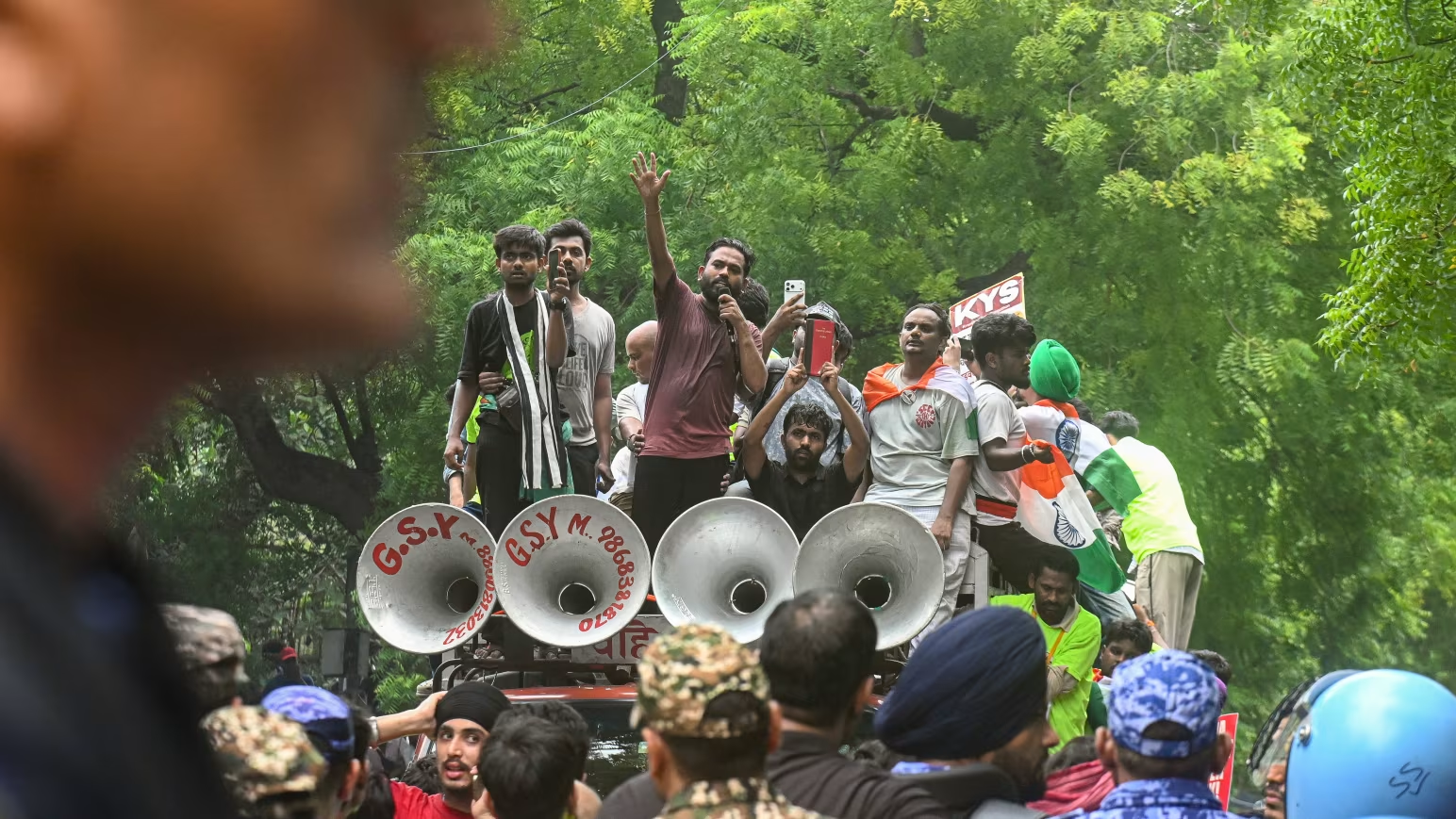
For days, tens of thousands of Gen Z protesters flooded the streets of New Delhi, led by a satirical movement calling itself the “Cockroach Janta Party,” demanding accountability over a university entrance exam leak they say robbed millions of students of a fair shot at their futures. At the center of their demands was Education Minister Dharmendra Pradhan, a trusted Modi lieutenant, on whose watch the leak occurred.
Pradhan’s resignation on Saturday was met with jubilation and no small amount of surprise at Jantar Mantar, the eighteenth-century observatory that had become the colorful, buoyant base camp for the protest movement. Crowds danced, sang, and waved the national flag late into the night, celebrating what they viewed as a rare victory for accountability and collective action.
It marked a notable retreat for Modi’s Bharatiya Janata Party, which has weathered multiple civil society protest movements since coming to power in 2014, and a dent in the personal aura Modi has cultivated as India’s strongman leader.
The movement’s success appears to have emboldened others to believe meaningful change is possible. “A week ago you couldn’t really give any feedback to the government,” said 22-year-old software engineer Akshit Tyagi, speaking from the protest site. “Now everyone has come out… and there is a validation that is spreading, and people are realizing that they can actually demand things from the government.”
Three of India’s neighbors, Sri Lanka, Nepal, and Bangladesh, have all experienced turbulent, youth-led political upheaval in recent years. Now, some in India are asking whether the Cockroach movement’s success could mark the start of something similar in a country where youth discontent has long simmered beneath the surface.
‘Didn’t Anticipate This’
Many of the young protesters at Jantar Mantar came of age entirely under Modi’s rule, a period defined by sweeping promises of national greatness, economic prosperity, and renewed nationalism. Those pledges shaped their formative years and their expectations of the country’s trajectory and their place within it.
India remains one of the world’s fastest-growing major economies, and Modi’s three terms have brought heavy investment in infrastructure, technology, and manufacturing. Yet many young Indians say that broader national success has failed to translate into real opportunity for them personally. The country has one of the youngest populations in the world, with more than 360 million people aged between 15 and 29, but a recent report found that nearly 40% of graduates aged 25 and under are unemployed.
When the government admitted in May that entrance exam papers for medical and dental courses had been leaked, forcing millions of students to resit them nationwide, long-simmering frustration erupted into open anger. The Cockroach Janta Party, originally a satirical online project created by Abhijeet Dipke, a Boston University graduate, quickly became a vehicle for this generational anxiety, giving young Indians a platform to voice grievances about employment, governance, and the lack of upward mobility.
“This indeed is a shock and setback for the BJP,” said Rahul Verma, a political scientist and fellow at the Centre for Policy Research in New Delhi. “They didn’t anticipate perhaps the kind of frustration or anxiety that is getting built-in in society.”
Over its twelve years in power, the BJP has weathered numerous protest movements, from public anger over a sudden demonetization scheme that invalidated more than 80% of the country’s banknotes to widespread opposition to a contentious citizenship law to months-long farmer demonstrations against agricultural reforms. Verma noted that those earlier movements were rooted in policy or ideological disagreements, which allowed the government to rally its base with counter-narratives.
By contrast, he described the Cockroach protests as the “first movement driven by administrative failure,” making it, in his view, far harder for the government to contain.