
Zafar iqbal CEO Republic Policy Think Tank
Pakistan stands at a defining moment in its intellectual journey. The country possesses one of the youngest populations in the world, yet it struggles to cultivate one of the most important habits that shapes enlightened societies: reading books. While millions of students read textbooks to pass examinations, very few continue reading after leaving classrooms. Books are often treated as academic requirements rather than lifelong companions. The result is visible in declining critical thinking, weak research culture, shrinking libraries, and limited public engagement with ideas.
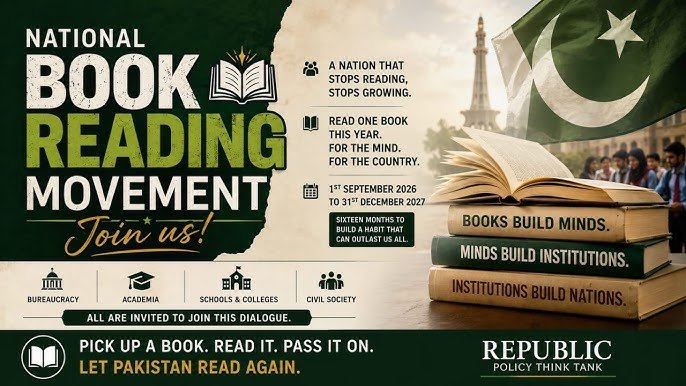
Recognising this challenge, Republic Policy Think Tank is launching the National Book Reading Movement, a nationwide campaign designed to revive the culture of reading in Pakistan. The movement will be formally inaugurated on 5 August 2026 at Quaid-e-Azam Library, Bagh-e-Jinnah, Lahore. It is not merely another literary event; it is the beginning of a long-term national effort to restore books to the centre of Pakistan’s intellectual and cultural life.
The movement is expected to continue for two to three years and will engage people across every district and tehsil of Pakistan. Republic Policy Think Tank aims to build partnerships with students, teachers, universities, civil servants, politicians, writers, researchers, journalists, business leaders, and members of civil society. The objective is simple but ambitious: to convince Pakistanis that reading books is essential for personal growth, responsible citizenship, national development, and democratic progress.
A comparison with other countries makes Pakistan’s challenge even clearer. In Europe and North America, reading is deeply rooted in daily life. Public libraries are busy community centres. Parents encourage children to read from an early age. Schools promote independent reading alongside classroom instruction. Governments and private institutions invest heavily in publishing, libraries, and literary festivals.
Even within South Asia, Pakistan lags behind. India has one of the world’s largest publishing industries and hosts hundreds of book fairs every year. Bangladesh celebrates literature through vibrant publishing houses and annual literary festivals. Sri Lanka has maintained a strong public library network and continues to promote reading among young people. These countries understand that books are not luxuries; they are investments in human capital.
Pakistan, unfortunately, has developed a different relationship with books. Reading is often confined to examination preparation. Students spend years memorising textbooks, guidebooks, and notes. Once examinations are over, many abandon reading altogether. Very few continue exploring history, philosophy, science, economics, politics, literature, psychology, international relations, or public policy. This narrow reading culture limits curiosity, creativity, and independent thinking.
The consequences extend far beyond education. Nations that read widely produce stronger researchers, innovative entrepreneurs, thoughtful policymakers, responsible citizens, and creative artists. Reading introduces people to different cultures, alternative viewpoints, scientific discoveries, and historical experiences. It encourages dialogue rather than prejudice and understanding rather than intolerance. A society that reads becomes more capable of solving complex problems through knowledge instead of emotion.
Some argue that digital technology has replaced books. Information is now available instantly through mobile phones, websites, podcasts, and artificial intelligence. While digital platforms have transformed access to knowledge, they cannot entirely replace the experience of reading a carefully written book. Books offer depth, context, evidence, and sustained argument that fragmented online content rarely provides. They demand concentration, patience, and reflection—qualities that are increasingly valuable in an age of constant distraction.
Paper books, in particular, continue to hold unique value. Holding a book, turning its pages, highlighting passages, and returning to important ideas creates a deeper intellectual connection than scrolling endlessly through short online posts. Digital resources should complement books, not replace them. The future belongs to societies that combine digital innovation with strong reading habits.
Pakistan must also revive its public libraries. Libraries should once again become vibrant centres of learning, discussion, and research rather than neglected buildings visited only during examinations. Every district, university, college, and school should encourage reading circles, book clubs, author talks, and community discussions. Local governments, educational institutions, publishers, and civil society organisations all have an important role in rebuilding the country’s reading ecosystem.
The National Book Reading Movement seeks to transform this vision into action. Republic Policy Think Tank will organise awareness campaigns, public dialogues, seminars, reading circles, school outreach programmes, and partnerships with educational institutions across Pakistan. The campaign will encourage citizens to read beyond textbooks and discover literature, philosophy, science, governance, economics, religion, history, biographies, technology, public administration, and countless other fields that enrich human understanding.
Young people are at the heart of this initiative. Pakistan’s future depends not only on educated graduates but on informed readers who continue learning throughout their lives. A nation that reads produces better leaders, better professionals, better parents, and better citizens. Reading strengthens imagination, develops empathy, improves communication, and prepares individuals to participate meaningfully in democratic society and the knowledge economy.
The inauguration of the National Book Reading Movement on 5 August 2026 at Quaid-e-Azam Library represents the first step in a much larger journey. Every citizen who values knowledge should become part of this movement. Teachers should inspire students to read beyond the syllabus. Parents should make books a regular part of family life. Universities should promote independent reading and research. Public institutions should invest in libraries and publishing. Writers and intellectuals should guide a new generation of readers.
Pakistan cannot become a prosperous, innovative, and democratic nation without becoming a nation of readers. Roads, buildings, and technology are essential for development, but ideas build civilizations. Those ideas are preserved, challenged, and transmitted through books.
The National Book Reading Movement is therefore not simply a campaign to read more books. It is a movement to build a more informed, thoughtful, creative, and enlightened Pakistan. Every page read is an investment in the future. Every book opened is another step towards a stronger nation. The time to revive Pakistan’s reading culture has arrived, and the responsibility belongs to all of us.