
Michael B. G. Froman
How Overcapacity Ends
here has been no shortage of complaints about Chinese overcapacity in recent years. Beijing’s commitment to driving exports and widening its trade surplus, by any means necessary, has undermined the manufacturing aspirations of advanced economies such as the United States and those in Europe, as well as developing countries in Africa, Asia, and Latin America. There is more of a global consensus about the nature of the challenge than ever before, but it has had little effect on Chinese policy.
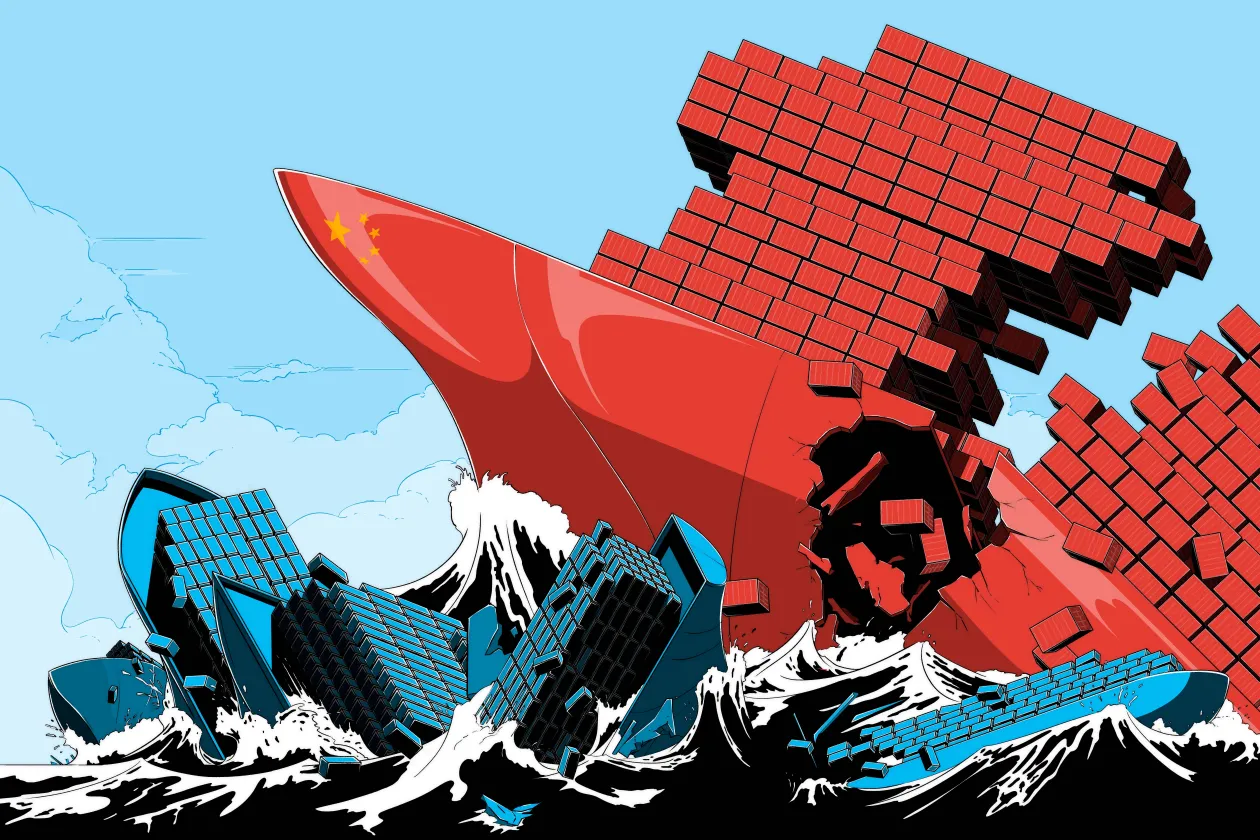
Now, the problem is morphing into a qualitatively new and more dangerous one: the world’s ability to absorb Chinese overcapacity is approaching a breaking point. And if that breaking point comes, the consequence could be a global economic crisis at a time when governments are particularly ill equipped to manage the fallout.
Over the past two decades, China has established the largest trade surplus in recorded history. In 2025, it reached nearly $1.2 trillion, growing at three times the rate of global goods trade. This paradigm has been strategically beneficial for China and disinflationary for the rest of the world in the short run, but it is politically and structurally unsustainable—creating an increasing and underappreciated risk to the entire global economy.
China’s remarkable path of economic development over the last several decades has been made possible by a benign international environment in which other countries were eager to accept low-cost manufactured goods in exchange for efficient supply chains and consumer welfare. But that international environment has turned toxic. The political appetite for accepting the deindustrialization and critical dependencies that come with the flood of Chinese imports is finite and shrinking. As these trends continue, protectionism is likely to rise, cutting off Chinese manufacturers’ market access and thereby short-circuiting Beijing’s strategy, introduced in 2020, of “dual circulation,” which promotes both domestic economic self-sufficiency and continued engagement in international markets.
But the problem goes well beyond political backlash. It is a problem of arithmetic. When the Chinese economy was substantially smaller, a strategy based on driving export growth at two or three times the rate of overall global economic growth was possible because there was sufficient global demand to absorb its exports. Today, however, China has a much larger economy and cannot continue on this trajectory without eventually running out of customers. Put simply, Beijing has outgrown its economic model.
When the Chinese export machine stalls, the reckoning will be most painful for China. But a material slowdown in its economy would send shock waves around the world, especially among China’s major trading partners, not only in the Asia Pacific but also in countries elsewhere whose economies have become intertwined with China’s. The United States would not be immune to the shock, but it would be the only actor with the economic and institutional capacity to stabilize the global economy.
The surest way to avoid this costly chain of events is a preemptive and gradual rebalancing of the Chinese economy. This has long been China’s best path toward more sustainable growth, and a route the United States has advocated for years. But whereas in decades past it was a smart choice, now it is a necessity.
ABSOLUTE DISADVANTAGE
China now accounts for roughly 30 percent of global industrial production, and by 2030, it is expected to reach 45 percent, according to a 2024 UN report. With the exception of the U.S. economy immediately after World War II, there is no historical precedent for such a concentration of industrial power. Measured as a share of global GDP, China’s current manufactured goods surplus is greater than the combined surpluses of Germany and Japan at any point during the 1980s.
This manufacturing surplus reflects a concerted policy choice. The Organization for Economic Cooperation and Development has estimated that 60 percent of China’s gains in global manufacturing market share have been driven by government subsidies. Perhaps the most significant, if implicit, subsidy is Chinese manufacturing firms’ access to Beijing’s state-directed financial system, which channels vast credit to prioritized sectors, enabling Chinese firms to expand without the same concern for profit and return as their international peers. The result is a self-defeating race to the bottom, in which firms cut prices below cost, accept razor-thin or negative margins, and continue building to chase greater market share. Nearly 30 percent of Chinese industrial firms operate at a loss, up from 20 percent before the COVID-19 pandemic. In sectors with the fastest investment growth—largely those prioritized under Chinese leader Xi Jinping’s “Made in China 2025” initiative, which seeks to foster Chinese self-sufficiency in advanced industries—that number is as high as 34 percent. Rather than allowing failing firms to exit, local governments prop up unprofitable companies to preserve employment and tax revenue, and state-owned banks roll over debt for insolvent borrowers. This system, in addition to a persistently undervalued renminbi that makes exports cheap, allows Chinese firms to charge up to 30 percent less than their peers based elsewhere.
These price wars and overcapacity have negative effects not only abroad but also at home. The Chinese word for this phenomenon is neijuan, translated as “involution,” a term used to refer to excessive competition that pushes Chinese companies to the brink for ever-diminishing returns. Firms invest more to produce more to export more at lower or negative margins, subsidized by local governments whose own fiscal health depends on the factories’ staying open. The result is an industrial machine that cannot stop and cannot slow down—but that, owing to the limits of demand, cannot keep going.
A crisis is not inevitable. China’s economy is resilient, and at least on paper, its leadership has signaled a recognition of the problem and an interest in taking steps to address it. The Chinese Communist Party adopted an anti-involution campaign in 2025, and its 15th Five-Year Plan, for 2026 to 2030, promotes consumption, particularly in rural areas. The CCP has also taken modest steps to strengthen its social safety net, with the goal of reducing the incentive for households to save instead of spend.
But China’s leadership remains unwilling to make the most important change: fundamentally reorienting the country’s growth strategy toward a more sustainable model. Beijing has, in general, continued to suppress domestic consumption, with the goal of maximizing industrial output in strategic and low-value sectors alike. The result is what the economist Yasheng Huang calls an “absolute advantage” economy: a country that competes simultaneously with the United States when it comes to artificial intelligence, electric vehicles, and electronics, and with the poorest nations in Africa when it comes to the manufacture of textiles, apparel, and household baubles. This defies any historical precedent, not to mention the basic economic logic of comparative advantage that most other countries follow. Even governments that pursued mercantilist development strategies, such as those in South Korea and Taiwan, relinquished low-value-added manufacturing as domestic wages rose.
Beijing is reluctant to change course because its export-led growth model is both an economic grand strategy and a political project. Dual circulation plays to China’s advantages in scale manufacturing, energy, infrastructure, labor, and engineering expertise. It also reflects Xi’s deeply rooted belief, as reflected in a 2020 speech, that although China must “accelerate construction of the digital economy . . . the real economy is the foundation, and the various manufacturing industries cannot be abandoned.” As the economist Zongyuan Zoe Liu has written in these pages, “As the party sees it, consumption is an individualistic distraction that threatens to divert resources away from China’s core economic strength: its industrial base.”
The political dilemma posed by restructuring goes beyond Xi’s affinity for industry. To properly rebalance, Beijing would need to reconstruct the fiscal model on which every province and municipality depends, accept the resulting collapse in local government revenues, and absorb mass layoffs. Such a change would require aligning incentives with a substantially different economic goal from the one officials and institutions at all levels have been accustomed to pursuing over the last two decades. Local officials’ promotions are tied to hitting growth targets, regardless of whether that growth is sustainable. To hit those targets and finance local spending, they sell land, plow the proceeds into subsidized factory plots and industrial parks, marshal credit from local bank branches and local government financing vehicles, and build yet more factories. Because provinces and municipalities are chronically in deficit and lack alternative means for generating revenue at scale, this production-oriented cycle continues in perpetuity. This problem and its solutions—foremost, a more consumption-oriented economic model—are well known in China. That does not mean the issue is any easier to address.
WRITING ON THE WALL
As Beijing debates whether to embrace the reforms necessary to avert disaster, other countries are likely to try to stem the flow of Chinese exports. Such moves could suddenly close off China’s access to a broad swath of foreign markets, accelerating the failure of its export-led growth model and raising the prospect of a global economic crisis. In the first decade of this century, wealthy countries accommodated losing low-margin manufacturing to Chinese firms. But Beijing’s recent push into high-value manufacturing poses a direct threat to those countries’ economic strategies, setting the stage for a wave of protectionism even in traditional havens of free trade.
Take the case of Germany, long an advocate and beneficiary of trade with China. In 2025, German goods exports to China fell to their lowest level in a decade—down 9.3 percent from 2024 and down 23 percent from their 2022 peak, according to the Rhodium Group. Traffic in the other direction increased. In the second quarter of 2025, German imports from China rose by at least ten percent year-over-year across 2,241 product categories, including chemicals and vehicle manufacturing; collectively, those categories made up over 60 percent of all German imports from China.
The displacement is most severe in autos. German firms’ share of the Chinese auto market is shrinking as China’s share of the global auto market grows. Between 2022 and 2025, German car exports to China fell 66 percent, and China’s total vehicle exports more than doubled, making China the world’s largest auto exporter. As a result, German autoworker layoffs are now higher than during the global financial crisis of 2008–9 or the COVID pandemic, forcing German and European business associations to call for unprecedentedly stringent local content requirements. The employers’ association Gesamtmetall reported in December 2025 that Germany’s metal and electrical engineering industry, the country’s largest, was shedding nearly 10,000 jobs a month. Volkswagen is now considering whether to cut as many as 100,000 jobs—nearly a sixth of its workforce—and to end production at four plants in Germany. BMW and Mercedes-Benz are pursuing sweeping restructurings, too; analysts have told the Financial Times that the German auto industry is now shrinking “in a lasting, permanent way.” This China-driven shock has forced the German Chancellery to contemplate what was once unthinkable: backing proposals for the European Union to consider a mechanism similar to the United States’ Section 301 tariff, which would allow the EU to impose tariffs to target China’s export glut and incentivize a revaluation of the Chinese renminbi. And all of this has political ramifications. As the China expert Daniel Rosen has noted, what is taking place is the equivalent of “Hillbilly Elegy with German characteristics”—the destruction of an industry that is part and parcel of German identity.
The EU has long been more ideologically committed than the United States to multilateralism and free trade, at least rhetorically, as a key element of its project of integration. But after years of trying to triangulate between the United States and China, it is belatedly and reluctantly following Washington’s lead in erecting trade barriers to Chinese exports. In October 2024, after an investigation into Chinese subsidies along the electric vehicle supply chain, the European Commission imposed countervailing duties of up to 35.3 percent on Chinese-made EVs. In March, the commission put forward the Industrial Accelerator Act, which would set “Made in EU” local content requirements and mandate technology transfer for deals involving key sectors. It has also been considering broader supply chain rules for the entire bloc, including legislation that would require European companies to diversify to have at least three sources for imports in critical sectors.
The challenges China faces are not limited to the United States and Europe. When, in 2025, China demonstrated its willingness to weaponize its dominance in the processing of critical minerals and the production of related goods, such as magnets, it mobilized a coordinated and global reaction. The new Forum on Resource Geostrategic Engagement, convened by the Trump administration, is a coalition supported by dozens of countries, aimed at rapidly scaling public and private investment in “China free” critical minerals supply chains. It could well be a harbinger of a more daunting prospect for Beijing: coalitions of the willing cooperating to close global markets to Chinese goods and to force Beijing to rebalance on someone else’s timeline. In a number of sensitive sectors, such as telecommunications, EVs, and drones, such cliques have already formed, setting bans and restrictions on the use of equipment from Chinese telecommunications companies Huawei and ZTE.
Major importing economies are already increasing their deployment of tariffs, local content requirements, and national security exclusions. If this continues, whether as a coordinated effort or a thicket of unilateral measures, the effect on China could be a sudden and sustained shortfall in external demand.
THE WORLD IS NOT ENOUGH
If the political economy of trade among China’s trading partners poses one challenge to Beijing’s economic model, the laws of arithmetic pose an equally daunting one. Over the first two months of 2026, China’s trade surplus grew by more than 20 percent year-over-year. Meanwhile, the International Monetary Fund has projected that the global economy will grow only 3.1 percent this year. This trend is unsustainable: global demand is not rising fast enough to absorb Chinese exports at this pace, in key sectors or in aggregate. Eventually, the market for new factories in China will run dry, as did the market for property. China’s trade surplus could, in effect, collapse on itself.
Current distortions are severest in the sectors Beijing has designated as the most strategic. Chinese factories have built up the capacity to produce roughly 1,200 gigawatts of solar infrastructure annually—nearly double the amount installed worldwide last year. Chinese export volumes of solar cells, which make up solar panels, jumped 73 percent in the first half of 2025 on a year-over-year basis, while the average unit price of those cells dropped by roughly 25 percent year-over-year. Although a cheap and abundant supply of solar panels might be good for countries pursuing an energy transition, it is not good for countries seeking to play a role in the manufacture of clean energy products.
This problem is even more acute for electric vehicles. In 2025, Chinese vehicle exports rose 21 percent to $142 billion, and lithium-ion battery shipments reached $77 billion. To enable this stunning growth, China marshaled the capacity to build roughly 25 million EVs and plug-in hybrids, at a time when its own domestic demand for new energy vehicles has stalled at around 12 million per year, according to estimates by the economist Brad Setser. Global demand for EVs, meanwhile, is projected to grow to only 23 million this year. China now has the capacity to produce roughly 55 million cars, including EVs and internal combustion engine vehicles, or roughly 60 percent of the global market of around 90 million cars. It also continues to invest heavily in new auto manufacturing capacity at a pace that exceeds the growth in global demand for autos, suggesting that its market share will likely increase. At some point, there may simply be no more buyers for all of China’s cars.
In addition to the end of the capital expenditure boom that built these excess factories, the exhaustion of markets would create the conditions for a crisis. The cost would be borne not just by China but by the rest of the world, as well.
GAME OVER?
Beijing is likely to do whatever it can to keep exports growing and dual circulation flowing. It could weaken the renminbi; expand subsidies for priority sectors, which have already consumed trillions; and push harder into the next tier of industries China has yet to dominate, including commercial aircraft and AI hardware. If trading partners try to mount further obstacles to Chinese exports, Beijing could turn to tools of economic coercion, such as restricted access to refined critical minerals, to compel other countries to keep their markets open. China’s trade surplus could expand further as a share of global GDP, well beyond the roughly two percent it already represents in manufactured goods. But the world is unlikely to tolerate such a situation for long.
China has faced a collapse in external demand before. During the global financial crisis of 2008–9 and the period of recovery immediately thereafter, economists such as Michael Pettis and Nicholas Lardy urged Beijing to accelerate its long-promised efforts to increase household consumption. Instead, Beijing rolled out a roughly $586 billion stimulus—equivalent to around 12 percent of China’s GDP in 2008—funneled almost entirely into infrastructure and construction. The investment remedy worked in large part because demographic tailwinds were still at China’s back: its middle class was growing and increasingly urban, and the working-age population was expanding, too. But those tailwinds have since reversed. Mass internal migration to China’s cities has slowed, the country’s working-age population peaked in 2015, and its total population began shrinking in 2022.
When China’s bloated property sector began to crater in 2021, Beijing punted again, rebalancing by applying its industrial policy to high-value manufacturing—EVs, batteries, solar modules, and semiconductors. By 2024, as Setser has tracked, Chinese export volumes were growing more than ten percentage points faster than global trade, and in 2025, net exports accounted for roughly 30 percent of GDP growth.
But when this latest surge plateaus or recedes, the game could well be up. It is difficult to identify a sector capable of generating another 30 percent of GDP growth for the Chinese economy. The property sector is in a prolonged downturn that could last for the better part of a generation. The infrastructure sector can no longer support new, unnecessary high-speed rail lines in third-tier cities. Manufacturing easily meets domestic demand. Services, which in most economies absorb displaced industrial labor, remain thin because the household share of consumption is too depressed to sustain them. The industries China could still develop—commercial aircraft, AI hardware—are too small to make up the difference.
THE NEXT CHINA SHOCK
A shock to China’s system could ripple through its lopsided economy with severe consequences. Firms already operating at narrow margins could fail in large numbers, and state-owned banks could be forced to recognize losses on the zombie firms they have spent years carrying. Local government financing vehicles could face cascading defaults. Provincial revenues could collapse with the tumble in land sales and industrial activity. And unemployment in coastal manufacturing provinces could turn them against Beijing in a way it has not had to deal with in decades.
Beijing might see stimulus as part of a solution. But unlike in 2008, a stimulus in 2026 would feed into a constrained Chinese economy, not a growing one. The CCP would be forced to rebalance on the worst possible terms, with output collapsing, debt burdens rising, and its legitimacy strained. China could well face a version of Japan’s lost decade—but worse. In 1991, Japan began its lost decade as one of the richest countries in the world, with a per capita income comparable, when adjusted for purchasing power, to that of the United States. Today, China is much poorer on a relative basis than Japan was. Its per capita income, when adjusted for purchasing power, is about half of Japan’s and one third of the United States’. China also faces a worse demographic outlook than Japan did and lacks the institutional infrastructure that enabled Tokyo to gradually recover.
The economic ramifications of such a shock would be global. A sharp decrease in Chinese demand for global exports, particularly for raw materials and intermediate goods, would ripple through large commodity-exporting economies. The many emerging and developing countries that have China as their largest trading partner would be particularly vulnerable. When Chinese fixed-asset investment decelerated between 2012 and 2015, copper prices fell by over 40 percent, oil by over 60 percent, and iron ore by over 70 percent. This sharp drop in commodity prices caused GDP growth in resource-intensive sub-Saharan African countries to fall sharply, reducing growth for the region from 5.3 percent in 2013 to 1.3 percent in 2016, its lowest level in more than two decades. A full-blown export shock would be considerably worse. Australia, Brazil, and Chile each send 25 to 40 percent of their total exports to China; Angola, the Democratic Republic of the Congo, Mongolia, and the Republic of the Congo send 45 to 90 percent of theirs to China. These countries’ economic viability rests on the assumption of a standing Chinese bid. Many more countries are dependent on Chinese demand to one degree or another.
Adding fuel to the fire, Chinese capital could retrench. Although Beijing’s global lending, through the Belt and Road Initiative, has come off its 2016 peak, China remains by far the largest bilateral creditor to the developing world. If Beijing were forced to address a domestic crisis, a fresh wave of sovereign restructurings and defaults could cascade in Pakistan, Ecuador, Zambia, and beyond.
By some measures, the global economy is in much better shape than it was in 2009. Bank balance sheets are stronger, and the financial system is better positioned to detect signs of stress. But in other respects, the situation is worse. Advanced economies entered 2008 with an average public debt of roughly 70 percent of GDP. Today, that debt stands near 110 percent. The era of ultracheap government borrowing is over, and as servicing public-sector debt becomes ever more expensive, governments will have fewer and fewer resources to respond to macroeconomic shocks.
Should the worst-case scenario play out, the U.S. Federal Reserve swap lines on the scale of 2008 or 2020 could be needed once again, alongside additional International Monetary Fund resources. Even those measures might fall short of preventing a wave of sovereign defaults—and they might be less effective than they were in 2008 and 2020.
THE WAY OUT
If the world faces a China crisis, Beijing will be unlikely to lead the response. China has yet to demonstrate any capacity for or interest in assuming the position that Washington has held since World War II, which includes steering the global economy through crises such as the Asian financial crisis in 1997, which spread to Russia and Brazil, and the global financial and subsequent eurozone crisis of 2008–12. Even if the next crisis is made in China, the cleanup is likely to fall, as it often does, on the United States and the institutions it anchors.
During much of the global financial crisis of 2008–9 and its aftermath, I served as the deputy national security adviser for international economic affairs and U.S. sherpa for the G-8 and G-20 meetings. There, I saw the coordination among political leaders, finance ministries, and central banks that brought the world’s financial systems back from the brink of a potential depression. At the London G-20 summit, in 2009, China agreed not to further devalue its currency—which it had held artificially low for nearly a year to protect its exporters—but it took the collective pressure of U.S. and other leaders to get it done.
At that summit, I watched U.S. President Barack Obama, British Prime Minister Gordon Brown, Chinese President Hu Jintao, and French President Nicolas Sarkozy gather in the corner of the room to hammer out the last remaining details of the response to the global financial crisis. It is hard to imagine that type of cooperation today. The institutions, tools, and habits of collaboration have deteriorated significantly since 2008, as has trust in U.S. leadership. In a February Politico poll, between 42 and 57 percent of respondents in Canada, France, Germany, and the United Kingdom agreed that the United States “cannot be depended upon in a crisis.” This is not an ideal time for one to occur.
To avoid the most catastrophic outcome, China must orchestrate, with the United States and other major economies, a preemptive and gradual rebalancing of its economy. Such a coordinated approach might replicate the spirit of the 1985 Plaza Accord, an agreement between France, Japan, the United States, the United Kingdom, and West Germany to intervene in foreign exchange markets to bring down the highly overvalued U.S. dollar and reduce the large U.S. trade deficit. Today, the United States could build on the emerging consensus about the nature of the China challenge to forge a concerted effort to secure verifiable commitments from China to revalue the renminbi and rebalance the Chinese economy, including by constraining exports. The renminbi would appreciate in stages. Subsidies to priority sectors would ratchet down. Beijing would implement more vigorous reform of the country’s household registration system, to allow greater social and economic mobility and establish a stronger social safety net. China’s trading partners could titrate their protectionism to reflect the scope of the transition and coordinate their adjustments so the burden does not fall on any one economy or sector alone. These are steps that China has long known will be necessary for more balanced and sustainable growth—steps it has largely chosen to ignore. But if Beijing continues kicking the can, it will soon run out of road.

There is deep and understandable frustration in the United States about China’s stonewalling on these issues over the last two decades. When asked, earlier this year, whether Washington would continue advocating for rebalancing as a central part of the U.S.-Chinese trade agenda, U.S. Trade Representative Jamieson Greer noted, “Well, how effective was that? . . . We’ve just come to terms with the fact that there’s not going to be some giant comprehensive reform of the way the Chinese political system works, including all these economic elements of it.” Instead, the administration is focusing on establishing a “Board of Trade” to manage bilateral trade across “nonsensitive goods,” in the White House’s words, and on the negotiation of purchase and sales agreements for goods including soybeans, other agricultural and energy products, and airplanes
Such limited transactions may be beneficial in and of themselves, but they will do little to reduce the broader economic risks that Chinese mercantilism poses to the United States and the global economy, or to mitigate the underlying economic causes of tension in the relationship. Washington can shape Beijing’s future economic policy, but to do so, it must assemble a coalition of the willing to pressure and enable China to rebalance. Achieving such an outcome might allow the formation of a new global economic equilibrium—and more important, might prevent the next major global economic crisis.
The most obvious opportunity is the G-20 summit in Miami this December, a gathering the United States will host for the first time since 2009. The Trump administration has already made clear that it wants to take the G-20 “back to basics,” and historically, the group has worked best when it has focused on the management of global economic risks. The task at hand requires that focus. As Treasury Secretary Scott Bessent said in April, “The slow-motion buildup of global imbalances after a lack of sustainable growth is the biggest risk. The world cannot take a China with a trillion-dollar trade surplus.” Bessent’s worries are well founded, and the United States should place China’s imbalances at the core of the summit.
None of this work will be easy. But the alternatives are far worse. In this potential crisis, China would suffer more than the United States, irrevocably undermining its bid to stand alongside Washington—let alone replace it—as a responsible steward of the global economy and damaging the relationships with middle- and low-income countries that Beijing has spent decades cultivating. But the fallout will not hurt China alone. It could cascade across the global economy in a way not seen since 2008–9. That is the real next China shock, and it should be at the center of U.S.-Chinese relations. The United States has an opportunity to put it there—and a clear interest in doing so.