
Rising electricity, gas and fuel prices, increasing national debt and drug abuse are among the leading concerns of Pakistanis, while confidence in several state institutions remains limited, according to the National Citizen Survey 2026 released on Monday.
The nationwide study was conducted by the Institute for Public Opinion Research in collaboration with the Pakistan Institute of Legislative Development and Transparency. Its purpose was to assess citizens’ priorities and examine how closely they correspond with federal spending decisions.
The survey covered 5,155 voting-age citizens through face-to-face interviews conducted in their homes between August 23 and September 5. Respondents were drawn from all four provinces and included rural and urban populations across different age, gender and income groups. The reported margin of error was ±1.55 per cent.
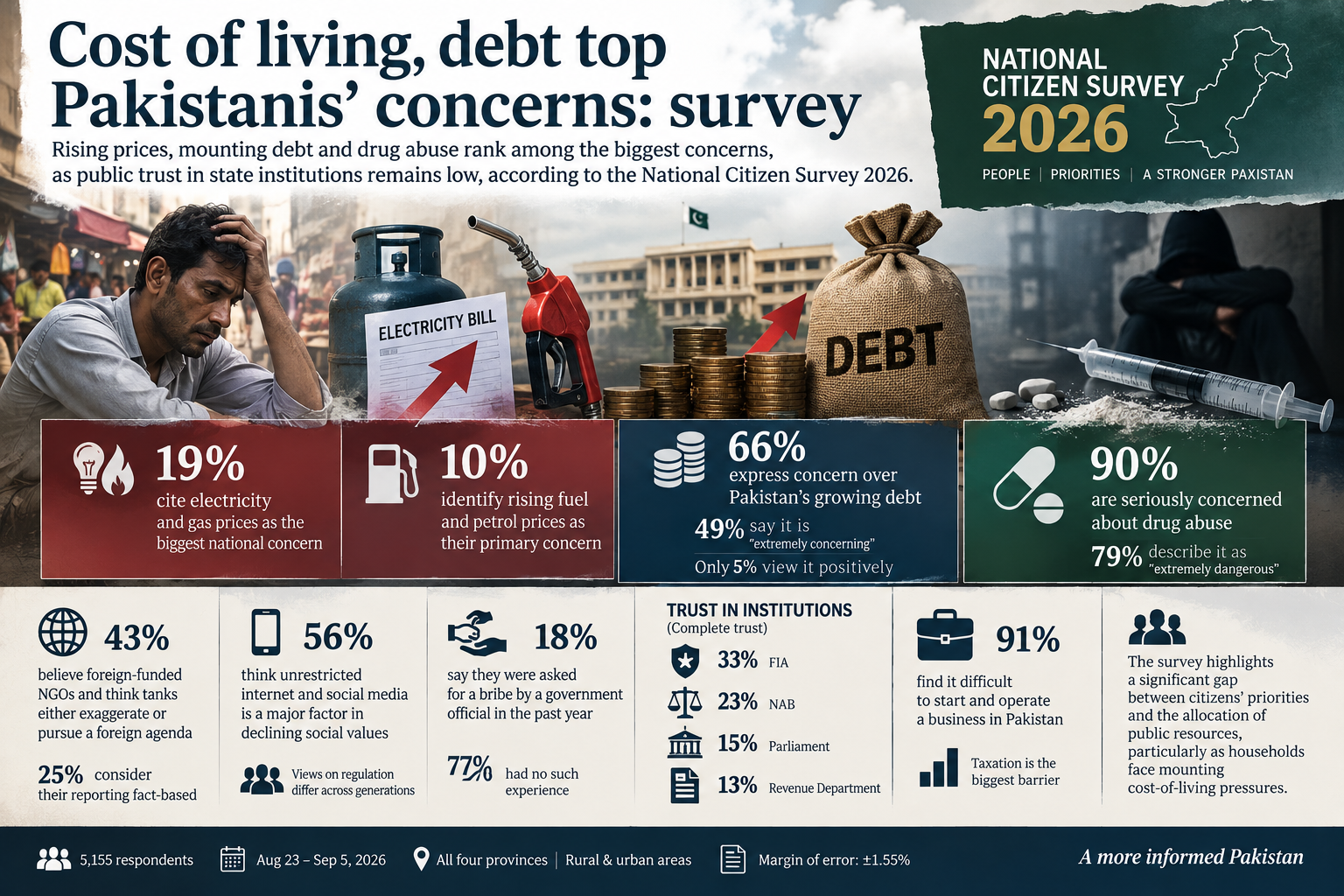
Cost-of-living pressures featured prominently in the findings. Electricity and gas prices were identified as the country’s most important problem by 19 per cent of respondents, while another 10 per cent regarded rising petrol and fuel prices as their primary concern.
Pakistan’s increasing debt burden also generated widespread anxiety. Around 66 per cent of respondents expressed concern about the national debt, including 49 per cent who described the situation as “extremely concerning”. Only 5 per cent viewed the debt situation positively.
Drug abuse emerged as an even broader social concern. Seventy-nine per cent of respondents described increasing drug use as “extremely dangerous”, while overall concern about the issue reached 90 per cent.
The findings also indicated scepticism towards reports about Pakistan produced by foreign-funded non-governmental organisations and think tanks. Around 43 per cent of respondents believed such reporting was either exaggerated or influenced by a foreign agenda, compared with 25 per cent who regarded it as fact-based.
Internet and social media use was another area of concern. Fifty-six per cent of those surveyed believed unrestricted access to the internet and social media was a major contributor to what they regarded as declining social and moral values. Views on the extent of regulation, however, differed across generations.
Despite broader perceptions of corruption in government institutions, direct experiences of bribery were considerably less common. Only 18 per cent of respondents said a government official had personally asked them for a bribe during the previous year, while 77 per cent reported no such experience.
The survey also assessed confidence in state institutions. Among the institutions examined, the Federal Investigation Agency recorded the highest level of complete trust at 33 per cent, followed by the National Accountability Bureau at 23 per cent. Parliament received complete trust from 15 per cent of respondents, while the Revenue Department stood at 13 per cent.
The business environment attracted particularly negative responses. As many as 91 per cent of respondents said starting and operating a business in Pakistan was difficult, with taxation identified as the single largest obstacle.
According to the survey organisers, the results point to a significant gap between citizens’ priorities and the allocation of public resources, particularly as households struggle with increasing living costs.
The National Citizen Survey 2026 was presented as Pakistan’s first nationwide public opinion exercise specifically designed to examine the relationship between citizens’ priorities and federal budget allocations.