
Tariq Mahmood Awan
Every state rests on four elements, and no serious student of political theory can dispute them: population, territory, government, and sovereignty. A state that possesses all four is a state in the full sense of the word. Remove sovereignty from that equation, and what remains is not a state but a government within a state, a federating unit operating inside a larger sovereign order. This distinction, simple as it sounds, is the single most important idea a policymaker must hold in mind before uttering the words new province. A province in Pakistan has population, it has territory, and it forms a government, but it does not, and under the Constitution of the Islamic Republic of Pakistan it cannot, possess sovereignty. Sovereignty rests with the federation alone. Every proposal to divide Punjab, to carve Hazara, to reconstitute South Punjab, or to create any new federating unit must begin from this settled premise, because a policymaker who forgets it will end up designing an administrative district and calling it a province, and Pakistan has already suffered enough from administrative units mistaken for constitutional ones.
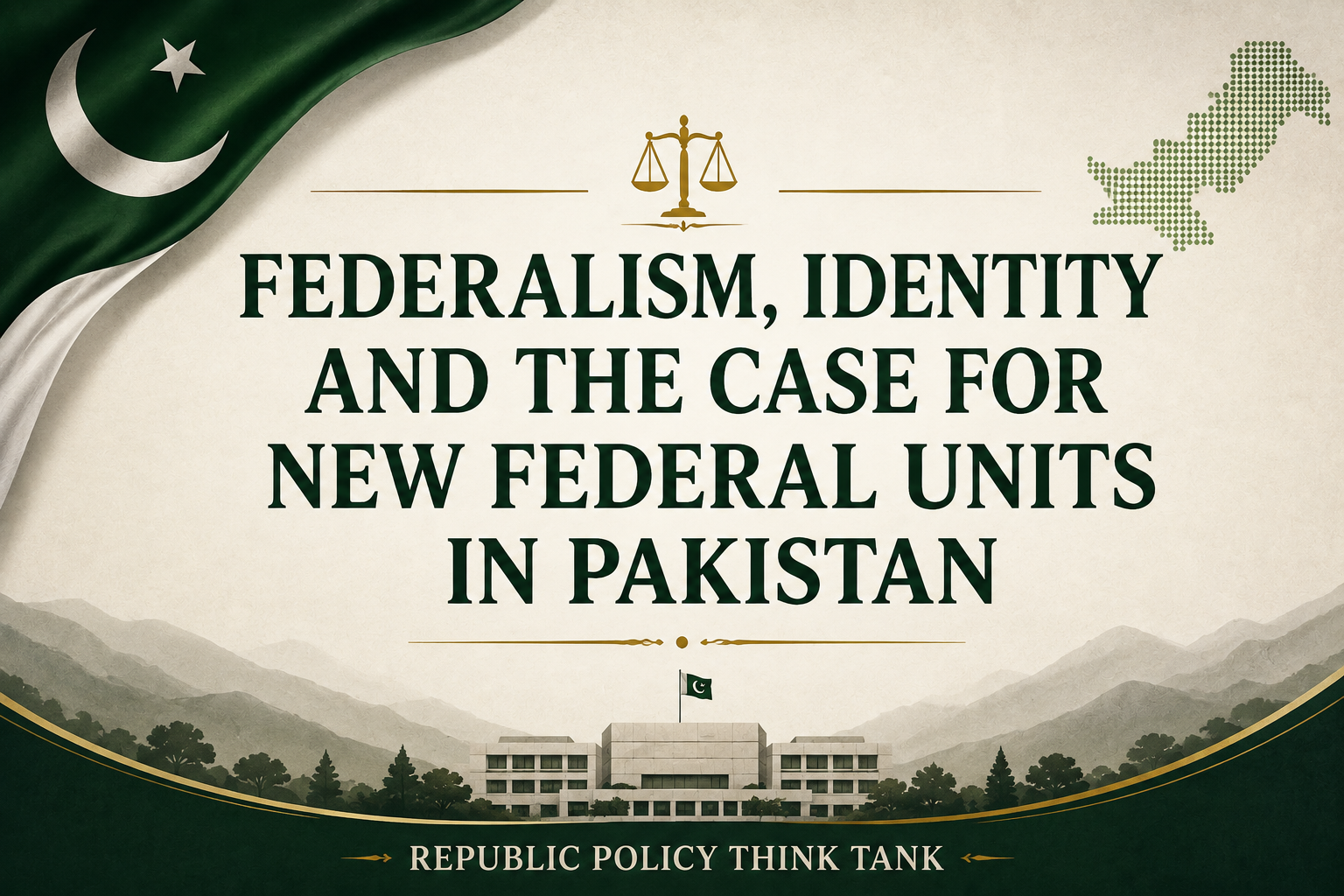
This chapter makes an argument that policymakers in Islamabad and in the provincial capitals have not yet been forced to confront in its entirety: the creation of a new province is not a demarcation exercise. It is not a boundary commission drawing a red line across a map and handing the resulting territory a new governor and a new secretariat. It is the birth of a federal unit, complete with a legislature that must be elected, an executive that must be formed, a judiciary that must sit, a bureaucracy that must serve it, and a fiscal base that must sustain it. Anyone who proposes new provinces without addressing every one of these five structural demands is not offering a roadmap. He is offering a slogan, and slogans have never built durable federations anywhere in the world.
Pakistan’s Constitution is neither silent on this question nor does it leave it to political convenience. Article 1 defines Pakistan as a federal republic consisting of provinces and territories, and it explicitly provides that the limits of these units may be altered, but strictly in accordance with the Constitution. That final phrase deserves to be read twice by every policymaker who imagines that new provinces can be announced by de facto manipulation. Article 239, the provision that governs constitutional amendment, sets the actual procedure. Under Article 239(4), no bill altering the boundaries of a province may be presented to the President for assent unless the provincial assembly of the affected province has first approved it by a vote of not less than two-thirds of its total membership. Only after this provincial threshold is crossed does the amendment proceed to Parliament, where it must again secure a two-thirds majority in both the National Assembly and the Senate. This is not bureaucratic obstruction. It is a deliberate constitutional safeguard, placed there by the framers of 1973 to ensure that provinces, as constitutional partners in the federation, cannot be split or reshaped by the will of the centre alone. A policymaker who wishes to see new provinces created must therefore first build the political consensus this threshold demands, and consensus of this magnitude will only be achieved through political process. Furthermore, even if a new amendment is inserted, which simplifies the existing constitutional process to create provinces, will only mean, a manipulation to create new provinces.
It must also be said, in the interest of intellectual honesty, that a genuine constitutional gap exists here, and this book does not intend to paper over it. Unlike the Constitution of India, which under Articles 2 and 3 gives Parliament an express and unambiguous power to admit, establish, or form new states, and which Parliament actually exercised through the States Reorganisation Act of 1956, Pakistan’s Constitution contains no equivalent express provision for creating a wholly new province from scratch. Article 239(4) speaks of altering the limits of an existing province, and constitutional lawyers in Pakistan remain genuinely divided over whether this altering power extends to the outright creation of a new federating unit or whether it is confined to redrawing boundaries between provinces that already exist. This ambiguity is precisely why serious legal opinion has argued that the cleanest and most defensible route is to first amend the Constitution to insert an explicit provision recognising the power to create new provinces, and only thereafter to bring forward any specific territorial proposal. Recent political discussion, circulating under the informal label of a Twenty-Eighth Constitutional Amendment, has floated an even more consequential idea: amending Article 1 itself to vest the power of creating new provinces solely in the federal Parliament, thereby diminishing the weight currently given to provincial assembly consent. This proposal, whatever its political merits, should alarm any policymaker who values the federal character of the 1973 settlement, because it would convert provinces from constitutional partners into administrative recipients of decisions made in Islamabad, and that is precisely the centralising instinct this book has argued against from its very first page.
There has also been recurring speculation about using the referendum power under Article 48(6) as a shortcut around provincial assembly consent. This argument does not withstand scrutiny, and it should not withstand scrutiny in the mind of any careful policymaker. A referendum ordered by the federal executive cannot lawfully override an explicit safeguard that the Constitution has placed in Article 239 for the specific protection of a province’s territorial integrity. To permit a referendum to substitute for the two-thirds vote of a provincial assembly would be to treat a constitutional right as a matter of executive convenience, and it would set a precedent that no future province, however settled its boundaries, could ever again consider secure from unilateral alteration. Constitutional design must remain stronger than political impatience, and a policymaker serious about durable reform will resist the temptation of shortcuts of this kind.
Pakistan is not the first federation to confront this question, and a policymaker who studies comparative experience honestly will find that no functioning federation has treated the creation of a new federating unit as a light administrative matter. India’s States Reorganisation Act of 1956 is instructive precisely because it shows both the promise and the burden of this exercise. The Indian Parliament acted on the recommendation of a dedicated States Reorganisation Commission, which spent years assessing linguistic and cultural identity before a single new state boundary was drawn, and even after 1956 the process did not stop, continuing through subsequent decades and culminating, most recently, in the bifurcation of Andhra Pradesh into Andhra Pradesh and Telangana. Nigeria offers a second, equally sobering lesson. Its federation grew from three regions at independence to thirty-six states today, yet each act of state creation, whether under military decree or civilian legislation, required a defined process of population assessment and economic viability study, and Nigerian scholars themselves continue to note that several of these thirty-six states remain financially dependent on federal allocation, unable to generate the revenue base a genuine federating unit requires. The United States offers a third lesson, drawn from an older and more conservative constitutional tradition. Article IV, Section 3 of the American Constitution permits Congress to admit new states, but it explicitly forbids the carving of a new state out of the territory of an existing state without that state’s own legislative consent, a principle strikingly close in spirit to Pakistan’s own requirement under Article 239(4). What unites these three very different federations, one linguistic, one post colonial and ethnically fragmented, one older than Pakistan by nearly two centuries, is a single shared conviction: new federating units are created only after sustained institutional assessment, and only with the consent of those whose territory is affected. A policymaker in Islamabad who wishes to shortcut this pattern is not innovating. He is ignoring the accumulated experience of every serious federation that has walked this road before him.
If the constitutional threshold is cleared, the harder work begins, and it is here that Pakistan’s public debate has been at its thinnest, reduced too often to maps and slogans rather than institutional design. The first demand is population, read together with cultural and regional identity. A proposed province must demonstrate a population base capable of sustaining a provincial government, and more importantly, it must demonstrate that this population organises itself around a coherent cultural, linguistic, or regional identity. Population without identity produces an artificial unit, and an artificial unit cannot generate the sustained political consensus a province needs merely to survive its first decade. The second demand is size, considered not in isolation but alongside population and identity together. Balochistan illustrates this with unusual clarity. Its sheer geographic scale, combined with the presence of distinct communities within it, Baloch, Pashtun, and Brahui, has fed decades of argument that its size alone renders effective governance difficult, quite apart from any question of ethnic representation. Size, in other words, is not a matter of square kilometres on a map. It is a question of whether a government of that scale can actually reach its own citizens.
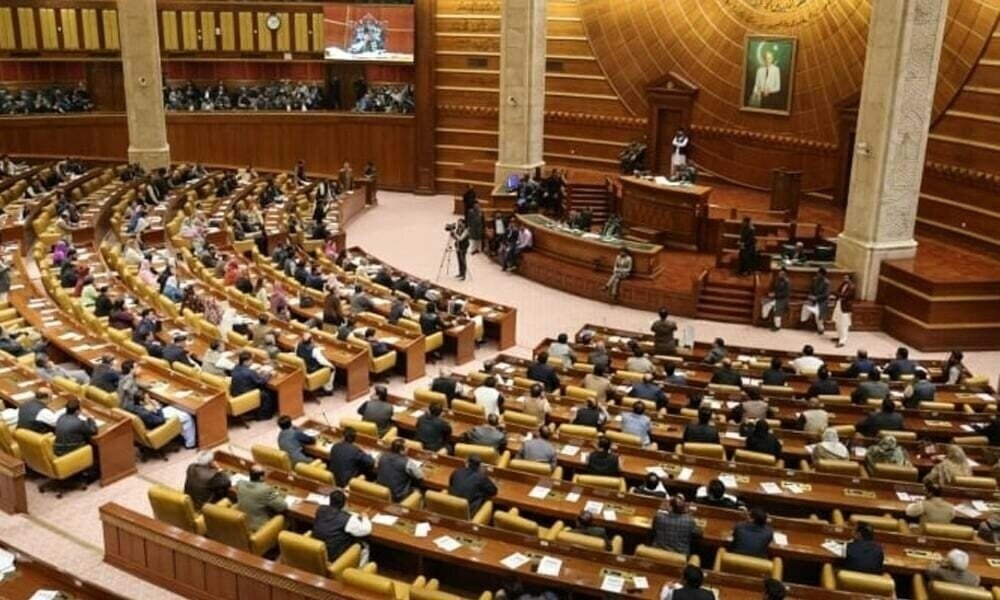
The third demand, and the one this chapter insists no policymaker may skip, is the restructuring of all three organs of government. Begin with the legislature. A new province requires a provincial assembly, and that assembly must be the product of a political order that is transparent, genuinely representative, and free of serious question over its legitimacy. This requires working out, in advance and in detail, how political parties will organise and contest within the new territory, how many seats it will command in the National Assembly and the Senate, and what administrative and financial burden this new representation places on the federation as a whole. Representation is not a formality here. It is the very reason cultural and regional communities demand provincial status in the first place, and an assembly that cannot genuinely represent its people converts the entire exercise into another layer of bureaucracy rather than an expansion of federal democracy.
Move next to the political executive, where the central question is the distribution of power between the federation and the new province. This distribution cannot be improvised. It must be read against the Fourth Schedule of the Constitution, which sets out the Federal Legislative List in two parts. Part I contains subjects reserved exclusively to the federal government. Part II contains subjects placed under the Council of Common Interests, the joint federal provincial forum established under Articles 153 and 154. Everything beyond these two lists falls to the residuary powers of the provinces, a principle considerably strengthened after the Eighteenth Amendment. A new province forces Pakistan to decide, explicitly and in writing, whether this existing distribution of federal, common, and residuary authority applies to it precisely as it applies to the four existing provinces, or whether the Fourth Schedule itself requires fresh adjustment. Only once this question of legislative and executive competence is resolved can the province proceed to the practical formation of a chief minister, a cabinet, and a functioning parliamentary executive answerable to its own assembly.
Then comes the organ that may be the most consequential and, paradoxically, the most neglected in Pakistan’s public discourse: the bureaucracy. Pakistan today operates what can only be described, without exaggeration, as a unitary bureaucracy wearing federal clothing. Federal services and the so called All Pakistan services continue to occupy provincial posts through cadre arrangements controlled from the centre, a practice that sits in serious tension with the spirit of Articles 240 to 242 and with the federal vision the 1973 Constitution was meant to embody. A new province constructed on top of this same unitary structure would merely add another province shaped compartment to a bureaucracy that remains, beneath its formal designation, centrally controlled. That is not federalism. It is administrative expansion dressed in federal language, and any policymaker who presents it as reform is either mistaken or is deliberately obscuring the substance of what is being proposed. If Pakistan intends new provinces to mean genuine federal devolution, it must simultaneously federalise its civil services, end the practice of reserving provincial posts for federally controlled cadres, and build a bureaucracy answerable to the government it actually serves. Nothing less satisfies the constitutional promise of federal governance, and nothing less should satisfy a policymaker who claims to be serious about it.
The judiciary requires equal attention. Pakistan’s four provinces each possess a High Court, and a new province would require the same, whether through the establishment of an entirely new regional High Court or through a carefully managed reorganisation of existing judicial territory. This is a substantial institutional undertaking in its own right. Judges must be appointed according to constitutional procedure, benches must be constituted, pending case loads must be transferred without prejudice to litigants, and the jurisdictional relationship between the new High Court and the Supreme Court must be settled with precision before a single case is heard.
Beyond the three organs of government lies a fourth institutional layer that Pakistan’s constitutional structure explicitly recognises: local government. Pakistan operates, at least in constitutional design, a four tier system, federal, provincial, local, and the Council of Common Interests as coordinating forum between federation and provinces. A new province forces an immediate and unavoidable decision. Does it absorb the existing local government institutions of the territory from which it is carved, or does it require an entirely new local government law drafted from first principles. This is not a peripheral question. Local government is where police service, everyday public service delivery, and the administration citizens actually experience in their daily lives are organised. A province created without a settled answer on local government inherits confusion in place of the efficiency its advocates promised, and confusion is precisely the condition the demand for a new province was meant to remedy in the first place.
The fifth and final demand, and one this chapter refuses to treat as an afterthought, is financial and economic viability. A new province requires a functioning system of taxation, a defined and negotiated share within the National Finance Commission award, a development strategy suited to its actual resource base, and a social protection system capable of serving its population from the very first day of its existence. A province unable to sustain itself financially becomes permanently dependent on federal transfer, and permanent dependency defeats the very promise of autonomy its advocates invoked to justify its creation. Feasibility and sustainability, economic no less than administrative, are therefore not secondary considerations to be resolved after the fact. They are preconditions, and no serious roadmap can proceed without them.
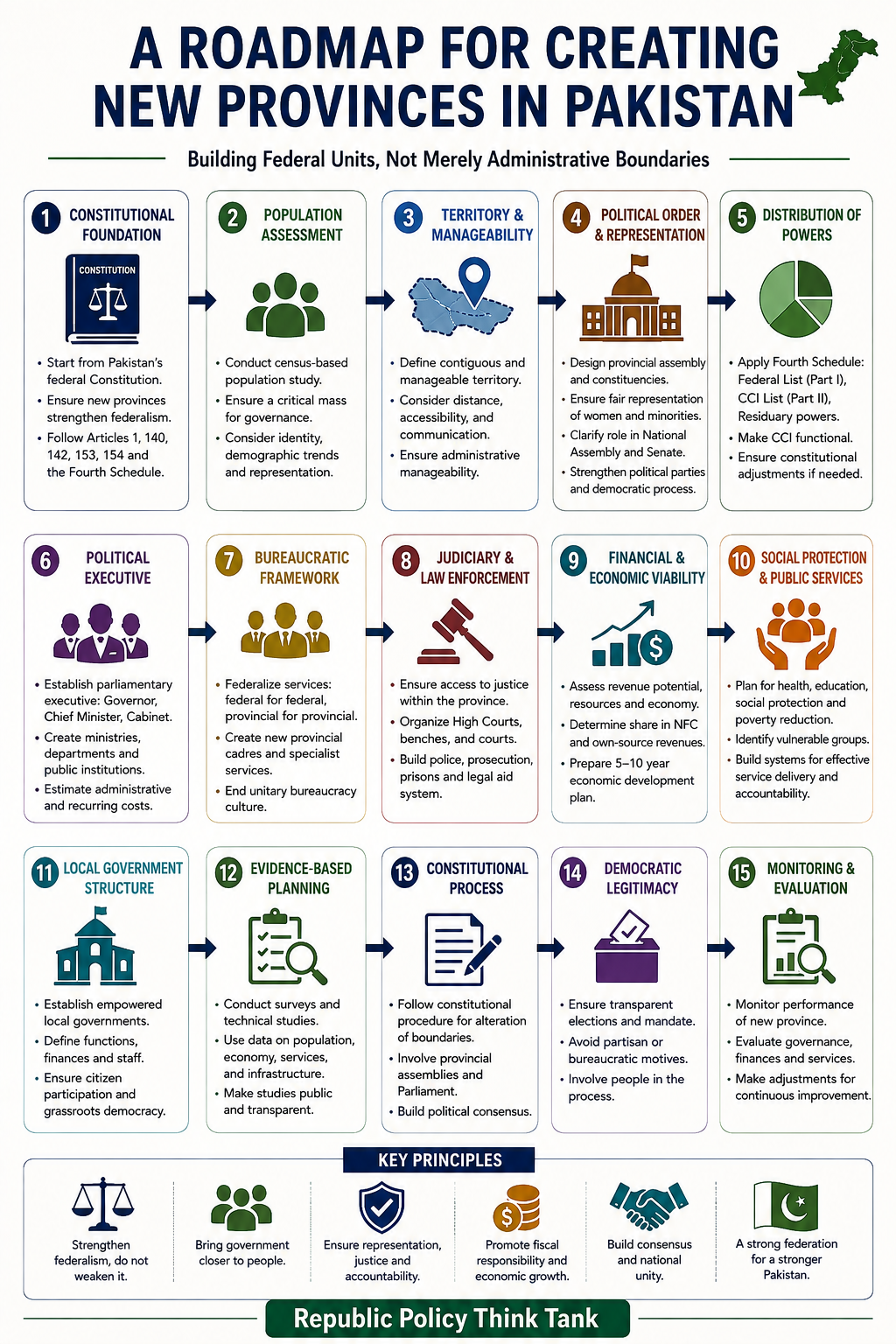
Drawing these threads together, this chapter proposes a sequence that no policymaker who wishes to be taken seriously can afford to skip. It begins with a technical, census based survey of population and cultural identity, establishing whether the demand for a new province rests on a genuine and demonstrable regional or cultural base rather than on transient political opportunism. It proceeds to a demarcation study that weighs territorial size against administrative manageability, rather than accepting boundary lines as self evident simply because they appear plausible on a map. It then requires the complete constitutional design of the three organs of government, legislature, executive, and judiciary, worked out article by article against the existing scheme of the Constitution, including an explicit decision on how the Fourth Schedule and the residuary powers of the province will operate. It requires, as a non negotiable element, a concrete plan to federalise the bureaucracy that will serve the new unit, ending the practice of federal cadre control over posts that properly belong to the province. It requires a clear and complete local government law integrated into Pakistan’s four tier structure of governance. It requires a rigorous financial viability assessment covering taxation authority, the National Finance Commission award, and social protection delivery. And only once every one of these structural foundations has been laid does the formal constitutional process under Article 239 become what it was always meant to be, the final seal placed on a decision already tested for its administrative, political, cultural, and financial soundness, rather than the opening move of an improvised political gamble.
This chapter closes where it began, with a distinction policymakers ignore at their peril: a province is a government, not a boundary. Pakistan may well need new federating units, and there are regions within this country where the demand for cultural recognition and administrative closeness to the people rests on genuine and longstanding grievance rather than manufactured sentiment. But the creation of a province is the creation of a federal government in miniature, requiring a legislature that represents, an executive that governs, a judiciary that adjudicates, a bureaucracy that is federal in substance and not merely in name, and a fiscal base capable of sustaining all four. It demands the patient construction of political consensus, both within the walls of Parliament and beyond them, through institutions credible enough to command public trust. Any policymaker who proposes to shortcut this sequence, whether through an executive announcement, a referendum improperly invoked, or a constitutional amendment stripped of provincial consent, is not building federalism. He is manufacturing another centralised structure and offering it to the public dressed in the vocabulary of provincial autonomy. Pakistan has lived with that particular deception for long enough. This roadmap is offered so that the next province this country creates, if and when it creates one, is built to last, rather than built to satisfy the urgency of a single political season.