
Tariq Mahmood Awan
Every federation on this earth is a home for more than one nation. This is the first truth that Pakistan must accept before it can even begin the conversation about new provinces, and it is a truth that this book will not soften or hide. A federation is not a single people wearing different administrative coats in different regions. A federation is a household of nations, and each federal unit inside it exists, first and foremost, to answer one question: does a distinct cultural community live here, and does that community wish to preserve its identity through a political home of its own. Language may carry that identity. Ethnicity may carry it. History may carry it. Jurisdictional memory may carry it. Even a sectarian or religious distinction may carry it. Whatever carries it, the cultural demand is the beginning, the middle and the end of the argument. Without it, there is no case for a province. With it, the case becomes not just possible but necessary.
This is the standard against which Pakistan’s four provinces, Punjab, Khyber Pakhtunkhwa, Balochistan and Sindh, must now be examined, one by one, honestly and without political convenience clouding the judgment.
Begin with Punjab, because Punjab carries the heaviest history and the most complicated present. The Punjab that exists today is not the Punjab that has always existed. Trace its record and you will find that the province absorbed the princely state of Bahawalpur during the One Unit period, that partition tore a portion of historic Punjab away into India, and that the boundary you see on a map today is the product of these successive ruptures, not a line drawn since the beginning of time. Borders move. They have always moved. When separate states and territories merge to form one federal unit, there is no natural law requiring that the resulting boundary be neat, compact or ethnically uniform. This is evolution, not design, because human beings migrate, opportunities pull them from one place to another, new cultures arrive, new ideologies take root, new faiths spread, and the map bends under all of this movement whether a constitution wills it or not.
So where, inside this evolved and imperfect Punjab, does genuine potential for a new federal unit actually exist. South Punjab presents a real sentiment, and that sentiment is Saraiki. It must be said plainly that this sentiment is primarily linguistic rather than ethnic. If you examine the ethnicity of Punjab closely, and modern ancestry data now allows us to do this with more precision than ever before, you find overwhelmingly the same Indo Iranian population stretching across the province. What separates the Saraiki speaking south from the rest is language, not blood. Language, however, is not a lesser basis for identity than blood. Language builds poetry, it builds proverbs, it builds a way of addressing elders and a way of mourning the dead, and a community that has preserved its language for centuries has preserved something worth protecting through political recognition.
Bahawalpur strengthens this case beyond language alone. Bahawalpur is not simply a Saraiki speaking division among other Saraiki speaking division. Bahawalpur was a state. It possessed its own ruler, its own treasury, its own diplomatic recognition before it ever became part of Pakistan’s federal machinery, and that historical fact of prior sovereignty gives Bahawalpur a claim that rests on more than language, it rests on memory of self rule.
Beyond South Punjab and Bahawalpur, the sentiment inside Punjab weakens considerably. Potohar is sometimes described as culturally distinct from central or mainland Punjab, and there is truth in that description, but the feeling has never matured into a serious political demand. Some parts of Mianwali once sat within a Pashtun cultural orbit, and Attock too carried traces of frontier influence at various points in history. But this book must state clearly, and without hesitation, that the claim a particular ruler once conquered a particular territory does not create a nation out of that territory today. You cannot live permanently in the past. A federation must look at the present population, its living language, its living self identification, and it must plan for the future generation that will inherit whatever boundary is drawn, not for a medieval campaign map that no living person remembers walking across.
Move now to Khyber Pakhtunkhwa, and here the picture sharpens considerably. Hazara carries a sentiment that Potohar and Mianwali do not, because Hazara is different ethnically, and most importantly it is different linguistically, and it is different geographically as well, sitting apart from the Pashtun heartland that defines the rest of the province. Compare this to the manner in which the former FATA region merged into the mainland province. That merger happened with remarkable ease, precisely because no ethnic dispute, no linguistic dispute and no serious jurisdictional dispute stood in its way. The tribal districts and the settled province spoke the same language and shared the same broad identity, so the union was natural rather than forced. Hazara is the opposite case. Hazara has genuine potential for federal recognition precisely because the very conditions that made the FATA merger effortless, shared language and shared ethnicity, are absent between Hazara and the rest of Khyber Pakhtunkhwa.
Balochistan is the most checkered of all four provinces, and it demands the most careful reading. The Pashtun belt of Balochistan connects on one side to the Pashtun regions of Afghanistan and on the other side to the Pashtun regions of northern Pakistan, yet this belt remains, for the most part, reasonably satisfied within the existing Balochistan setup. Pashtun nationalism exists there, nobody should pretend otherwise, but it has not translated into a strong sentiment demanding a separate province, even though a quiet wish is present, a sense that a province of their own might serve them better than the current arrangement does. Balochistan’s princely history matters enormously here as well. Kalat stood as the most significant of these princely states, and its memory continues to shape how Baloch political consciousness understands its own past.
But the most important corrective this book can offer about Baloch identity concerns geography, not sentiment. When people discuss Baloch nationalism, they habitually imagine it confined within the boundaries of Balochistan province. The reality contradicts this imagination sharply. More Baloch people live outside Balochistan than inside it. A very large Sindhi Baloch population exists, so large that Sindh’s own language and cultural environment has absorbed and shaped this community over generations. An equally significant Saraiki Baloch population exists in South Punjab and South KPK. Consider that Dera Ghazi Khan and Dera Ismail Khan, two of the most historically important towns in this belt, are named directly after Baloch chieftains. Consider that Muzaffargarh, Rahim Yar Khan and even Multan itself carry substantial Baloch communities to this day, the product of centuries of migration along the banks of the Indus river. This single fact should permanently correct the lazy assumption that Baloch identity and Balochistan province are the same thing. They are not. Baloch identity is a river people’s identity, distributed along the Indus far beyond the province that bears their name, and any federal restructuring that treats Baloch nationalism as a matter confined to one province’s boundary has already misunderstood the community it claims to represent. What genuine potential exists for a new unit inside Balochistan, then, comes from three distinct pulls working in different directions at once, the Pashtun belt in the north, the Baloch districts bordering Punjab, and the Baloch districts bordering Sindh, each of which experiences and manages its relationship with central Balochistan differently.
Sindh presents the clearest and most disciplined case of all four provinces. Sindh’s princely history is narrower than the others, containing essentially one significant state, Khairpur, and Khairpur’s memory sits comfortably within the wider frame of Sindhi nationalism rather than standing apart from it as a competing claim. This matters because Sindhi nationalism is, without exaggeration, the strongest and most coherent nationalist sentiment among all the ethnic identities that make up Pakistan. It has a settled sense of territory, a settled sense of language, and a settled historical narrative that does not fracture the way Punjab’s or Balochistan’s narratives do. The complication in Sindh arrived with the 1947 migration, when a substantial Urdu speaking population settled in the province’s major cities, above all Karachi, and also Hyderabad and Sukkur. But this book must be precise about what kind of complication this actually is. It is not, at its core, an identity dispute in the way South Punjab’s Saraiki sentiment or Hazara’s linguistic distinctiveness are identity disputes. It is, overwhelmingly, an administrative control dispute, a contest over municipal authority, over fiscal jurisdiction, over who governs the ports and the metropolitan institutions of Karachi. Because the underlying grievance is administrative rather than cultural, Sindh does not present a strong case for provincial division in the way the other provinces do. What Sindh does present is a legitimate case for a genuinely empowered local government system, and, where the federation and the province can reach honest consensus, a reconsideration of jurisdiction over specific ports or specific metropolitan functions. But even this must proceed through consensus. It cannot proceed through unilateral assertion by either side.
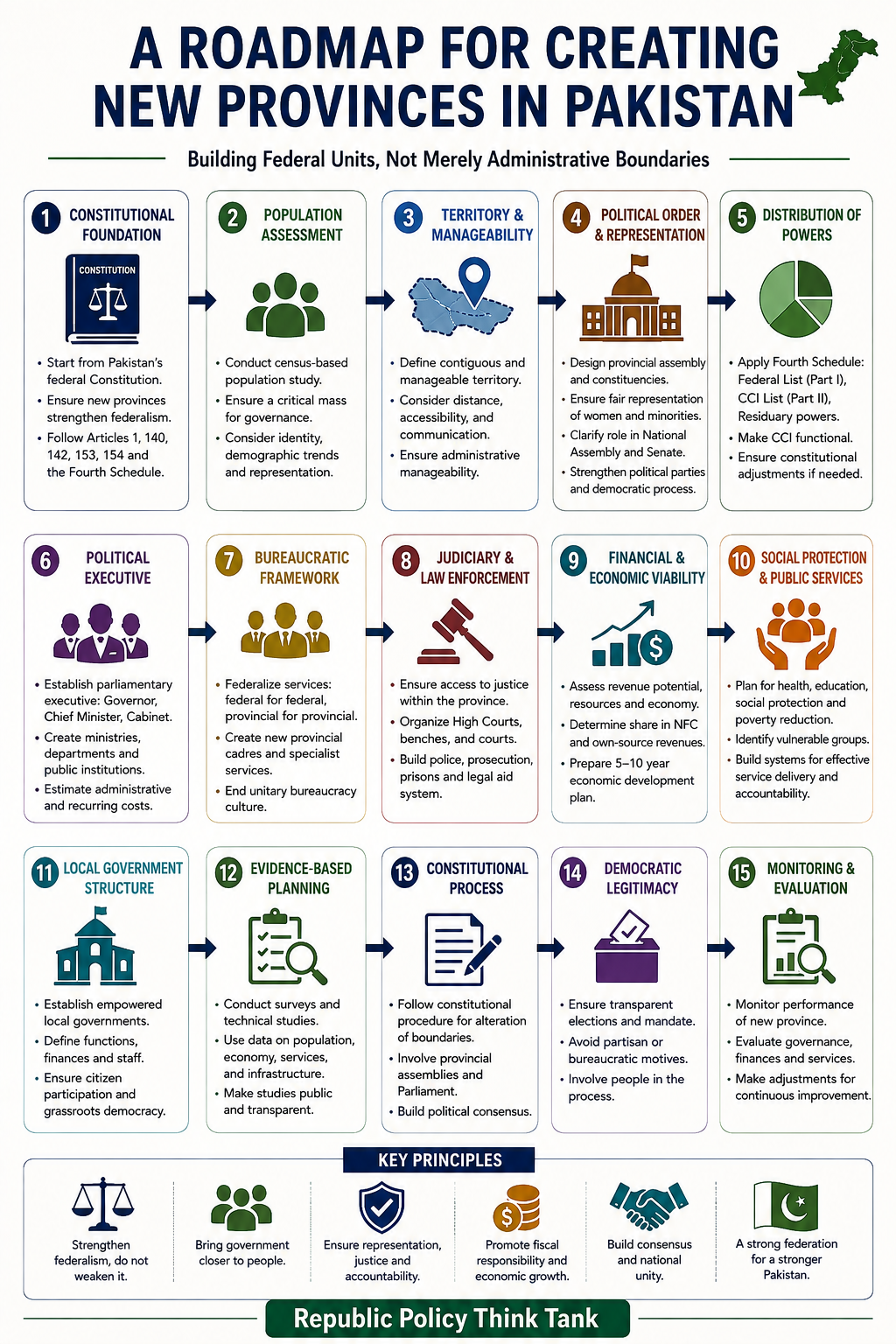
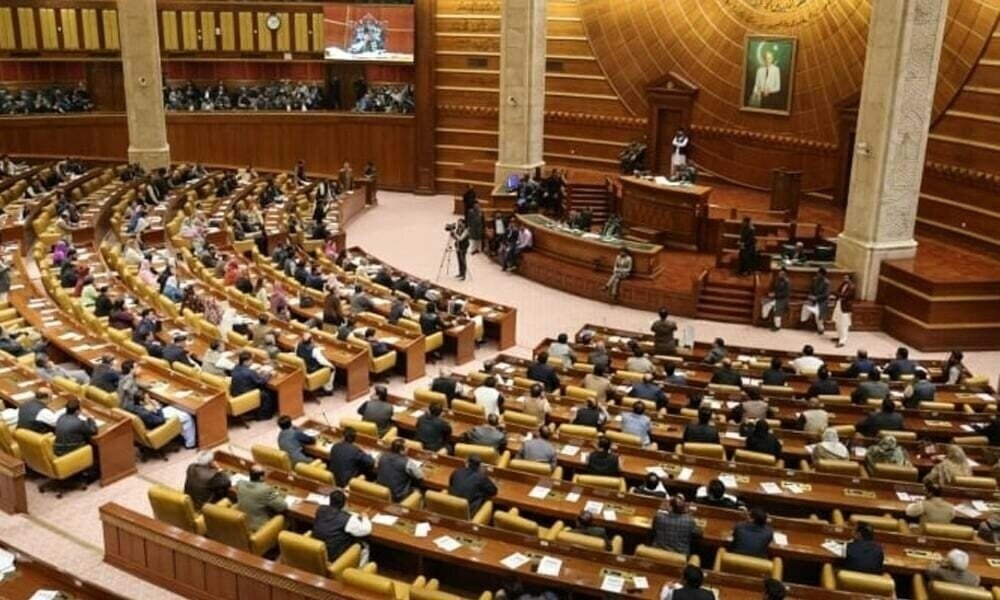
This brings the argument to its constitutional foundation, and here this book must be absolutely unambiguous, because the entire project collapses without this foundation. Pakistan is a federation, and a federation stands upon its constitution the way a house stands upon its foundation stone. The relationship between the federation and its provinces is not an administrative convenience that a government of the day can rearrange according to its mood. It is a compact, an agreement, and agreements of this magnitude can only be altered by the party that holds genuine representative authority, which in Pakistan’s constitutional order means the elected legislature and nothing less. This is why the distinction between de facto power and de jure authority matters so profoundly for Pakistan’s future. De facto power is the power a strong executive happens to possess at a given moment, the power to issue an order, to notify a boundary, to redraw a map because the machinery of the state currently obeys the hand that holds it. De jure authority is entirely different. De jure authority belongs only to a legislature that genuinely represents the people whose federation is being reshaped. If Pakistan ever allows a mechanism to develop where provinces are created through de facto power, through executive convenience dressed up as reform, that mechanism will not work, and this book predicts with confidence that it will not work, because a province created without genuine representative consent carries no legitimacy, and an illegitimate province inherits every instability that illegitimacy always produces. Only a genuinely representative legislature can undertake this work, and it must undertake it through consensus, because the provinces that emerge from this process are being created on the foundation of cultural identity, not administrative arithmetic.
This distinction between cultural identity and administrative convenience is, in truth, the single most important argument this chapter has to offer, and it must be stated with complete clarity so that no reader mistakes it for something smaller than it is. To argue that Pakistan should create new provinces simply because existing provinces are difficult to administer is not a healthy argument, and this book rejects it outright. Administrative difficulty is a real problem, nobody denies it, but administrative difficulty is solved through administrative tools, not through federal restructuring. Look at unitary states such as China for the clearest possible contrast. In a unitary state, administrative units exist entirely at the discretion of the central government. The centre can grant them powers, and the centre can take those powers away, and the centre can redraw their boundaries whenever governance requires it, because these units were never meant to be anything more than convenient instruments of central administration. Federal units are built on an entirely different principle. A federal unit is autonomous within the federation. Its existence and its powers are guaranteed inside the constitution itself, not granted at the pleasure of a central ministry, and the superior judiciary is given the power of judicial review specifically so that a province’s constitutional rights and its autonomy cannot be quietly eroded by an executive that finds those rights inconvenient. This is the difference the entire debate on new provinces in Pakistan keeps forgetting. A province is not a bigger district. A province is a constitutionally guaranteed home for a people, and if a demand for a new province is actually a demand for better administration and nothing more, it belongs at the door of local government, not at the door of the federal constitution.
Even Pakistan’s own founding vision supports this separation. When Pakistan’s earliest leadership envisioned administrative units for the country’s governance, those units were always conceived as instruments of local administration, closer in spirit to what today would sit under a local government framework, not as expressions of federal, autonomous, constitutionally guaranteed nationhood. Provinces and administrative units have never been the same category of institution, not in Pakistan’s founding conception and not in any serious federal theory anywhere else. Conflating the two, treating a province as though it were simply an administrative unit with a grander title, is precisely the error that has confused this entire national conversation for decades, and it is the error this book insists must finally be corrected.
So let the conclusion of this argument stand exactly as firmly as the argument itself. Pakistan needs new provinces. It needs them where a genuine cultural demand exists, in South Punjab and Bahawalpur on the basis of language and historical statehood together, in Hazara on the basis of ethnicity, language and geography together, and potentially within Balochistan’s differentiated belts where Pashtun, border Baloch and central Baloch communities each relate differently to the existing arrangement. Sindh’s genuine grievance, by contrast, belongs primarily to the register of administrative control and local government reform rather than federal restructuring, though the door to further constitutional consensus should never be shut by assumption alone. But every one of these cases, wherever the cultural demand is real, must be pursued as what it actually is, a federal restructuring of the Pakistani state, undertaken by a genuinely representative legislature, achieved through constitutional consensus, and never, under any circumstance, disguised as a mere administrative convenience or handed down through executive discretion. Pakistan does not need new districts wearing the language of provinces. Pakistan needs new provinces built on the honest recognition of the nations that already live within it, recognized not because governance is difficult, but because a federation that fails to give its distinct cultural communities a constitutional home is not fully a federation at all. That is the narrative this Republic must build, and that is the channel through which every future demand for a new province in Pakistan should be tested, understood and, where it is genuine, finally honoured.