
Pakistan on Thursday reaffirmed its commitment to implementing its defence agreements with Saudi Arabia, including the Strategic Mutual Defence Agreement (SMDA) and the trilateral Makkah Defence Alliance, amid heightened tensions in the Middle East.
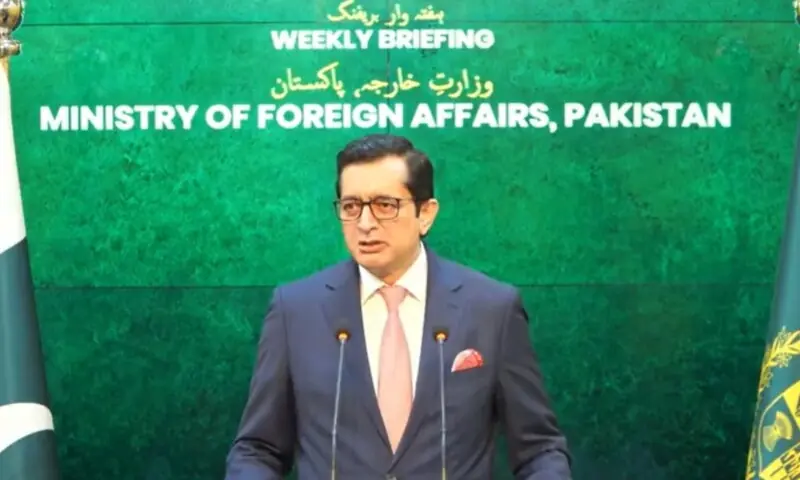
Foreign Office spokesperson Sajjad Haider Khan, speaking at his weekly press briefing, said Pakistan remained committed “in intent and spirit” to implementing both arrangements.
His remarks came after recent Houthi attacks in Saudi Arabia. A day earlier, the Saudi-led coalition accused the Houthis of sending a drone towards Makkah, saying it had been intercepted. The Houthis rejected the Saudi account, describing the allegation as false.
Asked whether Pakistan had developed a mechanism to help counter Houthi attacks against Saudi Arabia, Khan reiterated Islamabad’s commitment to the two defence arrangements but declined to disclose operational details. He said questions concerning when, where and how force might be used, as well as the objectives involved, were matters requiring operational confidentiality.
On Pakistan’s diplomatic efforts to reduce tensions involving the Houthis, the spokesperson said Islamabad had consistently supported peace and stability, which he described as being in the interests of Pakistan, Iran, the wider region and beyond.
Khan described the situation around the Bab al-Mandeb as “exceptionally serious” and called on the Houthis to halt their activities. He added that Pakistan’s discussions were focused on restoring peace and stability through dialogue and diplomacy rather than coercive measures.
PM Shehbaz to Attend UN General Assembly
The Foreign Office also announced that Prime Minister Shehbaz Sharif would lead Pakistan’s delegation to the 81st session of the United Nations General Assembly (UNGA) in New York next week.
According to Khan, Deputy Prime Minister and Foreign Minister Ishaq Dar and several federal ministers will accompany the prime minister.
The Foreign Office said PM Shehbaz would use his UNGA address to present Pakistan’s position on major regional and international developments while stressing dialogue, diplomacy, restraint and the peaceful resolution of disputes.
His address is also expected to cover sustainable development, climate change, counterterrorism, Islamophobia, global economic challenges, UN reforms and issues affecting the Global South. The Foreign Office said he would also raise the situations in Indian-occupied Kashmir and Palestine.
On the sidelines of the General Assembly, the prime minister is scheduled to attend high-level events and hold bilateral meetings with world leaders and the UN secretary-general. According to the Foreign Office, these engagements will emphasize Pakistan’s commitment to multilateralism, the UN Charter, regional peace and international cooperation.
FO Rejects Reports Concerning Pakistani Sikh Pilgrims
During the briefing, Khan also responded to reports concerning Pakistani Sikh pilgrims who were stopped at Faisalabad International Airport while travelling to India for religious rituals at Gurdwara Sri Hemkund Sahib.
He described the reports as part of a “malicious media campaign” by India and rejected claims that the pilgrims had simply been prevented from boarding their flight.
According to the spokesperson, Pakistani authorities were unaware that the Indian High Commission had issued the visas, which were not covered by the 1974 bilateral protocol governing visits to religious shrines between Pakistan and India. He said the visas had been issued independently without coordination under that arrangement.
Khan criticised what he described as India’s highly restrictive visa regime and maintained that Pakistan remained committed to welcoming Sikh pilgrims, including those travelling from India. He cited the number of visas issued on different religious occasions as evidence of Pakistan’s policy.
He further said Indian Sikh pilgrims had been prevented by their own country from travelling to Pakistan in 2025. Pakistan, he added, remained prepared to receive Sikh pilgrims through the Kartarpur Corridor whenever India allowed them to travel, maintaining that the corridor had been closed from the Indian side.
Pakistan Comments on India’s SCO Participation and China Border Mechanism
The spokesperson also confirmed that India’s chargé d’affaires participated in the 12th meeting of the Heads of Border Services of the Competent Authorities of the Shanghai Cooperation Organisation (SCO).
Khan expressed hope that such participation would continue, noting that peace, security and counterterrorism represented common challenges for both Pakistan and India.
Separately, he rejected India’s objections to a Pakistan-China joint mechanism for managing their common border and to the Joint Boundary Demarcation Commission. The commission was established under the Sino-Pakistan Boundary Agreement of March 2, 1963.
India has questioned the legality of the mechanism, but Khan maintained that the 1963 agreement remained valid. He described China as Pakistan’s neighbour and “all-weather strategic cooperative partner” and rejected New Delhi’s territorial assertions.
The spokesperson also criticised India’s position on the issue in the context of the Kashmir dispute, calling on New Delhi to examine its own actions in Indian-occupied Kashmir rather than advancing territorial claims against the Pakistan-China border arrangement.