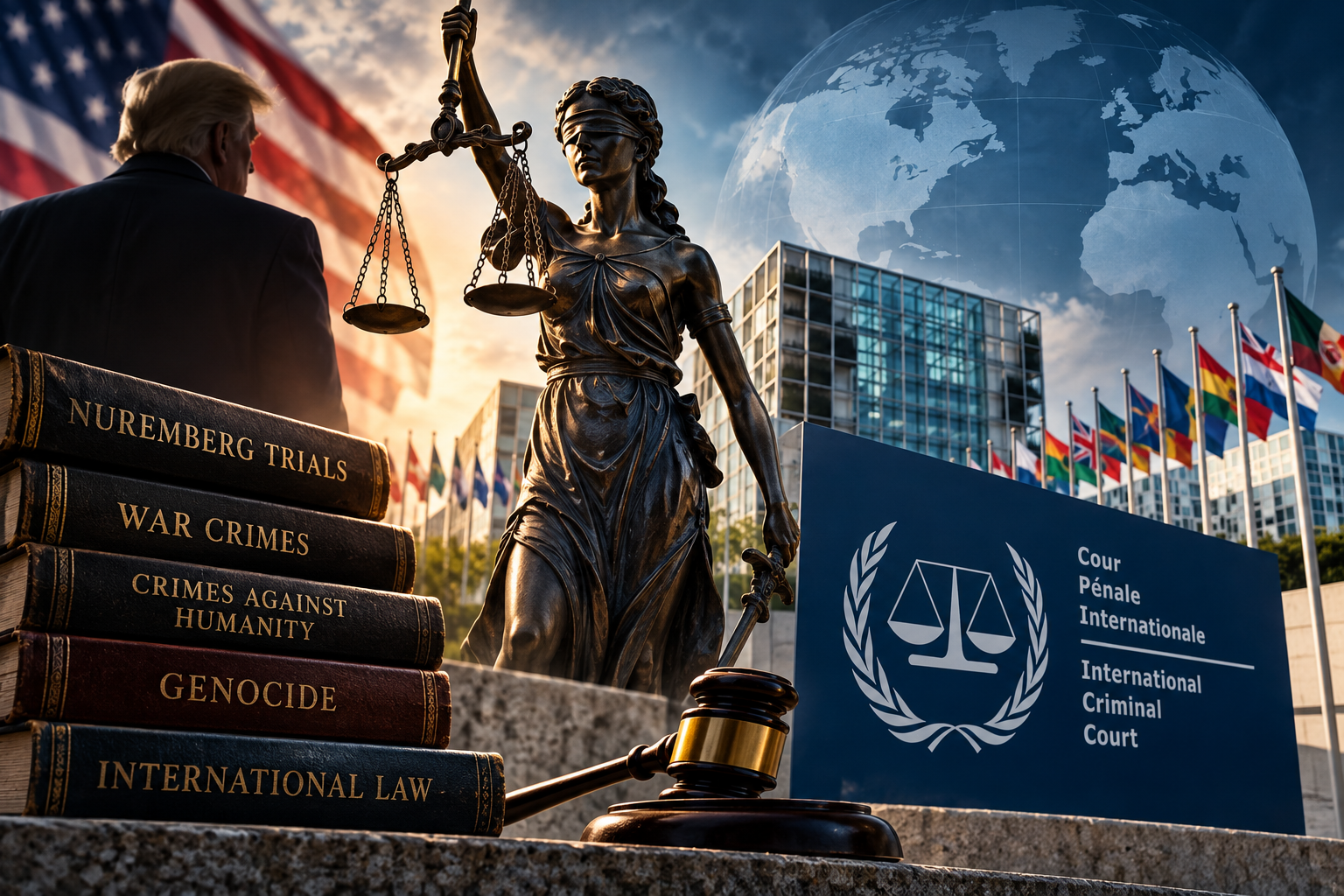

The United States’ confrontation with the International Criminal Court has revived a fundamental contradiction at the heart of the international legal order. Washington has historically played a major role in advancing the principle that individuals — including political and military leaders — can be held accountable for genocide, crimes against humanity and war crimes. Yet it has consistently resisted allowing the ICC to exercise the same authority over American nationals and, in important circumstances, those of its allies.
This tension is not simply about the United States or the ICC. It raises a larger question: Can international criminal justice become genuinely universal if the world’s most powerful states remain unwilling to accept its jurisdiction?
The ICC undoubtedly faces legitimate concerns regarding jurisdiction, institutional effectiveness, accountability and political legitimacy. But recognising those weaknesses does not necessarily justify weakening or dismantling the institution. The more consequential challenge is to build an international justice system sufficiently credible, capable and representative that major powers have incentives to participate in it.
From Nuremberg to The Hague
The historical role of the United States makes the present dispute particularly significant.
At Nuremberg, US Supreme Court Justice Robert H. Jackson served as chief American prosecutor and helped establish one of the defining principles of modern international criminal law: individuals could be personally responsible for international crimes regardless of their political or military position.
Washington subsequently supported the international tribunals established for the former Yugoslavia and Rwanda and participated extensively in negotiations surrounding the Rome Statute.
Nevertheless, the United States voted against the statute in 1998. President Bill Clinton supported the broader objective of prosecuting genocide, war crimes and crimes against humanity, but Washington remained concerned about the Court’s jurisdiction and safeguards. Although the United States participated in shaping the institution, it never ratified the treaty.
The divide widened under President George W. Bush. In 2002, Washington informed the United Nations that it did not intend to become a party and subsequently pursued bilateral arrangements designed to prevent participating countries from surrendering US nationals to the ICC.
The historical pattern therefore reveals something more complicated than straightforward opposition to international criminal accountability. The United States has supported the underlying principle while repeatedly disputing the authority, jurisdiction and institutional design through which that principle is applied.
That distinction remains central to the contemporary debate.
International Justice Has Costs — but Also Benefits
Concerns about sovereignty cannot simply be dismissed.
Few governments are comfortable allowing an international prosecutor or court to exercise jurisdiction over their nationals without their consent or safeguards they consider adequate. Similar objections have been raised by other major powers and states outside the Rome Statute system.
But sovereignty is only one side of the equation.
International crimes frequently cross national boundaries. Evidence may exist in several jurisdictions, perpetrators and victims may hold different nationalities, and investigations can require extensive international coordination. No national judicial system necessarily possesses the reach required to deal effectively with every such case.
There is also an obvious difficulty when alleged crimes involve powerful state officials. Exclusive reliance on domestic institutions can create questions about whether national authorities are willing and able to investigate their own political or military establishments.
The ICC attempts to address this problem through the principle of complementarity. National courts retain primary responsibility for prosecuting serious international crimes, while international jurisdiction becomes relevant where domestic systems are genuinely unable or unwilling to act.
The broader principle is therefore not that international justice should replace national sovereignty. It is that an international mechanism can provide an additional layer of accountability when national mechanisms fail.
Sovereignty and Accountability Must Be Reconciled
This creates an unavoidable dilemma for international governance.
States cannot demand effective international institutions while simultaneously insisting that those institutions exercise no meaningful authority when national interests become involved. Problems that transcend borders inevitably require some degree of coordinated authority.
Yet international institutions cannot expect states — particularly major powers — to surrender elements of sovereignty without credible safeguards, representative governance and confidence in institutional impartiality.
A sustainable international criminal justice system must therefore address both sides of the equation.
It needs sufficient independence to investigate grave crimes without political interference, but it also requires enough institutional legitimacy to secure broader international participation.
This is why the debate should move beyond the binary choice between defending the ICC exactly as it exists and dismantling it altogether.
Reform the ICC Without Politicising Justice
Institutional reform offers a possible middle course, but only if political oversight is carefully separated from judicial authority.
A more representative governance structure could potentially give major powers, regional organisations and a broader range of states greater participation in determining administrative rules, institutional priorities, financing and accountability mechanisms.
That should not translate into political control over prosecutions.
No state or group of powerful states should possess a veto over individual investigations, prosecutions or judicial decisions. Otherwise, the ICC risks reproducing one of the central criticisms directed at the UN Security Council: that geopolitical power can determine when international rules are enforced and when they are not.
Judicial independence must therefore remain fundamental.
At the same time, stronger investigative capacity, greater cooperation among national law-enforcement institutions, rigorous procedural safeguards and clearer institutional accountability could strengthen confidence in the system.
The objective should be neither an ICC controlled by great powers nor an international court permanently disconnected from them.
The more difficult goal is an institution in which powerful states have a legitimate role in governance while remaining unable to dictate judicial outcomes.
International Justice Needs a Broader Political Consensus
Ultimately, the future of international criminal justice depends on political legitimacy as much as legal authority.
An institution supported by a wider coalition — particularly one incorporating major global and regional powers — would possess greater capacity to investigate crimes, secure evidence, execute warrants and sustain international cooperation.
Broader participation could also help counter perceptions that international criminal justice represents the priorities of a limited group of states rather than genuinely universal principles.
That makes reform more than an institutional exercise. It is an attempt to reconcile two principles that have repeatedly collided in international affairs: state sovereignty and universal accountability for the gravest crimes.
The international community therefore faces a choice larger than the future of one court. It must determine whether international criminal justice can evolve into a system that is independent enough to hold power accountable while legitimate enough for powerful states to accept its authority.
Weakening the ICC without constructing a credible alternative would not resolve that contradiction. Reforming and broadening the international justice architecture offers a more serious route toward addressing it.
The ultimate test is straightforward but difficult: can the international system build a court strong enough to prosecute the gravest crimes while remaining legitimate enough that even the most powerful states accept that international law can apply to them?