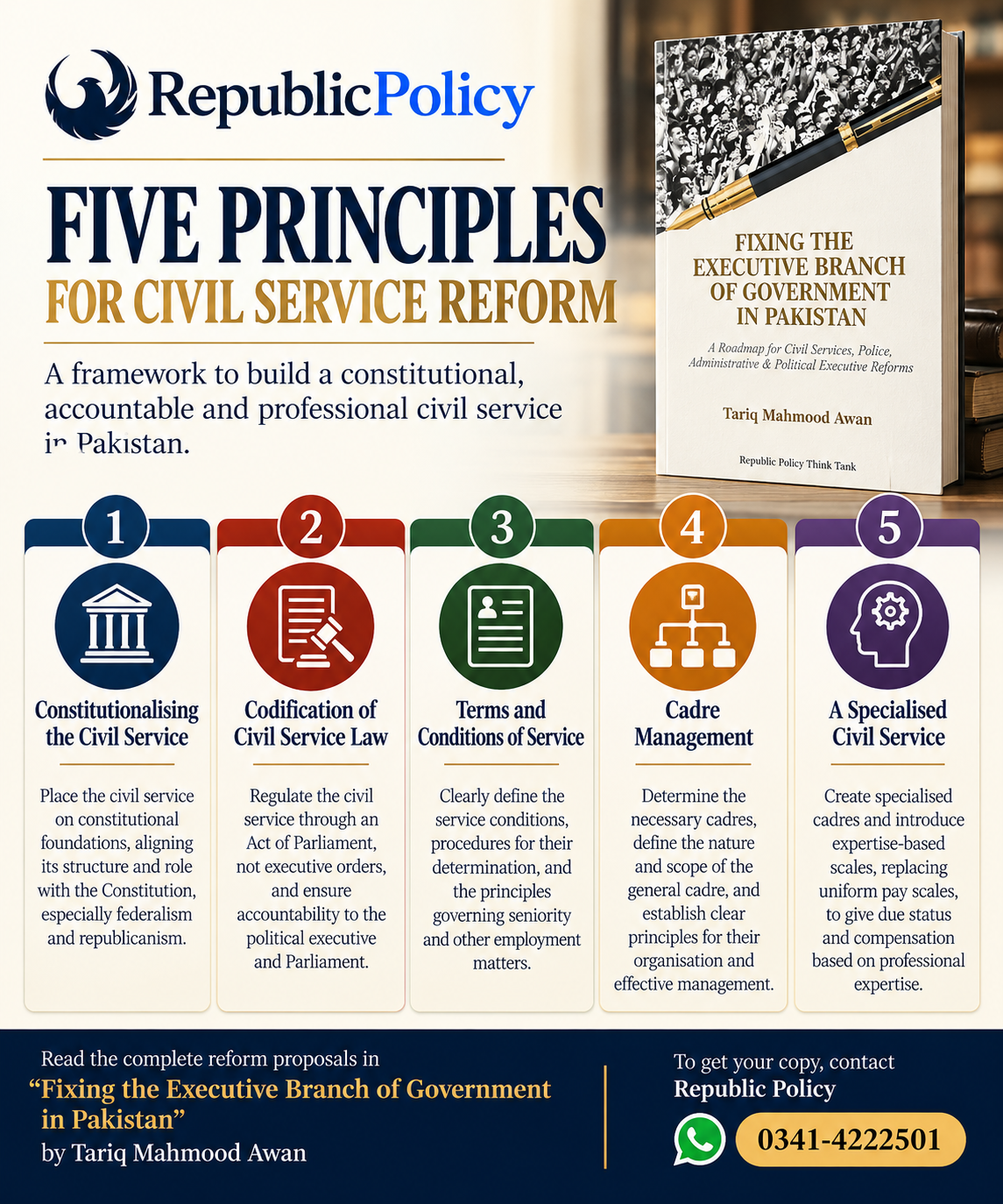

Republic Policy, in its book “Fixing the Executive Branch of Government,” has presented a five-component framework for reforming Pakistan’s civil service. The central objective of this framework is to restructure the constitutional, legal, administrative and institutional foundations of the civil service.
1. Constitutionalising the Civil Service
The first component is to place the civil service on constitutional foundations. Under this principle, the structure and role of the civil service should be aligned with the fundamental spirit of the Constitution, particularly federalism and republicanism. The administrative structure should reflect the same constitutional principles upon which the system of the state is founded.
2. Codification of Civil Service Law
The second component is the formal codification of law governing the civil service. Its legal foundation should not rest merely on executive orders or rules and procedures developed within bureaucratic offices. Instead, the civil service should be regulated through an Act of Parliament.
Under this framework, the bureaucratic executive should remain accountable to the political executive and Parliament, rather than the other way around. Therefore, the legal and administrative authority of the civil service should derive from clearly defined parliamentary legislation.
3. Terms and Conditions of Service
The third component concerns the terms and conditions of civil service employment. It requires clearly determining the conditions under which civil servants serve, the procedures through which these conditions are established, and the principles governing seniority and other service-related matters.
4. Cadre Management
The fourth component is cadre management. This requires determining which cadres are necessary within the civil service and defining the nature and scope of the general cadre. The administrative structure of the civil service should be based on clearly organised cadres and effective principles for their management.
5. A Specialised Civil Service
The fifth component calls for the development of specialised cadres and professional administrators. Republic Policy’s framework places specialisation at the centre of civil service reform.
For this purpose, it proposes replacing the existing system of privileges and uniform pay scales with specialisation-based scales, allowing professionals to receive status and compensation according to their expertise and specialised functions. For example, the position and status of an economist should be determined according to the economist’s particular professional expertise.
Republic Policy’s proposed civil service reform framework therefore rests on five fundamental pillars: constitutional alignment, codification of law, terms and conditions of service, cadre management, and specialisation.
These reforms are explained in greater detail in Republic Policy’s book, “Fixing the Executive Branch of Government.” Copies of the book can be obtained by contacting Republic Policy.