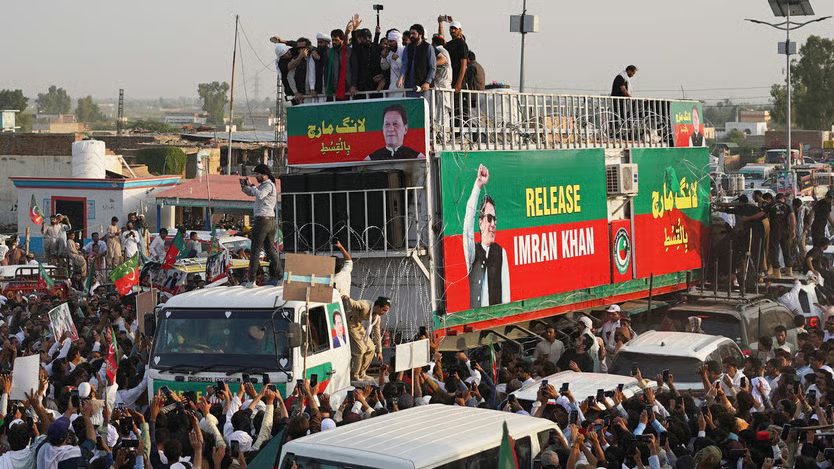

Pakistan’s latest political confrontation is about more than whether Imran Khan’s Pakistan Tehreek-e-Insaf can march on Islamabad. The extraordinary security preparations surrounding the proposed protest reveal a deeper problem: political competition is increasingly being managed through administrative coercion rather than democratic accommodation.
The spectacle of Islamabad being barricaded with thousands of shipping containers while police are deployed at entry points illustrates how routine political disputes can become questions of state security. PTI, meanwhile, has built much of its mobilisation around Imran Khan’s imprisonment, turning access to and the fate of its leader into the centre of its political campaign.
Yet the larger issue extends beyond PTI and the government. Pakistan has repeatedly struggled to define where political authority actually resides. Parliament formally legislates, elected governments formally govern, and constitutional institutions possess defined jurisdictions. But when unelected institutions acquire decisive influence over political arrangements, the distinction between constitutional authority and practical power becomes blurred.
Any attempt to redraw Pakistan’s political or administrative map would therefore be especially consequential. Administrative restructuring may sometimes be justified by population growth, governance failures or demands for greater decentralisation. But such changes cannot acquire democratic legitimacy merely because powerful state institutions consider them administratively desirable.
Pakistan is a federation. Changes affecting provinces, political representation, territorial administration or the distribution of authority must consequently emerge through constitutional processes, representative institutions and meaningful public debate. Otherwise, reform risks becoming another instrument through which power is centralised rather than devolved.
This is particularly important because Pakistan’s governance crisis is not simply a problem of inefficient administration. It is also a crisis of institutional boundaries. Political parties, bureaucracies, courts and the military have repeatedly moved into spaces that properly belong to other institutions, weakening accountability and creating overlapping centres of authority.
The answer cannot be another rearrangement imposed from above. Pakistan needs stronger institutions, clearer constitutional jurisdictions and greater political accountability.
Whether the immediate confrontation concerns PTI’s protest, Imran Khan’s imprisonment or proposals to reshape the country’s political architecture, the underlying question remains the same: will Pakistan’s future be determined through constitutional institutions or through the preferences of whoever possesses the greatest power at a particular moment?