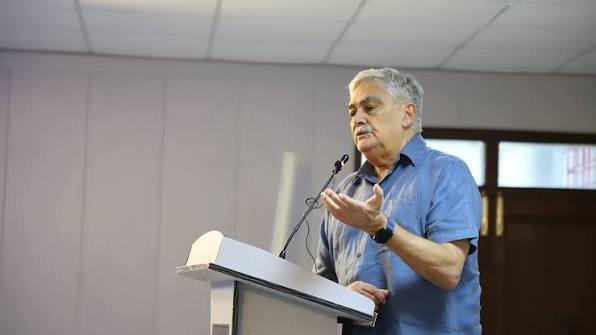

Naimat Ullah Khan
The purpose of research is to begin with a question, develop the question through critical engagement with the current body of knowledge, and conclude with something that is an important and valuable contribution to the knowledge. But in many parts of Pakistan’s higher education system the process of research has become a kind of a ritual. Research production is expected from universities, dissertations are expected from students, and approval is expected from supervisors. The question that remains, however, is still largely unanswered: do colleges teach students the skills of research or are they simply asking for research papers?
It is the difference that lies at the heart of Pakistan’s research woes. It is a lack of understanding of what research is; that is the problem. The choice of a topic, the collection of a few references, and structuring the data into scholarly chapters are not the only parts of research. It is a step-by-step process, and it entails identification of an emergent phenomenon, a review of existing knowledge, the identification of unanswered questions, and the development of a sound basis for further study. A research problem cannot be stated without reviewing previous research. Instead of assuming that a certain topic has not gotten enough attention, the research gap must result from a critical evaluation of pertinent literature.
Hence, the problem statement, research questions, and objectives are not things to be done at the beginning of a thesis, but they are the fruits of intellectual investigation. Unfortunately, this is the basic order that is frequently ignored. At any point in undergraduate, MPhil, and even doctorate studies, students can also be hit by a thesis deadline but not have a clear research topic. The research process is thus shortened when the topic is picked at the last minute. A literature review becomes an afterthought and requires a thorough reading of the literature, comparison, conceptualization, and critical analysis. Research objectives are sometimes formulated before a problem is adequately understood, and in some cases formulas are prepared to help define the research method that is to be used.
Such methods destroy the basic principle of academic and scientific research. The teaching of research technique is also seriously faulty. In lectures at university, students can become familiar with the positivist, interpretative, critical, and various methodological frameworks, as well as with qualitative and quantitative approaches. Yes, such theoretical debates are important, but methodological jargon does not necessarily lead to research competency. Moreover, students must be taught how to translate theory into the practice of actual research. How to Identify a Study Topic? What is the proper way to locate, classify, and critically evaluate literature? What is an academically important research problem? How to select a theoretical framework?
Why is one theory preferable to the other? How do researchers decide on a sampling strategy, justify the sample size, develop an interview guide, conduct fieldwork, and defend methodological choices? These are not “side questions. They are very practical for research training. Literature review should receive special attention because, as far as the researcher’s opinion goes, it is one of the most misunderstood parts of academic research in Pakistan. It is sometimes seen as a collection of abstracts and not as a critical dialogue between current studies. The researcher needs to identify conceptual disagreements, methodological limitations, empirical findings, and theoretical developments in a good literature review, as well as what is left unsolved. It is in this process that a research gap that can be defended comes into existence.
If there is no engagement, the problem statement becomes a guess, the problem objectives become directionless, and the theoretical framework can turn into a decorative pile of ideas instead of a tool for analyzing evidence. Students who have not received systematic instruction in such practices will not be able to construct independent arguments when studying. Without systematic training in such practices, students will always have difficulty making their own arguments in their studies. Add further to the mix the emergence of digital technologies and generative artificial intelligence. Literature discovery, summarization, language refinement, and conceptual exploration can be supported using tools like ChatGPT or other academic platforms.
The value of their products, however, depends on the researcher’s ability to evaluate them. These technologies do not enhance reading but rather take the place of it, giving the illusion of academic ability. Literature reviews, research gaps, problem statements, even theoretical frameworks can now be spewed out in minutes, but writing an academically plausible paragraph does not necessarily mean you understand the scholarship it claims to represent. There can be errors in the references, oversimplification of arguments, and lack of intellectual justification for conceptual relationships. It is not the use of AI alone that is dangerous, but the institution of intellectual dependency without the usual norms of verification, critical engagement, and academic accountability.
This issue is related to the long-term weaknesses of academic reading, writing, and critical thinking. Students with limited experience can find it challenging to determine where the writer’s argument begins and ends, to distinguish the writer’s interpretation of evidence from the evidence itself, to compare and contrast alternative interpretations, to identify the writer’s academic stance, and to develop an academic position on an issue. These deficits are particularly problematic in the social sciences, where interpretation, the ability to make sense of, and the practice of writing arguments and concepts are fundamental aspects of the production of knowledge. The solution, however, is not to demean students as not being smart enough. Writing for research is an academic skill that has to be learned. Requires organized instruction, practice, reinforcement, and supervision.
Although the presentation of assignments and concepts of methodology using slides can provide information, it is not an adequate replacement for guiding students in reading a journal article, synthesizing arguments in the scholarly literature, or developing a theoretically driven research design. The crises are thus not just a student issue or a supervisor problem. It shows a general weakness in the academy. Lack of supervision, lack of monitoring of milestones in research, and cursory guidance in method do not encourage systematic treatment of the work. Quite the reverse: when students delay selecting topics, refrain from independent reading, and fail to commit to an authentic process of academic supervision, they compromise the potential for meaningful academic supervision. There is time for both sides to get used to each other’s weaknesses.
As a result, an academic environment arises in which merely the completion of a thesis is more significant than the quality of the research. The research committees and institutional structures also play a part in supervision being substantive, the time limits reasonable, and academic standards consistently adopted. This challenge must be met by a substantial shift from the teaching of research as a theoretical discipline to the teaching of research as a useful intellectual skill. Research training should begin with undergraduate education and then progress in a graduated fashion in MPhil and PhD studies. Students need to be expected to conduct supervised literature studies, develop research issues, formulate research questions, justify theoretical choices, and design methodology before embarking on intensive research. Supervisors should establish deadlines for subject approval, evaluation of literature, development of research design, research data collection, and writing of theses.
Departments should provide practical research seminars where students are put in the position of reading real research papers, using research tools and data, and engaging with research questions. The depth of analysis and the methodological reasons should be rewarded in assessments, not the length of the documents produced. In the meantime, students should be aware that they shouldn’t rely on AI, colleagues, or supervisors for their research. To build a culture of research, one must be intellectually curious, a disciplined reader, prompt to interact with supervisors, and ready to question preconceived notions. The culture needs to be fostered by students as well as universities. Academic integrity should not only be about avoiding plagiarism but also involve the genuine intellectual ownership of research topics, arguments, interpretations, and conclusions. Pakistan needs more than just more academic publications, research journals, and theses.
It demands researchers who have an understanding of the importance of an issue, the way knowledge is produced, what can be proved with evidence, and where their conclusions are limited. Publications objectives and institutional rankings do not meet the international research standards. It requires methodological ability, critical thinking, responsibility in supervision, and intellectual independence. Research training will still be produced in the country without necessarily creating researchers, unless institutions see research training as a duty of the academic enterprise, not just a requirement for degrees to be earned. The problem is not just to multiply the amount of research; it is to renew the importance of research, the rigor of its methods, and the academic seriousness of its practice.
Naimat Ullah Khan, a sociologist, independent researcher, and political columnist, writes on political sociology, ethnic nationalism, federalism, and state-society relations in Pakistan. My research addresses questions of state legitimacy, ethnic identity, political mobilization, and center-periphery relations.