

Widespread Disruption and Security Clampdown Across KP
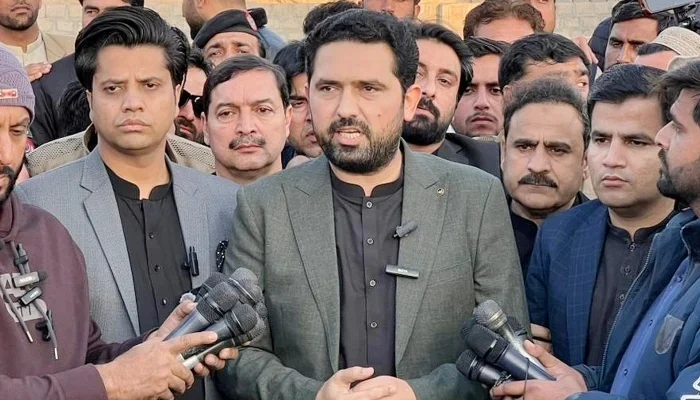
Daily life across Khyber Pakhtunkhwa faced severe disruption on the first day following the federal government’s declaration of emergency and imposition of governor’s rule. Security forces enforced strict traffic restrictions, extensive road blockades, and targeted detentions across multiple districts, including Shangla and Charsadda, where scores of Pakistan Tehreek-e-Insaf (PTI) workers were taken into custody. Ground reports indicate a pervasive security presence as local authorities attempt to maintain public order.
Peshawar Enforces Section 144 and Security Bans
In the provincial capital of Peshawar, the district administration implemented a strict seven-day ban under Section 144 of the Code of Criminal Procedure (CrPC). The executive order issued by the Deputy Commissioner prohibits public gatherings, the display of firearms, and the possession of potential weapons—including petrol bombs, batons, spikes, and ball bearings. Armed police personnel, equipped with riot gear and batons, have been deployed across major thoroughfares, with heavy concentrations stationed along the borders of the Peshawar Cantonment area.
Container Blockades Paralyze Capital’s Key Routes
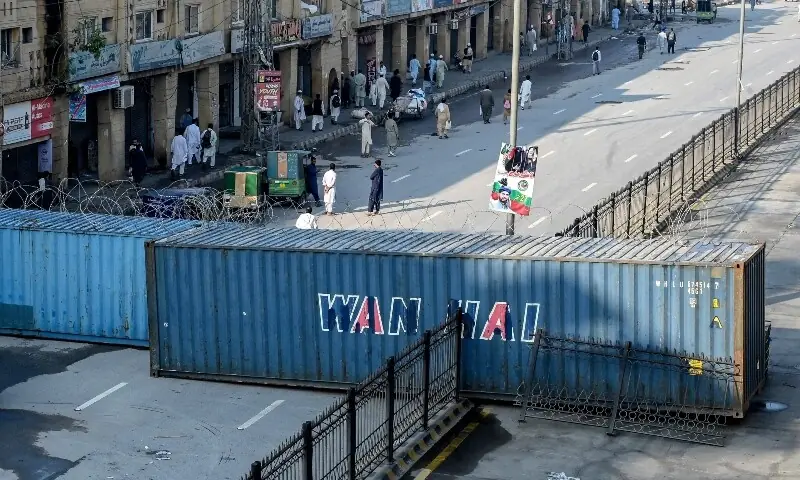
Access to critical administrative and commercial zones in Peshawar remains heavily restricted due to strategically placed shipping containers. All primary entry and exit points to Peshawar Cantt are completely sealed, blocking entry via Khyber Road and diverting commuter traffic toward Khyber Bazar, Ramdas, and Bhana Marhi Chungi. Major arteries—including University Road near Tehkal, Sher Shah Suri Road, Railway Road, and the GT Road entrance at Pir Zakori—have been blocked. To bypass closed routes connecting Saddar, Warsak, and Shami Road, commuters are forced to navigate long detours along the City Circular and Kohat Roads.
Deserted Highways and Reduced Public Mobility
While arterial routes such as Charsadda Road, Kohat Road, and inter-district connectors toward Khyber, Kohat, and Nowshera remain physically open, overall traffic volume dropped significantly as residents chose to stay indoors. Normally congested routes, including the City Circular Road and GT Road near Pir Zakori, appeared largely deserted. The combination of road closures, public transport disruptions, and educational institution shutdowns has effectively grounded routine civic and economic activity across the region.