
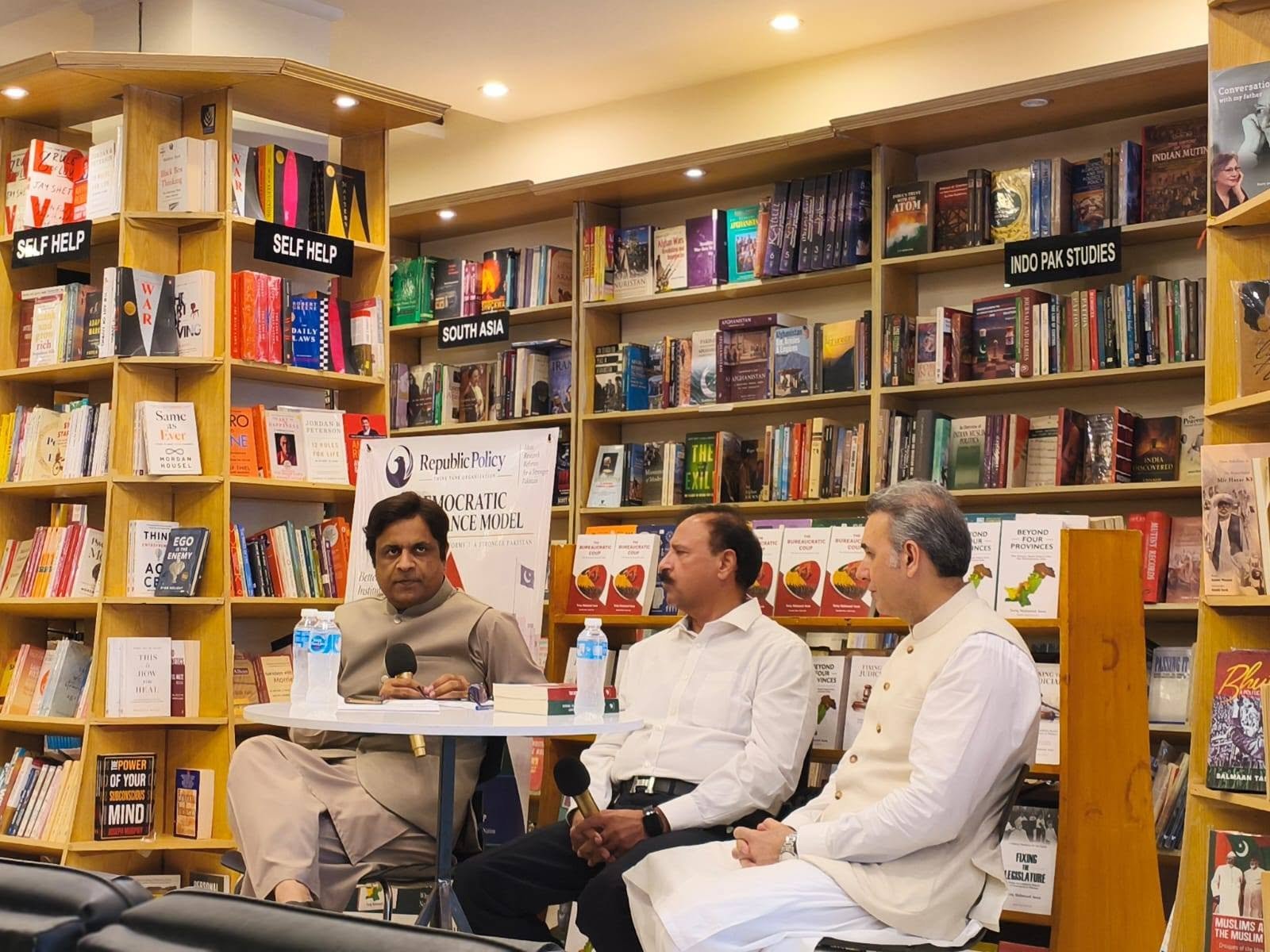

LAHORE: Republic Policy Think Tank (RP), under its National Reform Movement, organised its fifth seminar in the governance and civil service reform series under the title “Beyond CSS: Constitutionalism, Federalism, Structuralism and Alternative Recruitment Models.” The seminar focused on examining Pakistan’s existing Central Superior Services (CSS)-based recruitment system and exploring alternative models for a modern, professional, constitutional and federal public service.
The discussion centred on a fundamental question: Is Pakistan’s existing CSS-based recruitment system constitutionally sound, compatible with federalism and suitable for modern governance, or does the country need a fundamentally different public-sector recruitment model?
The seminar’s discussion questionnaire covered 16 questions across four major themes: constitutionalism and the legal framework; federalism and the structure of public services; alternative recruitment models and competitive examinations; and a roadmap for building a better recruitment system.
The constitutional debate focused on Articles 240 and 242 of the Constitution of Pakistan, read alongside Articles 142, 97 and 137. Participants were invited to examine the legal framework governing public services, the respective jurisdictions of federal and provincial public service commissions, and the relationship between constitutional provisions and existing recruitment practices.
A major area of discussion was whether the Federal Public Service Commission should recruit personnel for posts falling within the administrative and service structures of provincial governments. The questionnaire also examined recruitment arrangements for the Council of Common Interests and other intergovernmental institutions, with particular attention to federalism, provincial autonomy and the constitutional distribution of responsibilities.
The seminar also addressed the structure and relevance of existing federal occupational groups, the role of the Establishment Division in human resource planning, and the possibility of merging, restructuring or replacing overlapping services with specialised professional cadres. It raised questions about whether recruitment should reflect the actual functions, workload, professional requirements and institutional needs of government rather than follow a uniform examination-based approach.
Comparative international recruitment models were another key theme. The discussion invited participants to assess centralised competitive examinations, decentralised departmental recruitment, specialised professional selection and competency-based assessments. It also examined the effectiveness of the FPSC and provincial public service commissions, including their institutional independence, transparency, evaluation methods and accountability mechanisms.
Under the theme of reform, Republic Policy Think Tank called for proposals to develop a recruitment framework that respects federal and provincial jurisdictions, strengthens provincial and local governments, and selects public servants according to the functions they are constitutionally and administratively required to perform.
The seminar sought to develop practical recommendations for constitutional, legislative, institutional and administrative reforms, with the broader objective of establishing a professional, efficient, accountable and citizen-centred public service.
Republic Policy Think Tank maintains that civil service recruitment should be examined as part of the wider question of governance reform. The debate on CSS, therefore, extends beyond the design of a competitive examination to the constitutional authority, institutional structure, professional specialisation and administrative purpose of public services.
The seminar was held at Vanguard Books, Gurumangat Road, Gulberg, Lahore, at 3:00 PM on Friday, October 16, 2026, as part of Republic Policy Think Tank’s ongoing efforts to promote research-based dialogue on Pakistan’s governance and institutional reforms.