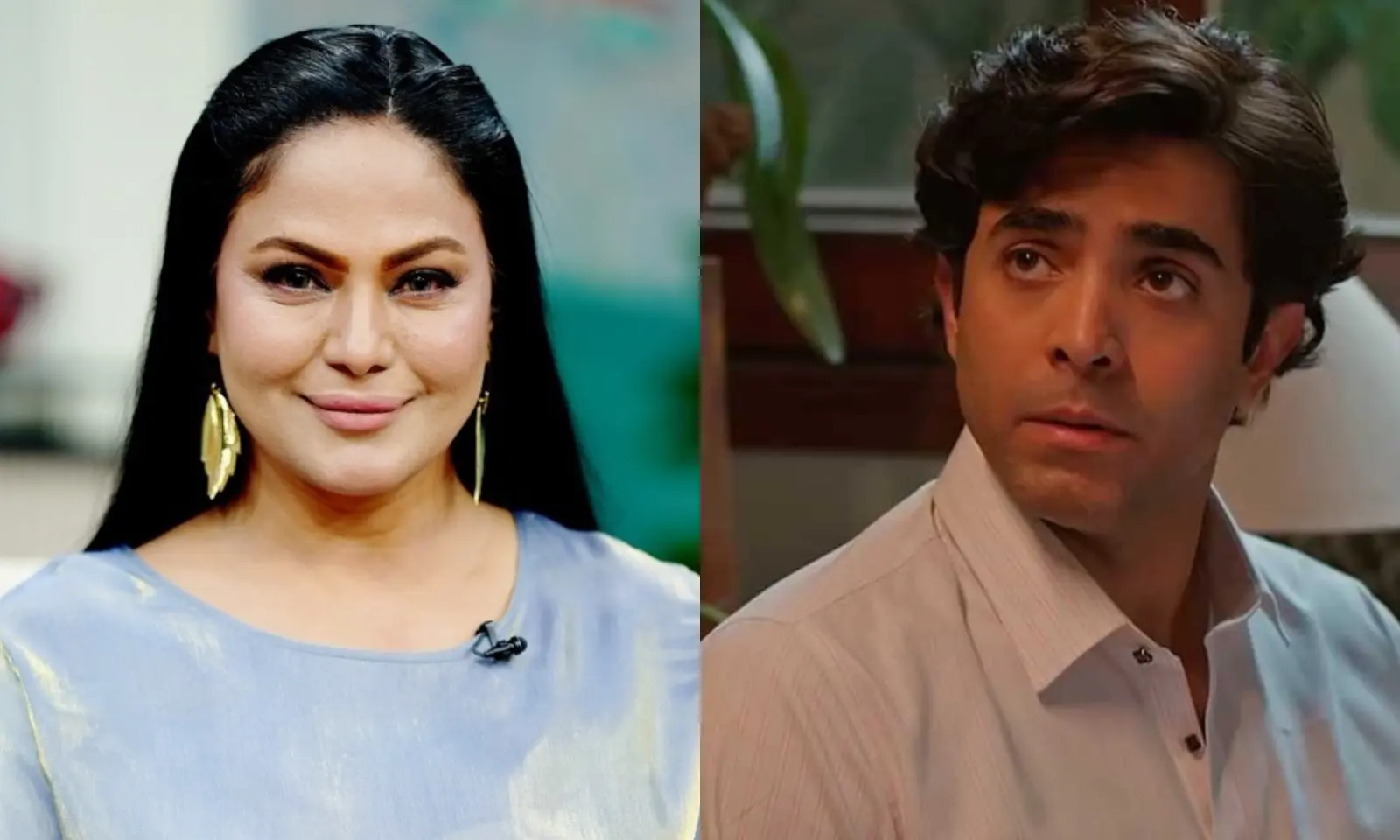

Veena Malik and a mental health expert warn against idealising fictional characters from television dramas, arguing that unrealistic expectations of perfect relationships can contribute to emotional distress, marital disappointment and mental health challenges among young people.
LAHORE: The character of Abu Bakar in the popular Pakistani television drama Dar-e-Nijaat has become an unlikely symbol of the ideal husband, winning widespread admiration from viewers for his patience, devotion and willingness to shoulder the responsibilities of others. Played by Sheheryar Munawar, the character has been celebrated across social media as a rare example of a supportive and emotionally available partner.
However, television host Veena Malik has questioned the growing fascination with this fictional ideal, warning that the expectations created by television dramas can become harmful when viewers begin measuring real-life relationships against imaginary standards.
During a discussion with Aeysha Imran Murtaza, a director at the Fountain House Institute of Mental Health, on her programme Veena Hai Na, Malik explored how romanticised portrayals of marriage and relationships can influence people’s expectations, particularly among young women.
The conversation centred on a broader concern: the gap between the idealised relationships presented on television and the complicated realities of everyday married life.
The fictional perfect husband
Abu Bakar has attracted considerable attention because of his seemingly endless patience, willingness to accommodate his wife and strong sense of responsibility towards his family. His character is frequently described by viewers as the kind of husband they would want in their own lives.
Yet the qualities that make him appealing as a fictional character may also create unrealistic expectations about marriage.
Murtaza said the institute encounters numerous cases involving people whose emotional difficulties are connected, at least partly, to unmet expectations in their personal relationships. She described the idealisation of a perfect romantic partner as an important issue that can contribute to psychological distress.
To illustrate the problem, she shared the experience of a young woman who sought help at the institute after developing depression following disappointment in her marriage.
According to Murtaza, the woman had initially imagined her husband to be like Abu Bakar. However, the realities of married life gradually challenged that perception.
As she became involved in managing household responsibilities and encountered the pressures facing her husband, she realised that he had his own obligations, limitations and exhaustion. The idealised image she had developed through television began to disappear, leaving her struggling to reconcile her expectations with reality.
The example highlighted how fictional portrayals of marriage can shape expectations that real people, with their ordinary human limitations, may find impossible to fulfil.
When idealism becomes a source of distress
Malik and Murtaza agreed that the expectation of a perfect relationship and an uncomplicated happy ending can create problems when people are not prepared for the compromises and responsibilities that accompany real relationships.
Murtaza clarified that having dreams or aspiring to an ideal relationship is not inherently harmful. The difficulty arises when individuals are encouraged to imagine an ideal but are not equipped with the understanding and practical skills needed to build healthy relationships.
She argued that young people are rarely taught the process through which expectations can be translated into realistic and sustainable relationships.
Malik expressed a similar concern, observing that idealism becomes destructive when individuals remain confined to fantasy rather than understanding the demands of real life.
“Idealism, if you’re only living in a fantasy, can literally destroy your life,” she remarked.
The discussion shifted attention from the question of whether Abu Bakar represents a desirable husband to a more fundamental issue: whether television audiences are being encouraged to distinguish between fictional romance and the realities of human relationships.
Empathy matters more than perfection
According to Murtaza, the foundation of a successful relationship is not the presence of a flawless partner but the ability of two people to understand, support and care for each other, particularly during difficult periods.
Real relationships involve competing responsibilities, financial pressures, emotional exhaustion, disagreements and changing circumstances. Neither partner can be expected to remain endlessly patient, available or self-sacrificing.
The idealisation of Abu Bakar, she suggested, can therefore create unfair expectations for both men and women. Men may feel pressured to perform an impossible role, while women may become disappointed when their partners fail to match the fictional character.
Sheheryar Munawar himself has previously commented on the pressures associated with the character. In an interview with the BBC’s Haroon Rashid, he highlighted Abu Bakar’s people-pleasing tendencies and saviour complex, asking viewers to consider the pressure under which such a person would live.
His observation adds another dimension to the debate: qualities that appear admirable on screen may carry emotional and psychological costs when interpreted as expectations for real people.
Media influence and the responsibility of parents
Murtaza also highlighted the lasting influence of television and other forms of media on children and young people. According to her, the characters they admire during childhood can continue shaping their perceptions and expectations well into adulthood.
She advised parents to remain aware of the content their children consume and, more importantly, to discuss the characters and stories that attract their attention.
Rather than simply restricting television viewing, parents should encourage critical thinking by asking children to identify both the positive and negative qualities of the characters they admire. Such conversations can help them understand that fictional personalities are constructed for storytelling and should not automatically become standards against which real people are judged.
The discussion also raises broader questions about the social responsibility of television drama producers. Entertainment naturally relies on compelling characters and emotionally engaging narratives. However, the repeated presentation of idealised relationships without adequately exploring their complexities can contribute to distorted perceptions of marriage and family life.
Beyond the television screen
The debate surrounding Abu Bakar reflects a wider challenge in contemporary media culture, where fictional characters increasingly become reference points for personal aspirations, romantic expectations and social behaviour.
Television dramas can inspire audiences, encourage empathy and initiate meaningful conversations. But their influence becomes problematic when entertainment is mistaken for a realistic guide to life.
A healthy relationship is not built around the expectation of a perfect husband or wife. It requires communication, mutual respect, emotional maturity, shared responsibility and the willingness to navigate difficulties together.
Abu Bakar may remain a popular fictional ideal, but real relationships cannot be judged by the standards of a television script. The more important lesson for audiences is to recognise that lasting companionship is not about finding someone who can solve every problem. It is about two people learning to face life’s problems together.