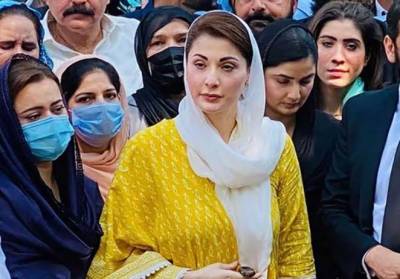

JHELUM: Punjab Chief Minister Maryam Nawaz Sharif has removed Jhelum Deputy Commissioner Mir Reza Ozgen from his position with immediate effect after expressing displeasure over his office’s request to shift an intermediate examination centre ahead of her scheduled visit to the district.
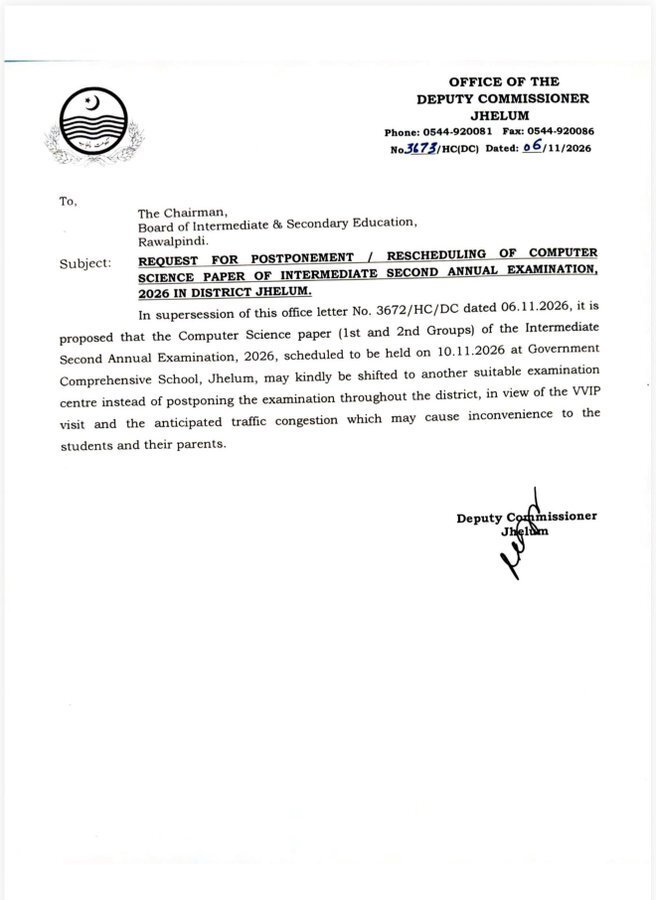
The decision followed a letter dated November 6, issued by the Deputy Commissioner’s Office in Jhelum to the chairman of the Board of Intermediate and Secondary Education (BISE), Rawalpindi. The letter requested the relocation of Computer Science papers for the Intermediate Second Annual Examination 2026, scheduled for November 10 at Government Comprehensive School, Jhelum.
The request was made in anticipation of traffic congestion associated with the chief minister’s visit. The district administration argued that the movement of a high-profile official could inconvenience students and their parents if the examination continued at the existing venue. It therefore proposed shifting the papers to another suitable examination centre rather than postponing the examination across the district.
Maryam Nawaz, however, viewed the request as a violation of her explicit instructions that official visits should not disrupt public life. Announcing the deputy commissioner’s removal in a post on X, she said she had directed district administrations to ensure that no inconvenience or disruption was caused to citizens during her visits.
Despite those instructions, she said, an incident had occurred that amounted to a clear disregard for her directions. She consequently announced that the deputy commissioner had been removed from his post with immediate effect.
In a separate post, the chief minister shared a copy of the notification confirming Ozgen’s transfer.
An examination centre caught in the arrangements for a VVIP visit
The letter from the Jhelum Deputy Commissioner’s Office provides important context for the controversy. It specifically referred to the Computer Science papers of both the first and second groups scheduled for November 10 at Government Comprehensive School, Jhelum.
The administration requested that the examinations be moved to another appropriate venue because of the anticipated traffic congestion during the chief minister’s visit. It argued that relocating the examination centre would be preferable to disrupting the examination schedule throughout the district.
The distinction is important. According to the letter, the proposed measure was not intended to postpone the examinations but to shift them to an alternative location. The stated concern was that the movement of the visiting delegation could create difficulties for students and their parents travelling to the examination centre.
Nevertheless, the episode has raised a broader question about the relationship between official protocol and the ordinary functioning of public institutions. Examination schedules are organised around students, educational institutions and examination boards. Any disruption, even a change of venue, can create logistical difficulties for candidates who may have already arranged transport and made preparations according to the announced schedule.
The administrative responsibility of a deputy commissioner
Deputy commissioners occupy a central position in Pakistan’s district administration. They coordinate government departments, oversee public order and revenue administration, manage emergency responses and facilitate the implementation of provincial government policies.
Their responsibilities also include ensuring that public services continue to operate during official visits, political events and other high-profile engagements. A chief minister’s visit may require traffic management, security arrangements and coordination among several departments. However, these arrangements are expected to accommodate routine public activity rather than displace it unnecessarily.
From this perspective, the Jhelum letter appears to have been an administrative attempt to prevent inconvenience to examination candidates. The chief minister’s response, meanwhile, reflects her insistence that district officials must ensure that official visits do not interfere with citizens’ daily lives.
The central institutional question is whether the proposed relocation was an appropriate administrative precaution or an unnecessary disruption that could have been avoided through better planning. The available account establishes the contents of the letter and the chief minister’s response, but does not provide an independent assessment of the traffic arrangements or the feasibility of alternative measures.
Public convenience and the culture of official protocol
The incident highlights a recurring governance challenge in Pakistan: the management of official movements in relation to the everyday needs of citizens.
Visits by senior political leaders often require extensive security and administrative preparations. Roads may be restricted, public facilities reorganised and district officials assigned special duties. While security requirements are legitimate, they should not automatically take precedence over essential public services.
Schools, hospitals, examination centres, public transport and commercial activity must continue to function as normally as possible. The responsibility of district administrations is to manage official engagements without transferring the burden of administrative convenience to ordinary citizens.
The chief minister’s stated position that public visits should not cause disruption is consistent with this principle. However, the principle must be translated into clear administrative procedures. District officials need practical guidelines for managing traffic, security and public services so that they can make timely decisions without uncertainty about their responsibilities.
A system based on clear protocols would also reduce the risk of administrative decisions being judged primarily through individual political reactions. Civil servants should be held accountable for negligence, poor planning or misuse of authority, but accountability must be based on transparent standards and an objective assessment of their decisions.
Transfers and accountability in public administration
The immediate removal of the deputy commissioner has also brought attention to the broader issue of administrative transfers in Punjab. The posting and transfer of senior district officials are important instruments through which provincial governments manage the civil administration. However, frequent or sudden changes can affect continuity, institutional performance and the ability of officers to take responsibility for long-term administrative outcomes.
A professional civil service requires both accountability and a degree of operational stability. Officers must follow lawful government directions and remain answerable for their decisions. At the same time, administrative action should be proportionate, reasoned and supported by a clear understanding of the circumstances in which a decision was made.
In this case, the publicly available account centres on the chief minister’s dissatisfaction with the request to shift the examination venue. It does not establish whether any formal inquiry was conducted, whether the proposed relocation was operationally necessary or whether alternative arrangements were considered.
These questions matter because district administration should function through institutional procedures rather than personal discretion alone. If an officer’s decision is considered inconsistent with government policy, the reasons should be examined and the relevant administrative responsibility clearly established.
Students’ interests must remain central
The immediate issue concerns an intermediate examination, making students the most important stakeholders in the matter. Candidates preparing for examinations depend on predictable schedules, accessible venues and timely communication from education authorities.
A change of examination centre can create practical difficulties, particularly for students travelling from distant areas or relying on public transport. Families may need to reorganise travel arrangements, while examination boards must ensure that security, supervision and examination materials are properly managed at any alternative venue.
The original letter itself referred to the possibility of inconvenience for students and their parents. That concern should remain central to any decision about examination arrangements, regardless of the administrative circumstances surrounding a government visit.
The Board of Intermediate and Secondary Education, as the relevant examining authority, also has an important role in ensuring that examination schedules and venues are managed transparently. Decisions affecting candidates should be based on their educational interests and operational requirements, not merely on the convenience of official movements.
The larger lesson for district governance
The Jhelum episode offers a reminder that the quality of governance is often measured through seemingly routine administrative decisions. A government visit, an examination schedule and a district-level traffic plan may appear to be separate matters, but they intersect in the everyday functioning of the state.
The purpose of district administration is to make public institutions work reliably, even when political and administrative demands compete for attention. The presence of a chief minister in a district should not suspend ordinary public services. Equally, administrative decisions intended to protect citizens from inconvenience should be assessed on their practical merits and in accordance with established procedures.
Maryam Nawaz’s action communicates a clear message to deputy commissioners that official visits must not become a source of disruption for the public. Whether the removal of the Jhelum deputy commissioner was proportionate to the circumstances is a separate question that would benefit from a transparent account of the administrative considerations involved.
Ultimately, effective governance requires more than strict instructions and immediate disciplinary action. It requires professional district administrations capable of anticipating problems, coordinating public services and protecting citizens’ interests without waiting for political intervention.
The most important principle in this episode is straightforward: public institutions must serve the public, and official protocol must be organised around that responsibility. Students should not have to bear the cost of administrative arrangements for a government visit, just as civil servants should be judged through fair, consistent and transparent standards of accountability.