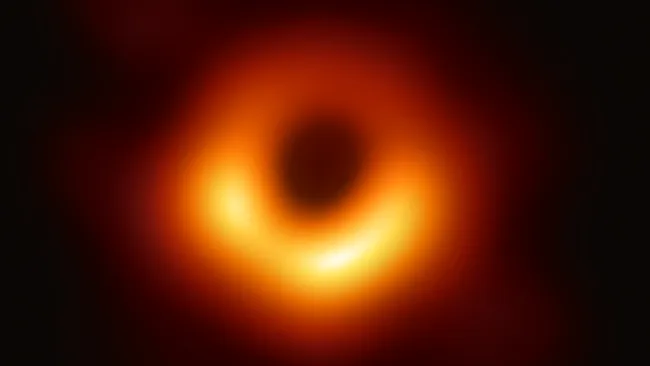

An independent research team has validated the historic image of the supermassive black hole at the centre of galaxy M87, reinforcing the predictions of Einstein’s general theory of relativity.
Scientists have independently verified the first image of a black hole ever captured, strengthening the evidence for Albert Einstein’s general theory of relativity, which predicted the existence of black holes and described the behaviour of gravity in their surroundings.
The historic image, unveiled to the public in 2019, was captured by the Event Horizon Telescope (EHT), a global network of radio telescopes operating together as an interferometer. It shows the supermassive black hole known as M87* at the centre of the galaxy Messier 87, located approximately 55 million light-years from Earth.
The black hole, estimated to have a mass around 6.5 billion times that of the Sun, represented a remarkable scientific achievement. Its image provided humanity with its first direct visual evidence of the immediate environment surrounding a black hole, allowing scientists to examine predictions of gravity under extreme conditions.
The independent verification is significant because imaging a black hole at such an enormous distance presents extraordinary technical challenges. Researchers must combine observations from telescopes spread across the globe to resolve an object whose apparent size is extraordinarily small.
Samuel Lai, a researcher at Australia’s Commonwealth Scientific and Industrial Research Organisation (CSIRO) and leader of the verification team, illustrated the challenge by comparing the task to standing in one’s backyard and attempting to photograph a doughnut on the Moon.
The independent validation adds confidence to one of modern astronomy’s most extraordinary observations and strengthens the scientific evidence supporting Einstein’s theory of general relativity.