
Mashhad Farooq
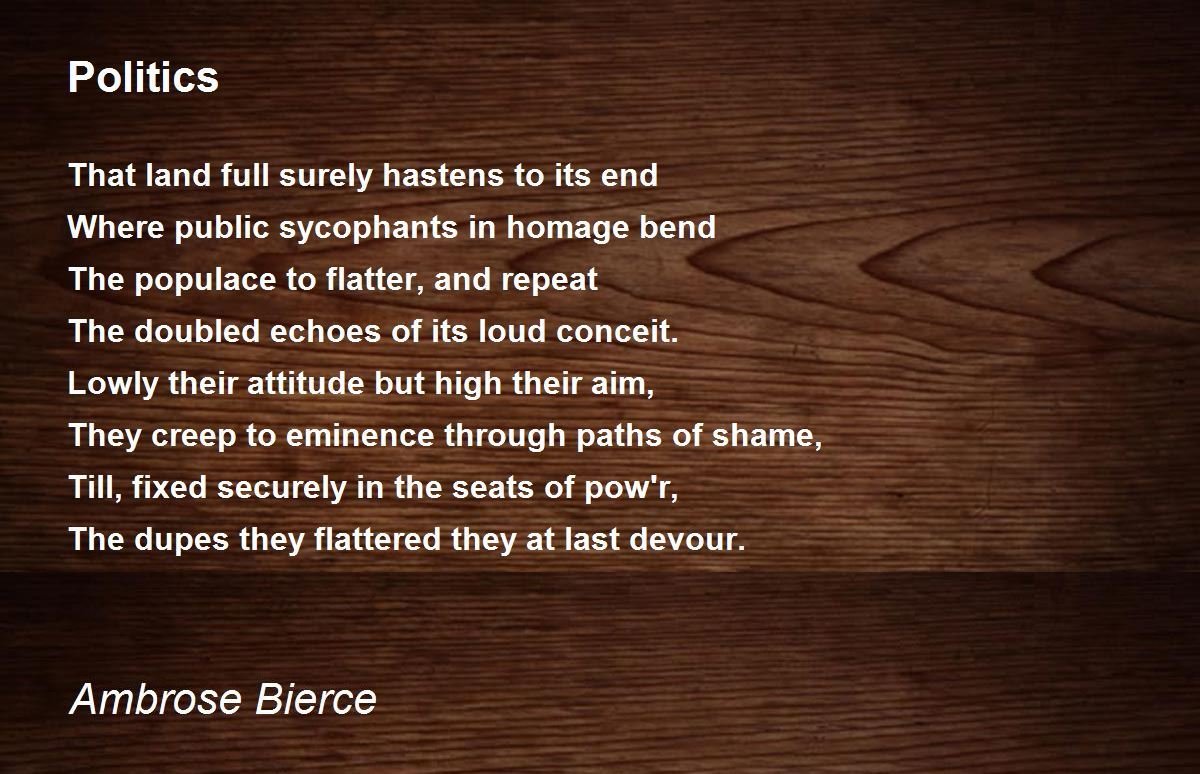
Ambrose Bierce’s poem “A Political Apostate” is a scathing critique of politicians who betray their principles. The poem is set in a political convention where the speaker, a former supporter of the party, witnesses the delegates nominate a candidate who is everything they profess to oppose. The speaker is disgusted by the hypocrisy of the delegates and their willingness to sacrifice their ideals for the sake of winning.
The poem reflects the social and cultural context of the late 19th century United States, a time of political corruption and machine politics. Bierce was a keen observer of the political scene, and his poem is a satirical commentary on the cynicism and deceit that he saw all around him.
The poem also speaks to the broader issue of political idealism versus pragmatism. The speaker is an idealist who believes in the power of principle to change the world. However, he is confronted by the harsh reality of politics, where idealism is often seen as a luxury that cannot afford to be indulged.
The poem is a powerful indictment of political corruption and the betrayal of principle. Bierce does not spare the delegates, whom he portrays as a herd of sheep blindly following their leaders. He also criticizes the political system itself, which he sees as being rigged in favour of the wealthy and powerful.
Please, subscribe to the monthly magazines of republicpolicy.com
The poem also has a contemporary relevance. In today’s world, we are all too familiar with politicians who make empty promises and who break their pledges once they are in power. Bierce’s poem reminds us that we must be vigilant in defending our principles and holding our politicians accountable.
Bierce’s poem is a masterful example of satire. He uses a variety of literary devices, such as irony, exaggeration, and understatement, to create a biting and humorous critique of politics.
One of the most striking features of the poem is its use of imagery. Bierce compares the delegates to a herd of sheep, to a “mob of howling wolves,” and to a “pack of hounds.” This imagery suggests that the delegates are mindless and unthinking and that they are more interested in following the crowd than in thinking for themselves.
Bierce also uses a variety of poetic devices, such as rhyme, meter, and alliteration, to create a musical and memorable poem. The poem’s rhythm and rhyme scheme helps to create a sense of momentum and movement, which reflects the speaker’s growing anger and disgust.
The poem can also be interpreted as a meditation on the nature of power and the dangers of corruption. Bierce suggests that power is corrupting and that those who seek it are often willing to sacrifice their principles in order to achieve their goals.
The poem also speaks to the importance of individual conscience. The speaker is a lone voice in the wilderness, but he refuses to compromise his beliefs. He stands up for what he believes in, even though he knows that he will be outnumbered and outmatched.
Ambrose Bierce’s “A Political Apostate” is a powerful and timeless poem. It is a scathing critique of political corruption and the betrayal of principle. The poem is also a meditation on the nature of power and the importance of individual conscience. Bierce’s poem is a must-read for anyone who cares about politics and democracy. The poem is quite relatable to Pakistani politics, where most of the politicians betray their principles for power and fear. And this creates disillusionment among the supporters. The central idea of the poem is that politicians must abide by their principles and do the politics of compasses.
Please, subscribe to the YouTube channel of republicpolicy.com