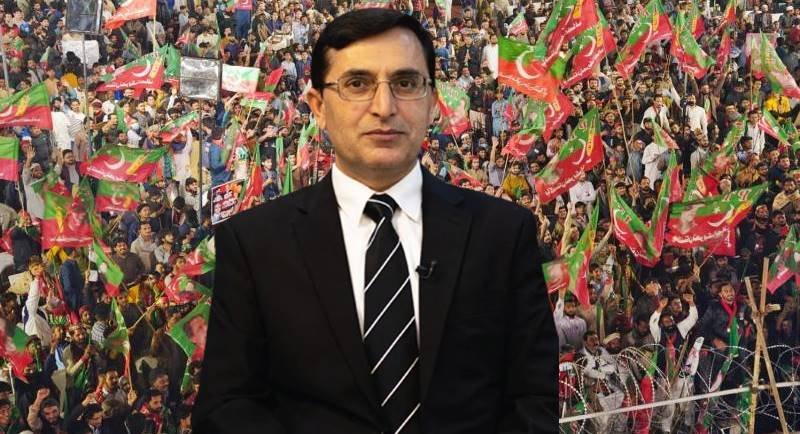

Hafeez Ahmed Khan
Critical Evaluation of PTI Manifesto: A Mixed Bag Realism and Illusion
In a separate event, PTI’s Barrister Gohar Khan revealed the party’s election manifesto that pledged social and constitutional reforms.
Speaking to the media in Islamabad, Gohar said PTI’s manifesto was named ‘Shandaar Pakistan, Shandaar Mustaqbil aur Kharaab Maazi sey chutkara’. He said that the party leaders who prepared the document could not attend the press conference due to the risk of being arrested.
Discussing the manifesto, the PTI leader vowed to establish a truth and reconciliation commission to deal with the injustices faced by the ordinary people.
He said that the party had always stressed that the rule of law should be upheld in the country and every citizen should be treated fairly.
“We cannot have two laws, one for the wealthy and one for the poor,” he added. As a barrister, I would say that the rule of law is essential for every country. “
He said that another part of the manifesto focused on modelling the country after ‘Riyasat-i-Madina’ (State of Madina). He said that some criminal and civil laws in the country were either too long or too complex.
“The Code of Criminal Procedure will be reformed so that the people are safeguarded,” he said, adding that the party did not want the poor to suffer due to obsolete laws.
He also said that the party would introduce constitutional reforms.
“One of the reforms would be that the people will directly choose the prime minister,” Barrister Gohar said. “We will reduce the National Assembly’s tenure to four years, bring the Senate tenure to five years and will directly elect 50 per cent of Senators,” he added.
Commenting on the economy, Gohar promised to reform the tax system and also expand the tax base. He also said that farmers would be given a subsidy to help them become self-reliant.
He also talked about the implementation of solar energy projects on a large scale and said the party would also introduce a universal health card. He also said the party was dedicated to bringing educational reforms and introducing a uniform education system across the country.
He said that the manifesto also had a part that provided a comprehensive account of the values that should be imparted to the youth that could help them thrive.
“The values of the youth, their education and participation in politics. We have kept a lot of incentives for them,” Gohar said.
He continued to say that if his party came to power, it would also provide social security for citizens.
Gohar emphasised it was necessary to eliminate corruption and promised that the party would introduce an initiative that would monitor the issue more closely.
Talking about foreign policy, the PTI leader said Pakistan needed to have a relationship based on equality with all countries. He also talked about the civil service reforms and judicial reforms which are vital for improving the governance in Pakistan.
Critical Evaluation:
The PTI’s manifesto has a clear and coherent vision of creating a ‘Shandaar Pakistan, Shandaar Mustaqbil aur Kharaab Maazi sey chutkara’ (Glorious Pakistan, Glorious Future and Freedom from the Bad Past). The manifesto outlines the party’s core values and principles, such as justice, equality, democracy, and welfare. The manifesto also identifies the country’s main challenges and opportunities, such as corruption, poverty, education, health, energy, and foreign relations. The manifesto then presents a comprehensive and integrated plan to address these issues and achieve the party’s vision. The manifesto is well-structured and organised into different sections, each with a clear title and subheadings. The manifesto uses simple and accessible language to communicate its message to the public. Then, all other manifestoes lack the structures, plans and means to implement them.
The PTI’s manifesto proposes a number of policies and reforms that aim to improve the social and economic conditions of the country and its people. Some of these policies and reforms are feasible and effective, while others are unrealistic and impractical. For example, the manifesto promises to form a truth and reconciliation commission to heal the wounds of the past and promote national unity. This is a feasible and effective policy that could help the country overcome its historical and political divisions and conflicts. However, the manifesto also promises to elect the prime minister directly by the people, reduce the tenure of the National Assembly to four years, and elect 50 per cent of the senators directly. These are unrealistic and impractical reforms that would require major constitutional amendments and consensus among the political parties and stakeholders, which is unlikely to happen in the current scenario. Moreover, the manifesto does not provide enough details and evidence on how the party would implement and finance its ambitious policies and reforms, such as reforming the tax system, providing subsidies to farmers, implementing solar energy projects, introducing universal health care, and creating a singular education system. The manifesto contrasts with federalism and devolution. The manifesto also does not address some of the potential challenges and risks that could arise from its policies and reforms, such as the impact on the fiscal deficit, the inflation rate, the balance of payments, regional and international relations, and the security situation.
The PTI’s manifesto claims to be based on the principles and ideals of ‘Riyasat-i-Madina’ (State of Madina), which is the model of governance established by the Prophet Muhammad (peace be upon him) in the seventh century. The manifesto argues that this model is relevant and applicable to the modern context and that it would ensure the welfare and dignity of all citizens. However, the manifesto does not explain how it would interpret and apply this model to the complex and diverse realities of Pakistan. The manifesto also does not acknowledge the possible contradictions and tensions between this model and some of the existing constitutional and legal provisions, such as the role of the parliament, the judiciary, the military, and the minorities. Furthermore, the manifesto does not address the credibility gap that the party faces due to its past performance and actions. The party has been accused of being involved in corruption, nepotism, mismanagement, and U-turns during its tenure in power in some provinces and at the federal level. The party has also been criticised for its alliance with some controversial political parties and candidates. The party has also failed to deliver on some of its previous promises and commitments, such as holding local government elections, empowering the youth, and reforming the police and the bureaucracy.
The PTI’s manifesto contains some original and innovative ideas and solutions that could potentially transform the country and its society. For example, the manifesto proposes to create a digital Pakistan, where every citizen would have access to the internet and online services. The manifesto also proposes to establish a national youth council, a national youth parliament, and a national youth development fund to empower and engage the young generation. The manifesto also proposes to launch a green Pakistan initiative, where the party would plant 10 billion trees, ban plastic bags, and promote renewable energy sources. The manifesto also proposes to enhance the cultural and creative industries, such as tourism, sports, arts, and media, to showcase the country’s diversity and potential.
The manifesto also proposes to strengthen civil society and the media to ensure accountability and transparency in the governance system. These ideas and solutions reflect the party’s vision and creativity and could appeal to the aspirations and expectations of the people, especially the youth.
Please, subscribe to the YouTube channel of republicpolicy.com