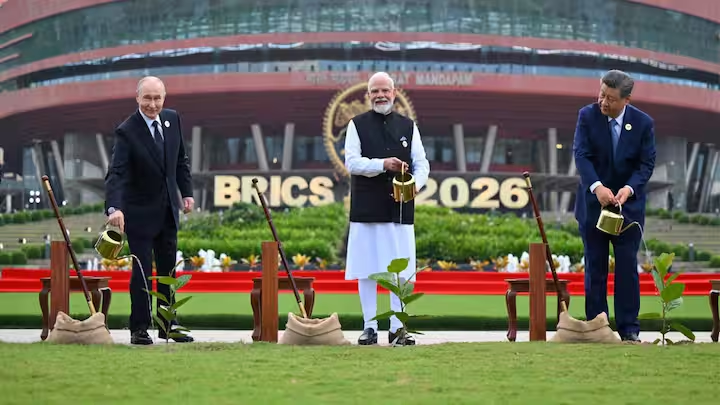

As New Delhi hosts the BRICS summit, the gathering offers a glimpse of a rapidly changing global order. China, India, Russia, Iran, Saudi Arabia and the UAE are increasingly operating within overlapping political and economic frameworks. The older geopolitical structure is giving way to a more fluid contest for influence across Asia and the Middle East, creating both opportunities and risks for smaller states.
The 18th BRICS Summit comes at an important moment. Chinese President Xi Jinping’s first visit to India since 2019 puts relations between Asia’s two largest powers at the centre of attention. China and India remain strategic competitors, but both understand the economic costs of prolonged confrontation. Their relationship is therefore moving towards managed competition rather than permanent hostility.
BRICS itself reflects this changing environment. Its 11 members stretch across Asia, Africa, the Middle East and Latin America, representing almost half of the world’s population and around 40 per cent of global GDP. India wants the grouping to place greater emphasis on trade, investment, technology, food and energy security, resilient supply chains and reform of global governance.
What is emerging, however, is broader than a new Asian order. Asia and the Middle East are becoming part of an increasingly interconnected economic and strategic power system. Military strength still matters, but capital, markets, technology, infrastructure and connectivity are becoming equally important instruments of influence.
China’s economic expansion has transformed its relationships across Asia and the Middle East. India is also extending its economic and strategic ambitions beyond South Asia. At the same time, Saudi Arabia, the UAE and Qatar are using their financial resources to become global investors, infrastructure partners and strategic actors rather than remaining primarily energy exporters.
For smaller and medium-sized countries, the lesson is clear. They cannot compete directly with major powers, but they should not become excessively dependent on any one of them either. Their best strategy is economic diversification combined with strategic flexibility.
Trade, investment, energy cooperation, technology and connectivity can strengthen national independence by giving states more diplomatic and economic options. But geography and foreign partnerships alone cannot generate lasting influence. Domestic economic competitiveness and credible institutions remain essential.
Pakistan illustrates this challenge particularly well. Its location connects South Asia with China, Central Asia and the Middle East. Its strategic partnership with China remains important, while expanding relations with Saudi Arabia and other Gulf countries provide additional opportunities.
Pakistan has also sought to strengthen its Middle Eastern position through the recently concluded Makkah accord involving Pakistan, Saudi Arabia and Türkiye, with the possibility of other countries joining. But diplomatic and security cooperation should now be accompanied by a stronger economic dimension. India, meanwhile, is pursuing influence in the emerging Asian and Middle Eastern order increasingly through economic engagement. In the long run, economic strength can often produce influence that diplomacy or military capability alone cannot sustain.
Pakistan should therefore seek to expand the Makkah framework beyond strategic cooperation by developing deeper partnerships in trade, investment, energy, technology and regional connectivity.
Other states face similar choices. Bangladesh can use its manufacturing base and its position between South and Southeast Asia. Sri Lanka can benefit from its location along major Indian Ocean shipping routes while maintaining strategic balance. Nepal can extract opportunities from its position between China and India, while Central Asian countries can diversify their economic connections through China, South Asia, Türkiye and the Gulf.
The Middle East will be increasingly important to this transformation. Gulf sovereign wealth is already moving beyond oil and gas into infrastructure, logistics, technology, renewable energy, food security and industrial development. The relationship between Asia and the Gulf is consequently becoming structural rather than merely transactional.
The emerging contest for power will therefore not be determined solely by military alliances. Capital, technology, markets, supply chains, infrastructure and connectivity will increasingly define geopolitical influence.
The coming Asian century may consequently belong to no single country. Instead, it could be shaped by several competing centres of power connected through investment, trade and technology. For countries such as Pakistan, the challenge is not simply choosing between these centres. It is building enough economic strength to engage with all of them while remaining dependent on none.