Abdullah Kamran
Pakistan’s determination to accelerate digital connectivity and expand its telecommunications infrastructure is, on its face, entirely reasonable. The country genuinely needs broader broadband coverage, faster fibre optic deployment, and steady movement toward a modern digital economy. Few would dispute that these are worthwhile national priorities. Yet when legislation crafted in pursuit of such goals begins to introduce uncertainty around fundamental rights that citizens rightfully expect the state to safeguard, the conversation shifts from technical policy to something far more consequential.
This is precisely the terrain occupied by the ongoing controversy over the Pakistan Telecommunication Reorganisation (Amendment) Bill. Despite its technical framing, the dispute surrounding this legislation has very little to do with telecom towers or fibre cables in any narrow sense. At its heart lies a principle that no government should treat lightly: the inviolability of private property.
To be fair, the government has offered reassurances on this front. Law Minister Azam Nazeer Tarar has publicly stated that there is no intention to seize private property, violate citizens’ privacy, or permit telecom installations on private land without the consent of the owners. These statements are welcome and should not be dismissed. But herein lies the fundamental issue: legislation must ultimately be evaluated by what it permits under law, not by what officials say they intend to do with it. Ministerial assurances, however sincere, are not a substitute for precise statutory language. Laws outlive the ministers who explain them, and future interpretations will rest on the text itself, not on speeches made during debate.
Given this reality, the objections raised by lawmakers deserve serious attention rather than dismissal. Particular concern has centered on provisions relating to access rights, deemed approvals, and the mechanisms established for resolving disputes. If the wording of the bill leaves room for ambiguity about who actually controls property once telecom infrastructure is involved, or if it hands excessive discretionary power to either private operators or government authorities, then these are not minor drafting issues. They strike at the heart of ownership itself, and they must be resolved before the legislation is allowed to advance any further.
What makes this controversy especially notable is that resistance to the bill has emerged not from opposition benches alone but from within the ruling coalition itself. The Pakistan Peoples Party’s objections are worth examining closely, because they are not aimed at the broader shift toward fibre optic infrastructure or digital modernization. Rather, they target specific clauses that appear to weaken long-standing protections around private property and due process. When a coalition partner raises such concerns, it signals that the unease extends well beyond typical partisan positioning. It suggests a genuine and shared apprehension about where this legislation might lead if left unamended.
Private property rights hold a special place in any functioning society, and the reason is straightforward: they provide certainty. When citizens invest their savings, their labor, and their futures into homes, businesses, and land, they do so with a reasonable expectation that ownership will carry real and enforceable legal protection. The moment that certainty begins to erode, even in seemingly narrow or technical contexts like telecommunications regulation, the damage rarely stays contained. Investor confidence weakens, public trust in institutions declines, and citizens grow warier of future government initiatives, regardless of how beneficial those initiatives might genuinely be.
The specific provisions drawing the sharpest criticism deserve closer scrutiny. Under the bill as currently drafted, certain approvals may be deemed granted automatically once a prescribed period lapses, effectively removing the need for explicit consent. Additionally, mechanisms exist that would refer property disputes to executive authorities for resolution, rather than through more independent or judicial channels. These provisions may well simplify bureaucratic procedures and speed up infrastructure rollout. Administrative convenience, however, cannot serve as sufficient justification for weakening the safeguards that protect private ownership. A right that exists only until a bureaucratic clock runs out is, in practical terms, barely a right at all. Such provisions transform property protection from a guarantee into a countdown.
There is also a wider principle worth considering here, one that extends well beyond this particular bill. Governments around the world, and Pakistan is no exception, frequently justify expanded or extraordinary powers by pointing to admirable goals. Digital connectivity is unquestionably valuable. Economic development matters immensely. Infrastructure expansion benefits the entire nation. Yet the defining feature of a genuine democratic system is the insistence that even the most worthy public objectives must be pursued strictly within legal boundaries that respect and protect individual rights. The moment that principle is compromised, even in service of a good cause, it becomes far easier to compromise it again for causes that are far less noble.
Pakistan’s recent legislative history reinforces the case for caution. Across a range of laws passed in recent years, recurring concerns have surfaced regarding executive overreach, insufficient oversight mechanisms, and inadequate channels for citizens to seek redress. Given this pattern, it is entirely reasonable, indeed necessary, for lawmakers to insist on precise legal language, transparent administrative procedures, and clearly defined avenues through which affected citizens can challenge decisions that impact their property.
Encouragingly, the government has signaled a willingness to revisit the bill and consider amendments in response to these objections. This openness to further scrutiny is itself a positive sign, demonstrating that parliamentary oversight can still function as intended when concerns are raised with sufficient force and clarity. That process of review and revision should continue until every ambiguity is eliminated and constitutional protections are unambiguously preserved in the final text.
None of this critique should be mistaken for opposition to telecommunications development itself. Pakistan’s digital future genuinely depends on sustained infrastructure investment and the removal of unnecessary bureaucratic bottlenecks that have historically slowed progress. But there remains a meaningful and important distinction between facilitating legitimate access for infrastructure development and diluting the fundamental rights of property owners. Countries that have successfully modernized their digital infrastructure have generally managed to achieve both goals simultaneously, without sacrificing one for the other.
There is a certain irony worth noting here. The same certainty that investors demand before committing capital to a market is precisely the same certainty that property owners require before they can be expected to surrender any rights over their land. Both depend on clear, predictable rules. The government’s ambition may well be greater national connectivity. Its real challenge, however, is ensuring that the path toward that ambition does not run through principles that citizens rightly consider non-negotiable. Private property rights deserve protection stronger than ministerial promises. They deserve protection written firmly into the law itself.
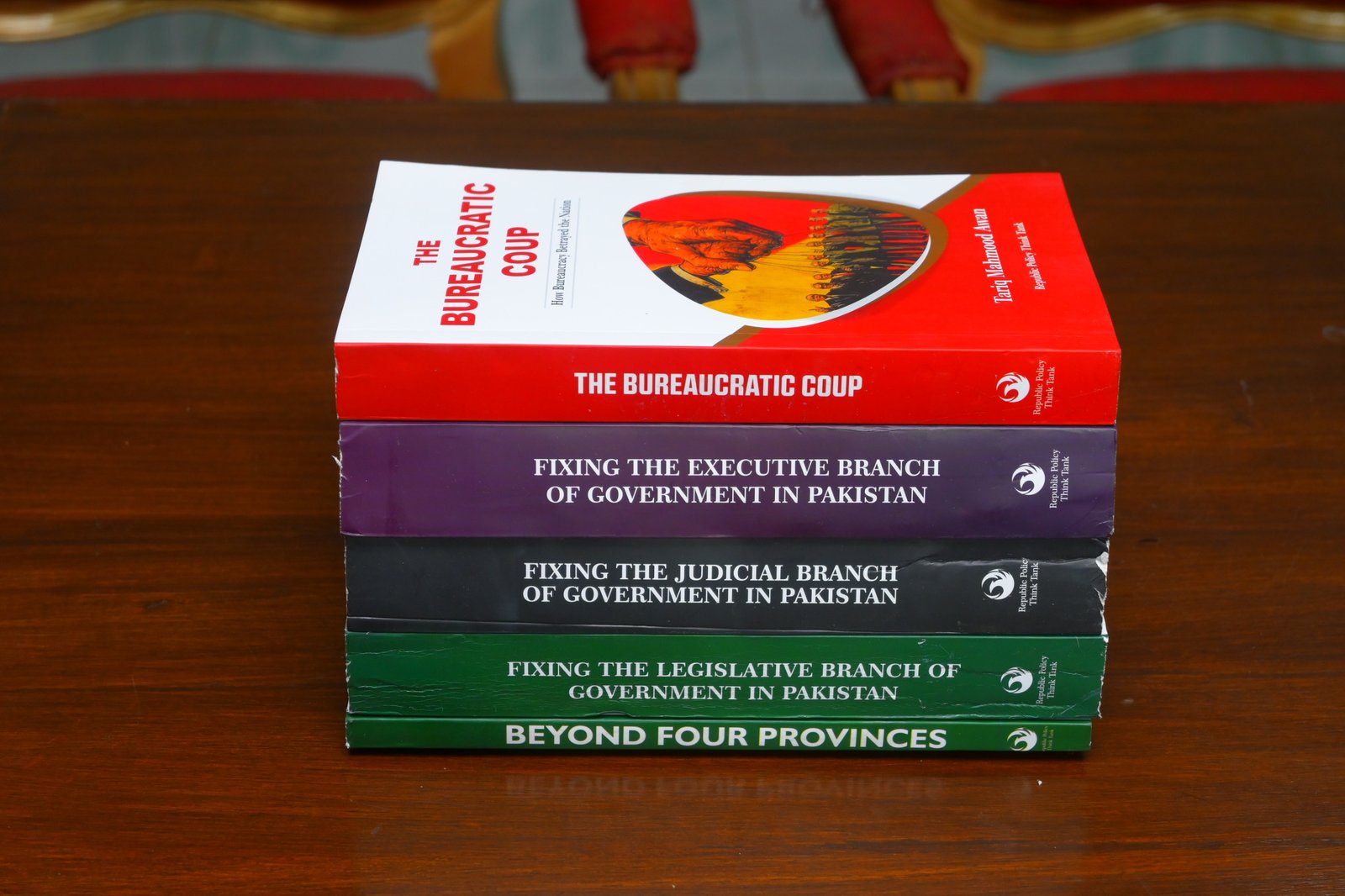
The best-selling books of Republic Policy Think Tank, including the landmark book The Bureaucratic Coup, are available at Vanguard Books, Liberty Books, Readings, Kitab Sarai, Sang-e-Meel, Saeed Book Bank Islamabad, National Book Foundation, and others across Pakistan. Contact for home delivery: 0300 9552542.