
By Saba Rafique – writer is a biotechnologist
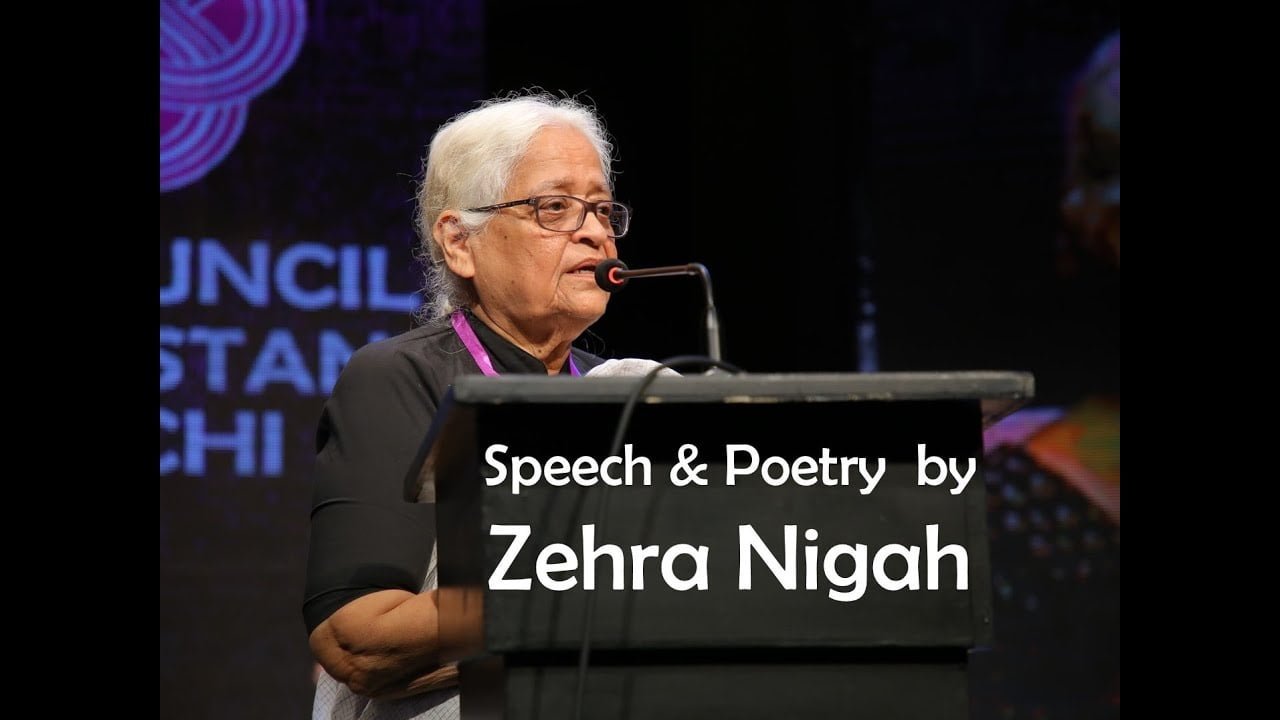
Zahra nighah is much loved and highly respected poet in Pakistan. She is also a scriptwriter of several popular television serials and films, including the award-winning Hindi film “pinjaar”Nigah appeared on the literary horizon as a child prodigy in the 1950s and has consistently been hailed as the one voice worth listening to in the Babel of the mushaira circuit. When she began to make a mark as a poet in the 1950s and 60s, women poets were a rarity. Women from respectable families were not encouraged to come on stage to recite their poetry let alone express themselves with any degree of sensuousness. So, she hid her femininity behind demureness, read her poems with eyes downcast and scuttled back to the safe haven of domesticity. But the sheer lyricism of her words, the engaging simplicity of her poetic idiom and the sharp insightful comments couched therein built a formidable reputation and amassed a legion of admirers. To this day, a hush invariably descends at noisome mushairas when she stands up to recite her poetry.
ZEHRA NIGAH talks as she writes: with grace and poise and wry humour. She is a woman completely at peace with herself. But as she says in the much-recited, much-quoted nazm “Samjhauta”, the easy calm hides the compromises she has had to make:
Mulayam garm samjhaute ki chadar
Yeh chadar mein ne barson mein buni hai
Kahin bhi sach ke gul boote nahi hai
Kissi bhi jhooth ka taanka nahin hai
Issi se main bhi tan dhak loongi apna
Issi se tum bhi aasooda rahoge
Na khush hoge, na pashmarda hoge
(Warm and soft, this blanket
Of compromise has taken me years to weave
Not a single flower of truth embellishes it
Not a single false stitch betrays it
It will do to cover my body though
And it will bring comfort too,
If not joy, nor sadness to you)
Is she a writer of feminine poetry or a feminist poet? She views the things around her through the eyes of a woman, yes, but her concerns are not those of a woman alone. She speaks in a woman’s tongue, using feminine imagery and idiom to make powerful social and political comments. She has alluded to the bitter fratricidal war that culminated in the creation of Bangladesh as well as the heart-rending situation in Afghanistan. She has written of the repressive Hudood Ordinances introduced during General Zia’s oppressive regime as also about love, friendship and small everyday joys and sorrows.
How the structure of her imagery-laden poems evolves and she says anything around her can “trigger the creative process”.?
For instance, “Bhejo Nabi ji Rehmatein” is a brutal poem about rape, yet it employs everyday images of tranquil domesticity — a woman teaching her pet parrot, the chapatti on the tawa, the infant rocking in its cradle. A shrill newspaper headline about the rape of countless women by marauding West Pakistani forces resulted in this chilling poem, its seeming gentleness more powerful than any diatribe on the atrocities committed on women in the guise of politics. Similarly, a TV report on the use of landmines in Afghanistan resulted in the ballad of Gul Badshah, a child soldier in a war that the adults around him have long ceased to comprehension
Despite early critical and popular acclaim, she has only two slim published volumes of poetry: Shaam ka Pehla Taara (The First Star of the Evening) and Waraq (Page). She says she has never felt the urge to be prolific, to write when there is nothing to say. Yet every word that emerges from her pen, every syllable that she speaks, carries the spark of a luminous intelligence.
Subscribe our website for latest updates:
https://republicpolicy.com/shop/
Read More