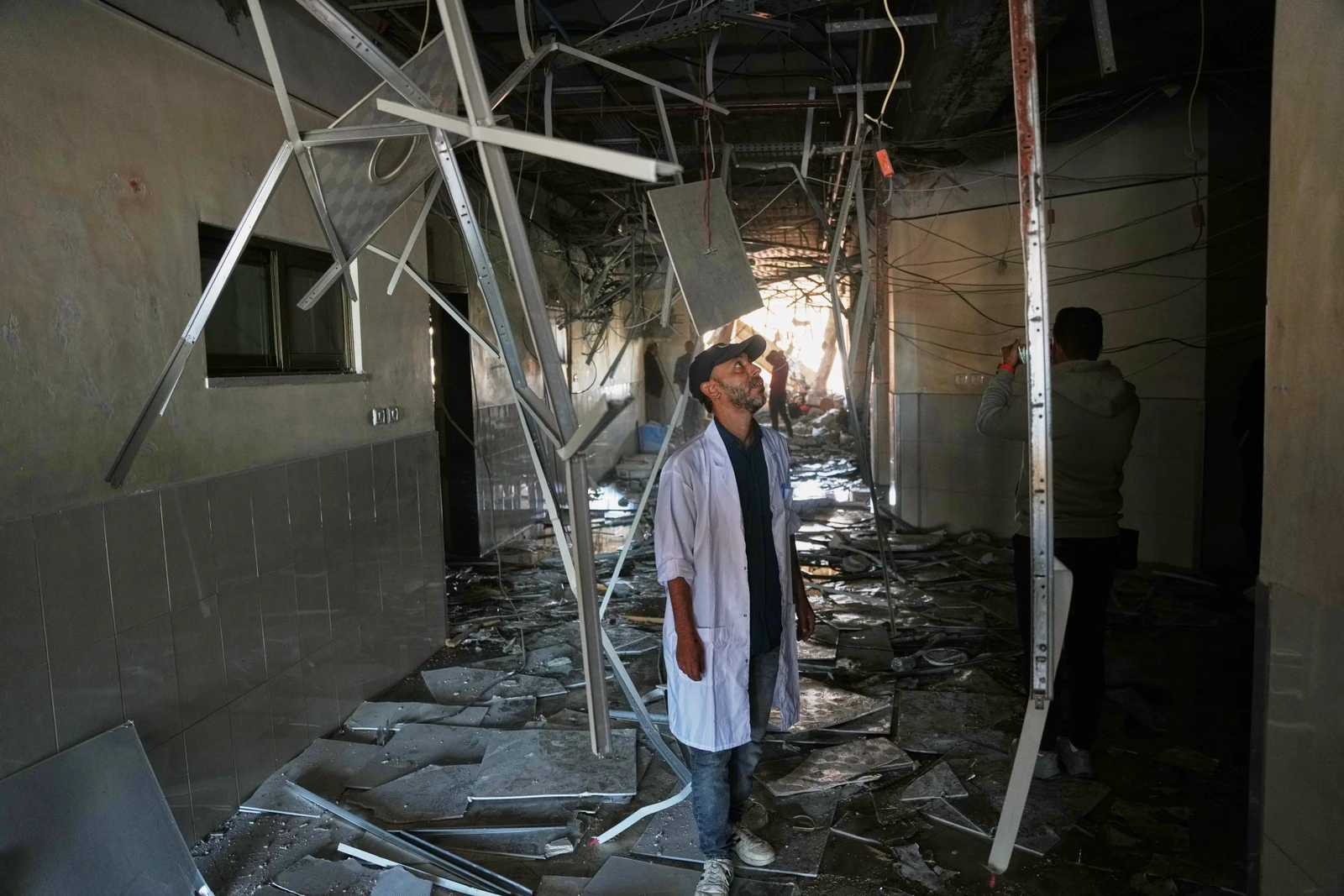

The killing of six people, including a surgeon and a 13-year-old boy, at Nasser Hospital highlights the continuing vulnerability of medical facilities despite the ceasefire. With hospitals damaged, essential medicines depleted and medical personnel killed or detained, Gaza faces a recovery crisis that extends far beyond the destruction of buildings.
BEIRUT: An Israeli airstrike on the surgical wing of Nasser Hospital, the largest medical facility in southern Gaza, has once again exposed the devastating consequences of the war on the Palestinian territory’s healthcare system. The attack killed six people, including a surgeon and a 13-year-old boy, and severely damaged operating rooms, patient wards and areas used by medical staff.
The Israeli military said it had targeted a Hamas commander whom it accused of using the hospital as a base for military operations. However, it did not provide public evidence to substantiate the allegation or explain why the surgical unit was struck. The commander was not listed among those killed in the attack.
The incident is significant not only because of the casualties but also because it illustrates the fragile conditions under which Gaza’s remaining medical institutions continue to operate. Although a ceasefire agreement between Israel and Hamas took effect in October 2025, Israeli strikes have continued, with Israel maintaining that its operations target militant activity.
Direct attacks on hospitals have become less frequent during the truce, but the latest strike demonstrates that the ceasefire has not brought an end to the risks confronting medical facilities, patients and healthcare workers.
More importantly, it highlights a wider humanitarian emergency: Gaza’s healthcare system is attempting to recover from years of destruction while continuing to serve a population facing displacement, untreated injuries, shortages of medicines and widespread disease.
A healthcare system repeatedly targeted and dismantled
Throughout the war, Israeli forces besieged and raided several hospitals across Gaza. Medical facilities were surrounded for extended periods, while patients and healthcare workers remained trapped inside amid shortages of food, water, electricity, fuel and medical supplies.
In several instances, military operations ended with troops entering hospital premises, damaging medical equipment and infrastructure or forcing patients and staff to evacuate. Hundreds of healthcare workers were detained during the conflict.
The destruction of Shifa Hospital in Gaza City, the territory’s largest medical facility before the war, became one of the most visible examples of the devastation inflicted on Gaza’s medical infrastructure. Two major Israeli military raids left substantial parts of the hospital in ruins.
Hospitals and other medical facilities were also repeatedly struck by airstrikes and gunfire. Israel maintained that many of these operations were directed against Hamas militants and military installations allegedly operating within or around civilian infrastructure. Palestinian and hospital officials disputed these claims.
The cumulative impact was severe. During some of the most destructive periods of the war, only 14 of Gaza’s 36 pre-war hospitals remained functional. Even those that continued operating faced shortages so acute that patients struggled to obtain essential medicines and pain relief, while infections spread in facilities lacking adequate equipment and supplies.
According to the World Health Organization, more than 1,050 attacks on healthcare facilities in Gaza have been documented, resulting in over 1,000 deaths. The United Nations has reported that more than 1,700 medical personnel were killed during the war, including individuals who died in attacks away from medical facilities.
Rights organisations have also documented the deaths of at least six Gaza medical workers in Israeli detention, including three prominent doctors, amid allegations of abuses in custody.
These figures indicate that the damage extends beyond hospital buildings. The loss of doctors, nurses, surgeons, laboratory technicians and other medical personnel has weakened the institutional capacity required to provide healthcare, even where facilities remain standing.
Nasser Hospital and the continuing vulnerability of medical facilities
The latest attack is particularly concerning because Nasser Hospital has already experienced repeated Israeli military operations.
In 2025, an Israeli strike killed 22 people after targeting a vantage point on the hospital roof used by journalists. Subsequent strikes hit rescue workers and journalists who had rushed to assist the wounded. Five journalists were among those killed, including Mariam Dagga, who was working with The Associated Press.
The latest attack on the hospital’s surgical wing has again raised questions about the protection of medical facilities and the practical application of international humanitarian law during military operations.
The Israeli military said it had targeted Muhammad Abu Ismail, whom it identified as the head of Hamas’s Khan Younis Brigade. It alleged that he had been using the hospital as a headquarters to plan attacks.
However, the military did not publicly explain the operational circumstances that led it to strike the surgical unit, nor did it establish whether the alleged commander was killed.
The distinction matters. An allegation that an armed group is operating near or within a hospital does not, by itself, establish that every part of the facility has become a legitimate military target. The circumstances, evidence, precautions taken and expected civilian harm must all be assessed under the applicable rules of armed conflict.
The dispute over Hamas’s alleged use of hospitals
Israel has repeatedly justified military operations against Gaza’s hospitals by accusing Hamas of using medical facilities as command centres, operational bases and locations for military activity.
The Israeli military has argued that such practices compromise the protected status of hospitals and allow armed groups to operate from locations where civilian casualties are likely to result from military action.
Palestinian officials and hospital administrators have rejected these allegations, maintaining that medical institutions are civilian facilities serving patients and the wider population.
There have, however, been reports of armed individuals inside some hospitals. Hamas security personnel have at times been observed controlling access to particular areas.
Doctors Without Borders, the international medical organisation also known as Médecins Sans Frontières, suspended most of its operations at Nasser Hospital in January after reporting the presence of masked armed men and incidents in which patients were arrested or intimidated.
The organisation later resumed operations following what it described as concrete improvements resulting from discussions with Gaza authorities, including restrictions on the entry of armed individuals.
These developments demonstrate that the protection of medical facilities requires all parties to respect their civilian and humanitarian character. Armed groups must not use hospitals to shield military operations, intimidate patients or compromise medical neutrality. At the same time, allegations of military activity cannot serve as an unrestricted justification for attacks that place patients, medical staff and other civilians at risk.
The responsibility to distinguish between military objectives and protected civilian infrastructure remains central to the conduct of hostilities.
International humanitarian law and the protection of hospitals
International humanitarian law provides special protection to hospitals, medical units, healthcare workers and the wounded. These protections are rooted in the Geneva Conventions of 1949 and their subsequent legal developments.
Medical facilities do not automatically lose their protected status simply because military personnel are present or because an armed group is alleged to have used parts of a hospital for military purposes.
Under international humanitarian law, a hospital may lose its special protection if it is used, outside its humanitarian function, to commit acts harmful to the enemy. Even then, the loss of protection is subject to specific legal conditions.
The rules require an effective warning, where appropriate, giving a reasonable period for the harmful activity to cease. Any subsequent attack must also comply with the principles of distinction, proportionality and precaution.
The principle of distinction requires parties to distinguish between civilians and combatants, as well as civilian objects and military objectives. Proportionality prohibits attacks expected to cause incidental civilian harm that would be excessive in relation to the anticipated concrete and direct military advantage. The obligation to take precautions requires parties to do everything feasible to minimise civilian casualties and damage to civilian infrastructure.
Consequently, the legal assessment of the Nasser Hospital strike cannot be settled solely by the Israeli military’s assertion that it was targeting a Hamas commander. It requires an examination of the alleged military activity, the target selected, the warnings issued, the expected civilian harm and the precautions taken.
The Israeli military said it had held warning conversations with Gaza health officials before the attack, informing them of alleged militant activity in hospitals and warning that it would act if the activity continued.
Whether those communications satisfied the legal requirements for an effective warning, and whether the attack itself complied with the rules governing proportionality and precautions, require an independent assessment of the available evidence.
Medical and human rights organisations have also criticised Israel’s restrictions on medical aid and equipment entering Gaza. Israel maintains that it permits humanitarian assistance but restricts certain dual-use materials that it believes could serve military purposes.
The practical consequences of these restrictions, however, remain serious for a healthcare system dependent on imported medicines, equipment, spare parts and fuel.
Gaza’s hospitals are functioning, but recovery remains distant
The ceasefire has created some space for humanitarian organisations and Gaza’s Health Ministry to restore medical services. However, the improvement remains limited.
Twenty of Gaza’s 36 pre-war hospitals are currently functioning, but none is fully operational. Many continue to face shortages of essential medicines, specialised equipment, laboratory supplies, electricity and fuel.
The World Health Organization reported on September 30 that 47 per cent of essential medicines were out of stock. Shortages of laboratory materials, medical equipment, replacement parts and fuel have further restricted the ability of healthcare providers to deliver essential services.
The problem is not simply the number of hospitals that remain open. A functioning hospital requires trained personnel, reliable electricity, water, medicines, diagnostic facilities, surgical equipment and access to specialised treatment. Without these elements, a hospital may remain operational in name while being unable to provide adequate medical care.
The humanitarian situation is further complicated by the scale of displacement. Almost the entire population has experienced the loss of homes or repeated displacement, while more than 1.6 million people are living in tents or other inadequate shelters.
Overcrowded living conditions, inadequate sanitation and limited access to clean water have contributed to the spread of communicable diseases and infections. Thousands of people are also living with serious, life-changing injuries sustained during the war, many of whom require prolonged treatment, rehabilitation and specialist medical attention.
For these patients, the destruction of medical infrastructure represents a continuing threat long after the immediate violence has subsided.
Reconstruction requires more than repairing buildings
The recovery of Gaza’s healthcare system will require a comprehensive programme extending beyond the reconstruction of damaged hospitals.
The first priority must be to ensure sustained and predictable access to essential medicines, medical equipment, fuel and humanitarian supplies. Restrictions and administrative delays that prevent hospitals from obtaining critical materials can undermine even the most ambitious reconstruction plans.
The second priority is the restoration of medical personnel and institutional capacity. The deaths, detention and displacement of healthcare workers have created a serious shortage of experienced professionals. Rebuilding hospitals without restoring the workforce needed to operate them would leave the healthcare system structurally weakened.
The third priority is the rehabilitation of essential infrastructure, including electricity, water, sanitation, laboratories, emergency departments and specialised treatment facilities. These systems are interconnected. A hospital cannot provide reliable care if its electricity supply is unstable, its water systems are damaged or its diagnostic equipment cannot function.
International humanitarian organisations, donor governments and medical agencies will have a central role in supporting this process. However, their efforts require secure access, predictable humanitarian arrangements and respect for the neutrality of medical institutions.
Above all, hospitals must be protected from military operations. Their purpose is to treat the wounded and save lives, irrespective of nationality, political affiliation or military status.
A ceasefire cannot substitute for humanitarian protection
The attack on Nasser Hospital raises a fundamental question about the meaning of a ceasefire when medical facilities remain exposed to military strikes and a large part of the population continues to live without adequate healthcare.
A reduction in the frequency of attacks is important, but it does not amount to the restoration of civilian security. Nor does it reverse the destruction of institutions that took decades to develop.
Gaza’s healthcare crisis is now both an immediate humanitarian emergency and a long-term institutional challenge. The territory needs functioning hospitals, trained medical professionals, reliable supplies and an environment in which healthcare workers can perform their duties without fear of attack or detention.
The international community must therefore focus not only on the number of aid deliveries or the reconstruction of physical infrastructure, but also on ensuring compliance with international humanitarian law and establishing effective safeguards for civilian institutions.
The destruction of a hospital is not merely the loss of a building. It is the loss of surgical capacity, emergency treatment, maternity services, medical expertise and the institutional networks on which an entire population depends.
Nasser Hospital’s damaged surgical wing is another reminder that the consequences of war extend far beyond the battlefield. Even when the guns fall silent, a healthcare system deprived of its personnel, infrastructure and supplies cannot recover overnight.
For Gaza, the path to recovery will depend on whether medical institutions can finally be protected, humanitarian assistance can enter without arbitrary obstruction and reconstruction can proceed on a scale commensurate with the devastation.
A ceasefire may reduce the violence. Only sustained protection, humanitarian access and institutional reconstruction can begin to restore the right to healthcare.