
This essay forms part of The New World Disorder, a series examining the erosion of the postwar international order and the difficult choices confronting smaller countries as American leadership recedes.
On a grey morning last autumn, I visited Andrei Morari and Ecaterina Samonii at their home in Chisinau, Moldova’s quiet and understated capital. Black tea sat on the kitchen table while their two cats moved around beneath it. The apartment contained small reminders of the past, including a Lenin figurine that Andrei had brought home from Moscow, where he had once studied history.
Only two days earlier, Moldovans had voted in a parliamentary election that President Maia Sandu described as the most consequential in the country’s history. The campaign had presented voters with what appeared to be a defining geopolitical choice: Europe or Russia.
Sandu’s pro-European Party of Action and Solidarity and its pro-Russian opponents portrayed the election in dramatically different terms, yet both sides warned that choosing the other could pull Moldova closer to the war raging across the border in Ukraine.
The pro-European party ultimately defeated the Patriotic Electoral Bloc. But inside Andrei and Ecaterina’s apartment, there was little sense of political triumph.
Neither had voted for the two competing camps.
Their concerns were more immediate than the geopolitical struggle between Brussels and Moscow. They wanted better healthcare, affordable housing and heating, and greater opportunities for young Moldovans. For them, the question of whether Moldova should move closer to Europe or Russia seemed less urgent than whether life inside Moldova itself could improve.
That tension extends far beyond the capital.
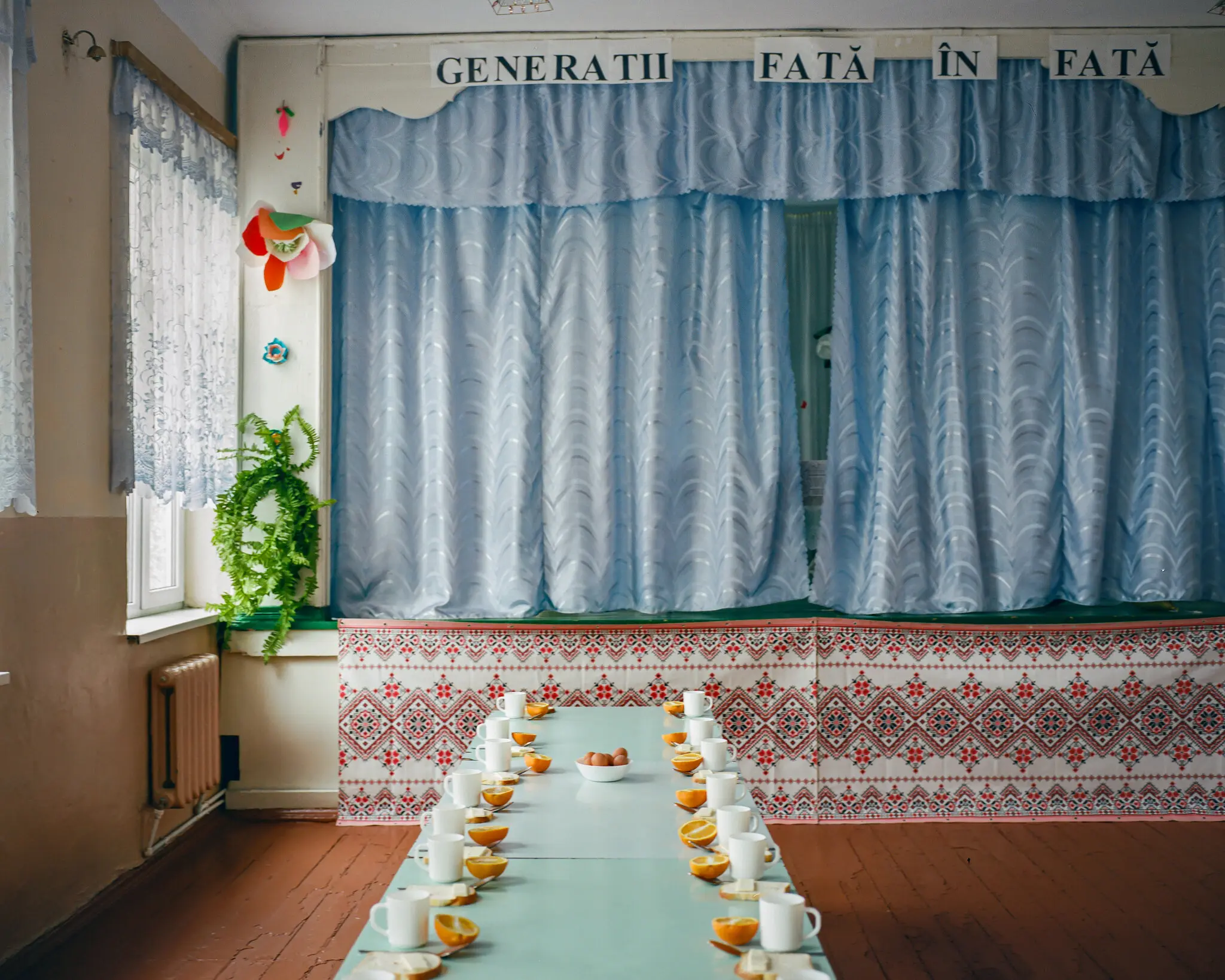
At a school in Horesti, a village near the Romanian border, breakfast tables are still prepared for pupils even as the community steadily loses population. The school now has fewer students than the legally required threshold. Residents fear that its closure would mean more than losing a local institution. In their view, if the school disappears, the village itself may eventually disappear with it.
Back in Chisinau, after Andrei left for work, Ecaterina and I continued drinking tea and talking about another feature of Moldova’s divided identity: language.
Romanian and Russian are both widely spoken, but those who know only one can experience a sense of social and cultural isolation. Language is therefore more than a means of communication. It can also reflect the historical and geopolitical divisions running through Moldovan society.
Yet Ecaterina’s frustration pointed to something deeper. For years, Moldovans have been asked to imagine their country’s future largely through a choice between two external poles—Europe and Russia. But not everyone sees their identity, aspirations or everyday problems reflected in either camp.
This is the predicament confronting many smaller states as the international order becomes increasingly fragmented. Great powers may view the world through strategic blocs, spheres of influence and competing alliances. Ordinary citizens often experience geopolitics differently. They worry about schools, hospitals, jobs, energy bills, housing and whether their children will have a reason to remain in the country.
Moldova therefore represents a larger dilemma facing countries caught between competing centres of power. When great powers move apart, smaller states are increasingly pressured to choose sides. But for many of their citizens, the most important question is not simply whether their country belongs to East or West.
It is whether either direction can produce a state that actually works for them.