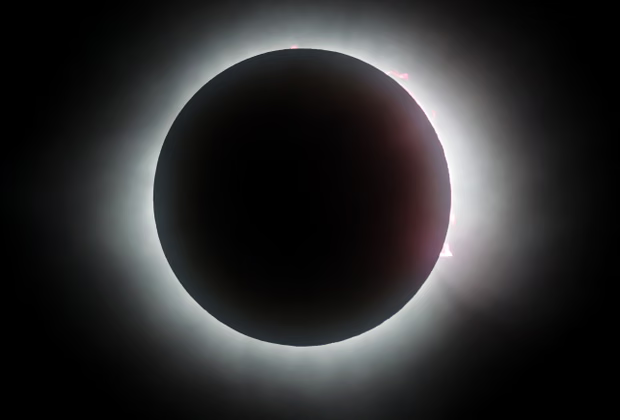

Hotels in Dunedin, New Zealand, are already fully booked two years ahead of the region’s first total solar eclipse in more than 850 years.
At 4.17pm on 22 July 2028, the moon will pass in front of the sun, casting a roughly 100km-wide band of darkness across southern New Zealand. Everywhere within that path, from the tourist hub of Queenstown in the west to Dunedin city in the east, will experience 2 minutes and 51 seconds of daytime darkness.
Despite the event still being two years away, hotels are already fielding bookings, including the Dunedin Leisure Lodge, which by Thursday had fully sold out its “solar eclipse package,” complete with complimentary eclipse glasses.
Dr. Ian Griffin, an astronomer and director of Tūhura Otago Museum, said the last eclipse visible from Dunedin occurred in 1163, before humans had even reached New Zealand. “So we will be the first people in Dunedin ever to see a solar eclipse from this part of the world, which is quite exciting,” he said. It will also mark the first total solar eclipse visible anywhere in New Zealand since 1965. “That three minutes of darkness, if it’s clear, will be absolutely memorable for anybody who sees it,” Griffin added.
On Wednesday, Dunedin’s museum officially began the two-year countdown to the event, which is expected to become a major tourism draw for the city. Around 35,000 visitors are projected to arrive in Dunedin, which has a population of just 130,000.
Griffin has been preparing for the eclipse since 2013 and said the anticipation runs deep personally. “I did buy my house all those years ago based on the fact that you could see the eclipse from it,” he said.
The eclipse falls in the middle of New Zealand’s winter, shortly after the country marks Matariki, the Māori new year, named for a star cluster known elsewhere as the Pleiades. The constellation is visible from New Zealand for eleven months of the year but disappears from the sky for roughly a month in winter, reappearing around the winter solstice. Dunedin is planning a night-sky festival spanning from Matariki through to the eclipse itself. “It’s actually unique anywhere around the world,” Griffin said. “We’ve got the cultural holiday celebrating the night sky, and then it will be following it about 10 days later with a fantastic eclipse.”
Dunedin mayor Sophie Barker said the anticipation is being felt across the city. “This remarkable event is now firmly on the horizon,” she said.