
Editorial
There is a particular kind of crisis that doesn’t announce itself with a blackout or a headline-grabbing failure. It arrives instead as a slow erosion, visible only in the numbers, until one day the system built to serve a nation finds itself serving fewer and fewer people who actually need it. That is the story unfolding inside Pakistan’s national grid.
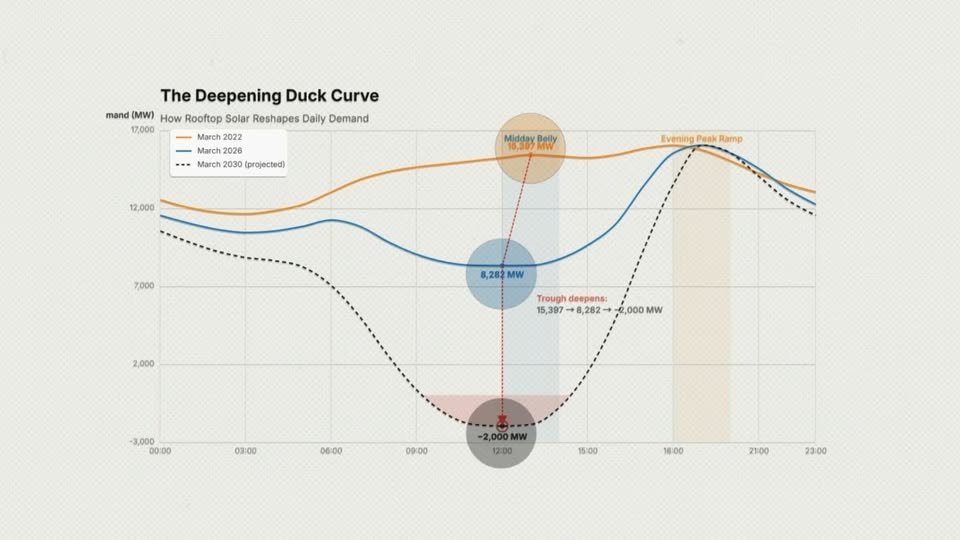
In March 2022, summer peak demand on the grid stood at 15,297 megawatts. By March 2025, that figure had fallen to just 8,282 megawatts, a drop of roughly 7,000 megawatts in only three years. On its face, this looks like a story of shrinking demand, of a nation using less power. It is nothing of the sort.
Total electricity consumption has actually grown. In FY22, the country consumed 123 terawatt-hours through the grid and another 8 terawatt-hours through solar. By FY25, grid consumption had barely moved to 124 terawatt-hours, while solar consumption had exploded to 38 terawatt-hours. Pakistanis are not using less electricity. They are simply generating more of it themselves, on their own rooftops, outside the reach of the very infrastructure built to power the country.
This shift carries a second, more troubling signature. Grid demand now collapses during daylight hours, when solar panels are producing freely, only to surge again after dark, when the sun disappears and households fall back on the grid out of necessity rather than choice. For power plants designed to run at steady, predictable loads, this daily whiplash, off in the day, on at night, is a mechanical nightmare. Cycling plants up and down like this accelerates wear, increases costs, and strains a system never engineered for such volatility. Analysts now project that daytime summer grid demand could fall as low as 2,000 megawatts, a fraction of what the system was built to carry.
The uncomfortable question this raises is not simply technical but existential. A national grid depends on shared cost, on enough paying customers spreading the burden of generation, transmission, and maintenance across the system. When that customer base thins out, particularly the wealthier, higher-consumption households most able to afford solar installation, the remaining customers are left holding a larger share of a shrinking pie. Prices rise for those who cannot afford to leave the grid, which in turn pushes more of them toward solar if they can manage it, accelerating the very exodus that created the problem in the first place.
This is not a distant hypothetical. It is already underway, and the trajectory suggests something urgent: Pakistan is not simply facing a question of energy policy but of institutional survival. A grid that nobody needs by day and everybody needs by night is a grid slowly being hollowed out from the inside, one solar panel at a time.