Safia Ramzan
Pakistan spends billions of rupees every year on government schools. The buildings stand. The classrooms exist. The teaching staff is employed. The budgets are allocated and, for the most part, spent. And yet, something deeply troubling is becoming increasingly difficult to ignore: the children who never attend school may, in certain measurable ways, be better off than those trapped inside the system. That is not a provocative exaggeration. It is an indictment of institutional failure so complete that it demands honest examination rather than bureaucratic deflection.
Walk into a government high school in Punjab and the physical infrastructure tells one story. Classrooms of reasonable size, boundary walls, a playground of some kind, a staff room with a register of names. The picture in Balochistan tells a bleaker story altogether, with ghost schools, absent teachers, and communities that have simply stopped expecting anything. But even where the buildings stand intact, look past the walls and a different reality asserts itself. Washrooms are unusable. Clean drinking water is absent or unreliable. The environment offers nothing that nurtures a child’s physical health or mental growth. These schools house children without truly serving them.
The deeper failure, however, is not about toilets or drinking water, as urgent as those are. It is conceptual. Pakistan’s government schools suffer from a fundamental confusion about what a school is supposed to be and what it is supposed to produce. The institution has been reduced, in practice, to a deployment mechanism for government employees. Teachers are posted. Headteachers are appointed. Attendance registers are filled. And the system congratulates itself for functioning when, in truth, it is merely existing.
A headteacher may be an excellent teacher. That is a separate skill from institutional leadership. Running a school demands vision, administrative capacity, the ability to identify weakness and drive improvement, and a sustained commitment to outcomes rather than processes. Our system promotes teachers into headships without asking whether they possess any of these qualities. The result is schools led by individuals who are neither trained nor incentivised to manage institutions. They manage paperwork instead.
The curriculum is where the failure becomes most damaging. Children in government high schools are burdened with an extraordinary number of subjects, yet the weight of this burden produces remarkably little of practical value. Nobody in authority pauses to ask the essential question: what is this education actually for? Does it develop critical thinking? Does it cultivate the ability to solve problems, communicate effectively, manage money, or acquire a practical skill? Does it prepare a fifteen-year-old for the century they are living in, a century already defined by artificial intelligence, rapid technological change, and entirely new categories of work?
The honest answer is no. The curriculum remains oriented toward memorisation and examination performance, both of which are forms of information transfer rather than genuine education. A child who completes matriculation in a government school should, at minimum, be capable of making basic life decisions, entering the workforce through some practical skill, and participating in society as a confident and competent citizen. What our system actually produces, in too many cases, is a young person with a certificate and without capability. No critical faculty has been sharpened. No skill has been developed. No practical knowledge has been imparted. The certificate merely qualifies them to pursue more certificates, and the cycle of credentialism without competence continues.
This mismatch between education and life is not merely a pedagogical problem. It is an economic catastrophe in slow motion. Pakistan’s labour market does not need more graduates who cannot perform. It needs young people who can think, create, build, and adapt. The government school system, as currently constituted, is producing the opposite.
There is another dimension of waste that receives almost no attention. Government schools typically close after midday. Their buildings, their grounds, their classrooms sit empty for the better part of each day and for every weekend. These institutions occupy thousands of acres of valuable land in cities and towns across the country. That land and those facilities could serve as community centres, skill development hubs, public libraries, sports grounds, literary and cultural spaces, and adult literacy programmes. The afternoon school could be a place where a carpenter learns to read a technical drawing, where a woman acquires a vocational qualification, where a neighbourhood chess club or debating society meets. Instead, the gates close and the opportunity dies with the day.
The question of what to do is not, in truth, especially complicated. The answers are well known to anyone who has studied education systems that actually work. What is missing is the institutional will to apply them. Three reforms stand above all others in importance.
First, the school must be reconceived as an autonomous unit of success or failure. Each school must be held accountable for outcomes, not merely for inputs. Enrolment numbers and teacher attendance are inputs. Learning outcomes, skill acquisition, student wellbeing, and community engagement are outputs. The measurement must shift.
Second, school leadership must be professionalised. A Teaching Administrative Service, drawing candidates trained specifically in educational administration and institutional management, should replace the current practice of appointing senior teachers as headteachers by default. An education administrator is a distinct professional from a classroom teacher, just as a hospital administrator is distinct from a doctor. Pakistan has long recognised this distinction in health. It must apply the same logic to education.
Third, the curriculum must be rebuilt around the demands of the twenty-first century. Critical thinking, financial literacy, communication, digital competence, creative problem-solving, and vocational skills must become central rather than peripheral. Subjects must earn their place in the timetable by demonstrating their relevance to real life. The examination system must reward understanding over memorisation.
None of this is impossible. None of it requires resources that Pakistan does not have. It requires something rarer in Pakistani governance: the willingness to admit that the current system is not reformable through tinkering, that it requires transformation, and that the transformation must begin at the level of the individual school unit.
Until that reckoning arrives, government schools will continue to be what they largely are today: expensive buildings where children spend their most formative years learning very little that will serve them, managed by a system more interested in its own continuation than in the futures of the young.
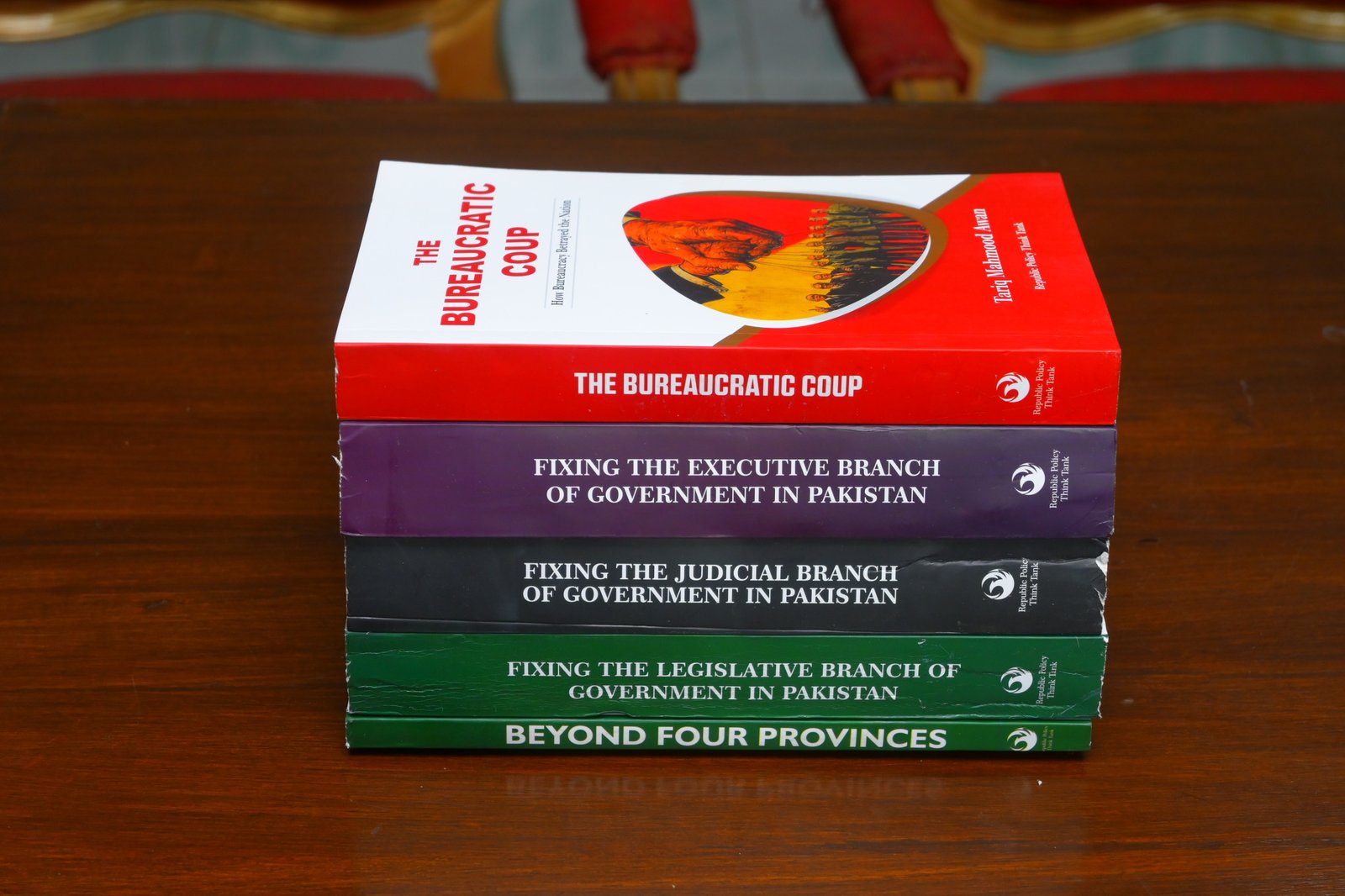
The best-selling books of Republic Policy Think Tank, including the landmark book The Bureaucratic Coup, are available at Vanguard Books, Liberty Books, Readings, Kitab Sarai, Sang-e-Meel, Saeed Book Bank Islamabad, National Book Foundation, and others across Pakistan. Contact for home delivery: 0300 9552542.