
Mubashar Nadeem
When the State Becomes the Ailment
There is a test that every state must eventually face. Not the test of elections or economic growth or diplomatic standing. The test of how it treats those it has locked away. Pakistan is facing that test now, and the results are not flattering.
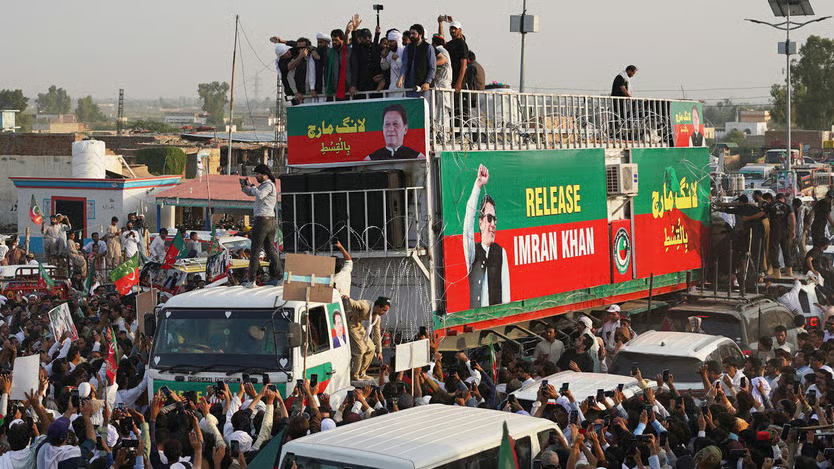
The Pakistan Tehreek-e-Insaf has raised fresh alarm over the health of its jailed leaders. Former Prime Minister Imran Khan and his wife Bushra Bibi are reportedly suffering from serious eye conditions. Senator Ejaz Chaudhry’s kidney disease has reached stage three. Yasmin Rashid, a cancer survivor, remains incarcerated and entirely dependent on the state for whatever medical attention she receives. The party says prolonged detention and restricted access to medical care have driven these conditions from manageable to serious. It is demanding transfers to proper medical facilities and access to personal physicians.
These are not radical demands. They are not political manoeuvres dressed up as humanitarian concern. Access to adequate medical care, the right to be treated with dignity, the basic entitlement not to have one’s health destroyed by the conditions of one’s confinement: these belong to every prisoner, regardless of what they are accused of, regardless of which party they represent, regardless of how the political winds are blowing. The state that cannot grasp this does not merely fail its prisoners. It fails itself.
The government will say, as governments invariably do, that proper procedures are being followed, that the law is being respected, that due process is running its course. Perhaps some of that is true. But the optics are damaging, and optics in a politically charged environment carry weight that no press release can undo. When PTI’s narrative of political persecution finds new oxygen in images of ailing leaders denied proper treatment, the state is not winning the argument. It is handing the argument to its opponents, gift-wrapped.
This matters beyond the immediate political contest. What is at stake is not whether one believes the PTI’s account of persecution or the government’s insistence on legal due process. Both of those positions can be held and debated in the open. What cannot be debated, what admits no ambiguity, is the basic principle that a person stripped of their civil liberties has not thereby been stripped of their humanity. The deprivation of liberty is the punishment. It is not a licence for the state to impose further suffering through medical neglect, restricted family contact, or the slow erosion of physical health in conditions of isolation.
There is no jurisprudence in the world, no constitutional tradition, no framework of civilised governance that treats the deterioration of a prisoner’s health as an acceptable instrument of state power. Prolonged solitary confinement, blocked access to personal physicians, delayed transfers for those with serious medical conditions: these are not tough measures. They are abuses. And when they are visited upon high-profile political prisoners, they do not project strength. They project a state that has confused cruelty with control.
Article 14 of the Constitution of Pakistan is unambiguous on the inviolability of human dignity. It does not apply selectively. It does not contain a clause exempting political opponents of the sitting government. Every Pakistani citizen, behind bars or not, carries that right. The courts, the prison authorities, and the government must be reminded of this, not as a political favour to PTI, but as an obligation to the constitutional order they claim to uphold.
The argument for decency here is not only moral. It is practical. A state that is seen to be weaponising the health of its prisoners pays a reputational cost that outlasts any political cycle. It sends a message to every citizen: that the protections the Constitution promises are negotiable, that your rights in custody depend not on the law but on who holds power. That message corrodes public trust in every institution simultaneously. It makes the judiciary look complicit. It makes the prison system look predatory. It makes the government look vindictive. None of that serves the national interest. None of that strengthens the case for stability.
Pakistan is at a sensitive moment. The last thing any serious stakeholder in this country’s future should want is to hand critics, domestic or international, evidence that its political prisoners are being denied basic medical care. If something grave were to happen to any of these individuals while in state custody, the consequences for the government’s standing would be severe and deserved.
The solution is not complicated. Transfer those who are seriously ill to appropriate facilities. Permit access to personal physicians. Treat these prisoners as the Constitution demands they be treated.
The state does not diminish itself by showing decency to its opponents. It diminishes itself by refusing to. And right now, it is refusing, and the country is watching.
Republic Policy’s landmark book, The Bureaucratic Coup, is available for home delivery. This is the only book that provides a true account of how bureaucracy works in Pakistan.
It is a must-read for every reader.
For home delivery, please contact Mr. Ammar Alvi at 03362567031.