
Tariq Mahmood Awan
“If you take that steel frame out of the fabric, it would collapse. There is one institution we will not cripple, and there is one institution we will not deprive of its functions or its privileges; and that is the institution that built up the British Raj—the British Civil Service of India.” This is the saying of British Prime Minister David Lloyd George, vindicating why the British raised the Indian Civil Service to realize the objectives of colonialism.
Against these objectives, the native Indians struggled for freedom, which culminated in the form of the Indian Independence Act 1947. It abolished the colonial scheme of the ‘reservation of posts’ on the recommendation of the revered Muhammad Ali Jinnah. Section 10 of the act abolished the scheme to enable new states to raise their services accordingly. Regrettably, the colonial scheme of the ‘reservation of posts’ was relaunched in the form of the Civil Service of Pakistan (CSP) in 1954, through a suspicious agreement lacking enforceability of law. Reportedly, the provinces of East Bengal and Sindh did not appreciate the contents of the agreements. They were of the view that they could not support the idea of centralized service when they struggled for provincial autonomy. Yet, the agreement was enforced amid administrative and constitutional crises by the centralists.
What is the scheme of reservation of posts? This scheme allows a specific cadre of a service to reserve posts of other cadres or services in order to absorb all the lucrative posts. This reservation of posts can extend to all federal departments, provincial departments, and local government departments. The objective of the scheme is to control all tiers of the government in order to create a centralized cartel that is unaccountable to organizations, governments, and people. For example, the cadre of the Pakistan Administrative Service (PAS) represents the same scheme to control federal, provincial, and local governments. The scheme enables PAS to be federal and provincial secretaries alongside deputy and assistant commissioners. This colonial scheme generates grave legal, administrative, and constitutional breaches. The British incorporated the scheme in the constitution of 1935 through article 246, but Pakistan never incorporated it in the constitution. How can a service formed by a customary agreement in 1954 remain enforceable in a federal parliamentary constitution?
The colonial scheme to the extent of reserving provincial and local government posts is unconstitutional. This scheme is the primary reason for the failure of local governments in Pakistan. Article 240(b) describes, “In the case of services of a province and posts in connection with the affairs of a province, by or under the Act of the Provincial Assembly.” Subsequently, the Provincial Civil Servants Acts were enacted to regulate the posts and services of a province. Hence, there is no constitutional or legislative provision available to reserve provincial or local government posts for a central service. A mere custom or a few federal unconstitutional Statutory Regulatory Orders (SROs) cannot constitutionally or legally make the federal government reserve provincial or local government posts for a federal or all-Pakistan service. Article 97, read with 137 of the constitution, limits the extension of federal executive authority on the provincial posts. Hence, the reservation of provincial posts for federal PAS is invalid and unconstitutional.
The scheme halts the proficiency of the organizations as a general cadre of lucrative posts is established on them. The purpose of a general cadre is to control organizations and develop a fast mode of vertical mobility. PAS has developed a general cadre so that each PAS officer reaches the zenith of grade 22, despite compromising organizational autonomy, federalism, and the constitution. The general cadre of PAS is the primary reason not to establish the specialized services.
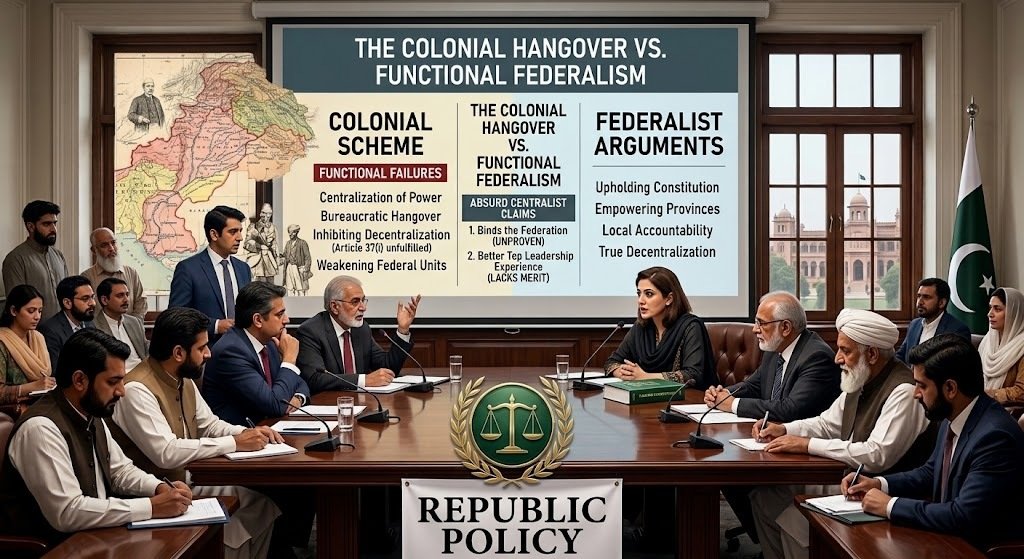
The colonial scheme is failing the functional federation. Apparently, there exists a colonial hangover in the civil service of Pakistan and subsequent nomenclatures. Centralists favor the scheme, as it serves their purpose of concentration of power at the center. Federalists oppose it with it being unconstitutional as well as the promise of decentralization guaranteed in Article 37 (i) of the constitution. In the backdrop of this, centralists throw two absurd arguments. Accordingly, the scheme binds the federation as federal officers serve in all provinces. Then, these appointments in provinces enhance their experience to serve better at the top positions of the federal government. Still, both these arguments lack administrative and federal merits.
The constitution of the nation is the supreme law, and neither administrative nor customary usages can challenge it. The appointment of federal officers in the domain of provinces does not make a federation strong; rather, operations of the Council of Common Interests (CCI) bind the federation together. CCI is the constitutional common platform where a common or All Pakistan Service is raised on common posts to execute the common subjects of the Federal Legislative List. Then, who is holding back the operations of the counsel? Is there any reference available in the libraries of political science arguing to place central officers in the provinces to make a strong federation? The other absurd argument is that having provincial experience will make a better federal officer. How can provincial experience improve the quality of federal officers for working in diametrically opposite positions in the federal government?
The cadre alignment of post, service, and legislative subject is compulsory for the structural construction of the civil service, and PAS is inherently devoid of this structural law. More important is the constitutional alignment of the executive according to schedule IV of the constitution. Hence, bureaucratic and political authorities must be produced by the same legislature. How is it constitutionally possible that the provincial assembly produces a Chief Minister of a province but not the chief secretary?
Nevertheless, the scheme has successfully been secured in the subsequent nomenclatures of erstwhile CSP. Federal bureaucracy always outplays the political executive in the process of civil service reforms. Is it justifiable that the scheme never got scrutinized? Accordingly, it is elemental to abolish the colonial scheme for good governance and constitutional federalism.
The Article was published in The Nations Newspaper