
Tahir Maqsood Chheena
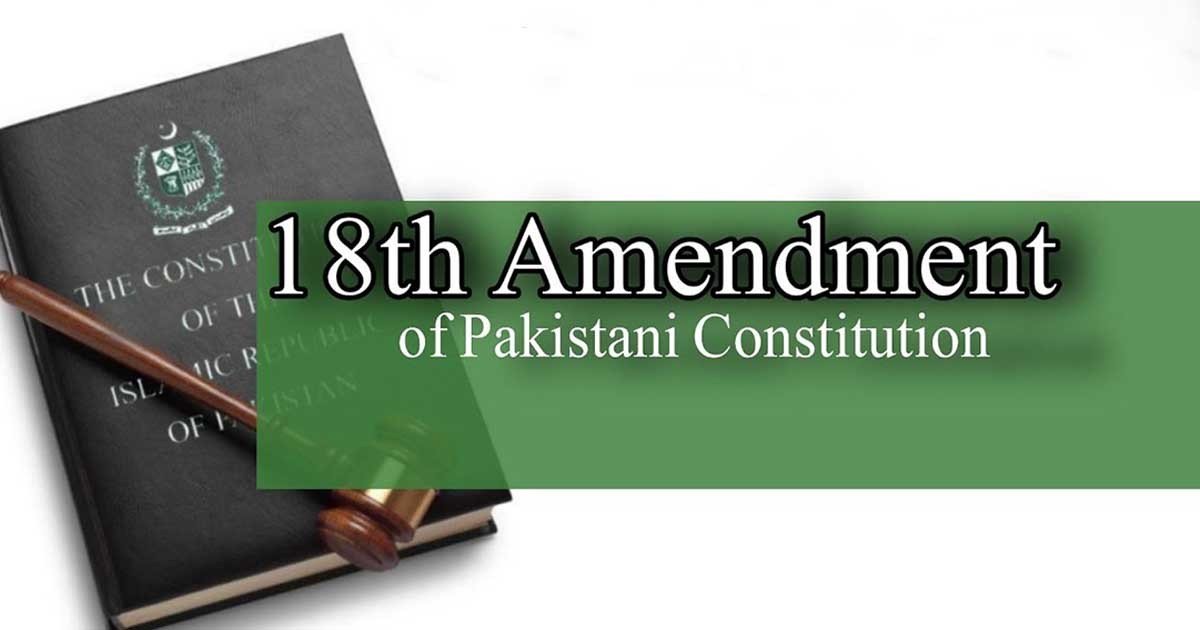
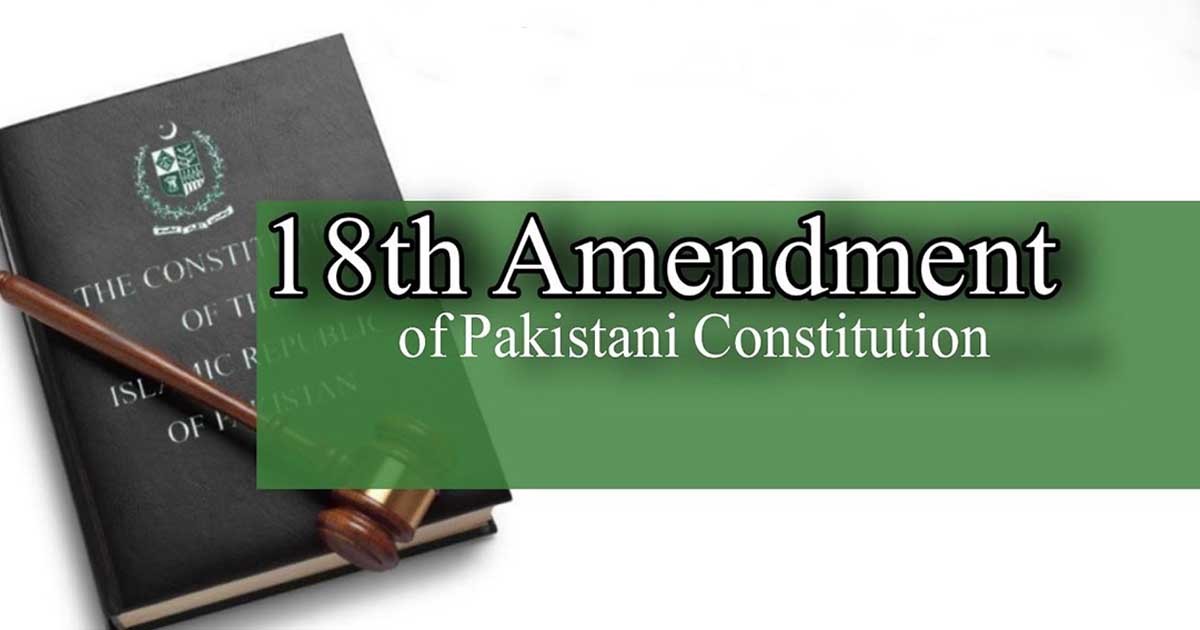
Pakistan is a country of extraordinary internal diversity. It is multi-ethnic, multilingual and regionally distinct in ways that make centralised governance not merely inefficient but constitutionally illegitimate. The Eighteenth Amendment, passed in 2010 by the consensus of all major political parties, was the most significant constitutional correction in Pakistan’s post-independence history. It acknowledged what decades of centralised rule had demonstrated through repeated failure: that national unity in Pakistan cannot be imposed from above. It must be earned through fair distribution of power, genuine provincial trust and democratic partnership between the federation and its constituent units.
The amendment was not a partisan achievement. It was a rare moment of cross-party agreement on a foundational question of governance. The National Finance Commission framework was strengthened. The concurrent legislative list, which had long served as an instrument of federal encroachment into provincial affairs, was abolished. Administrative, financial and legislative authority was transferred to the provinces in a manner consistent with the original federal compact that the 1973 Constitution had promised but never fully delivered. For the first time, the provinces gained the constitutional standing to govern themselves rather than simply execute federal directives dressed up as provincial policy.
That transformation was not merely procedural. It carried a deeper democratic logic. A federation that concentrates resources and decision-making at the centre while peripheral regions remain politically and economically marginalised breeds resentment, not cohesion. Pakistan’s own history provides the most devastating evidence of this truth. The separation of East Pakistan in 1971 was not simply a military failure. It was the catastrophic consequence of decades of institutional neglect, cultural dismissiveness and economic extraction directed at a majority population whose legitimate grievances were answered with force rather than representation. The Eighteenth Amendment was, in this historical context, an act of constitutional repair. It addressed the structural conditions that produce alienation and separatism before they metastasise into existential crises.
The question that now confronts Pakistan’s political landscape is whether the parties and leaders who benefit from democratic politics are willing to defend the constitutional architecture that makes democratic politics meaningful. Provincial autonomy is not a gift that the federation bestows and may arbitrarily withdraw. It is a constitutional guarantee, and any attempt to roll it back through legislative manoeuvre, administrative recentralisation or judicial interpretation that contradicts the amendment’s plain meaning is an assault on the federal compact itself.
This matters particularly in the present climate. There are recurring pressures, both institutional and political, to revisit the distribution of powers established by the amendment. Arguments about coordination failures, resource misallocation and provincial capacity deficits are used to justify centralising impulses that the amendment was specifically designed to constrain. Some of these concerns about implementation have merit. Provincial governments have not always used their expanded authority wisely, and the abolition of the concurrent list created genuine gaps in policy coordination on issues that cross administrative boundaries. But the solution to imperfect provincial governance is stronger provincial institutions, not a return to federal dominance that removes accountability from the level of government closest to the citizen.
Political parties face a defining choice in this environment. Those that position themselves as defenders of the Eighteenth Amendment and genuine federalism are not merely adopting a constitutionally principled stance. They are responding to the lived political reality of Pakistan’s provinces, where demands for greater autonomy, larger resource shares and genuine self-governance remain among the most consistently powerful mobilising forces in electoral politics. Balochistan’s long history of grievance, Sindh’s persistent complaints about water distribution and federal interference, and Khyber Pakhtunkhwa’s expectations following the merger of erstwhile FATA are all expressions of the same underlying demand: that the federation honour its constitutional commitments rather than treat them as negotiable conveniences.
A political party that defends provincial autonomy in substance rather than rhetoric, that resists attempts to recentralise authority, and that advocates for full implementation of the National Finance Commission award and the devolved legislative framework will find itself aligned with the most durable political currents in Pakistan’s diverse national life. More importantly, it will be performing a genuinely democratic function: holding the state to its own constitutional commitments in the face of institutional resistance. That kind of principled consistency is rare in Pakistan’s political culture, which makes it correspondingly valuable as a source of long-term legitimacy.
The spirit of the Eighteenth Amendment is not merely administrative. It is political and moral. It reflects the understanding that Pakistan’s strength as a nation does not lie in the concentration of authority in Islamabad but in the confident, resourced and representative governance of its provinces. The federation and the provinces are not rivals. They are constitutional partners whose cooperation produces the stability that neither can achieve through dominance over the other. This is the architecture the amendment created. This is what the country’s political parties must defend.
Pakistan’s future as a functioning democracy and a stable multi-ethnic state depends on whether its political leadership treats the Eighteenth Amendment as a living constitutional commitment or as a historical footnote subject to convenient revision. The answer to that question will define not just the fate of individual parties but the character of Pakistani democracy itself.