
Desk
The United States has launched fresh strikes on Iran after two American soldiers were killed in an Iranian attack in Jordan, pushing the eighth-month-old conflict deeper into an inland phase that shows no sign of slowing.
President Donald Trump called the deaths “a very sad thing,” reaffirming that Washington will never allow Iran to acquire a nuclear weapon. The Jordan deaths bring the total number of US troops killed since the war began to 16, with more than 430 wounded and one soldier still missing. The toll began on March 1, when an Iranian drone hit a civilian port in Kuwait, killing six soldiers; a seventh wounded in the same period died weeks later. Six more were lost in March when a refueling aircraft crashed in Iraq, an incident the US military attributed to neither hostile nor friendly fire. A Navy pilot died in a helicopter crash over the Arabian Sea in early July.
US Central Command said its latest round of strikes hit Iranian coastal surveillance and air-defense facilities, along with missile and drone storage sites, and specifically targeted Islamic Revolutionary Guard Corps units it holds responsible for the Jordan attack. This marked the eighth consecutive night of American strikes.
Analysts say the campaign has shifted from its early goal of degrading Iran’s missile launch capacity toward isolating the Iranian coastline, cutting off reinforcement routes for troops, drones, and missiles before an expected move against leadership and military infrastructure further inland. Air power alone, one former Pentagon official cautioned, rarely delivers the results it promises.
On the ground, reporting from Tehran described a night of strikes that was comparatively less intense than recent nights, though explosions were still heard across Hormozgan province, including on Qeshm Island and in Bandar Abbas. Iran’s military said it had also struck US assets across the region in retaliation. A separate 5.0-magnitude earthquake struck Khuzestan province overnight, with rescue teams dispatched to assess damage near the epicenter, though it does not appear linked to the fighting.
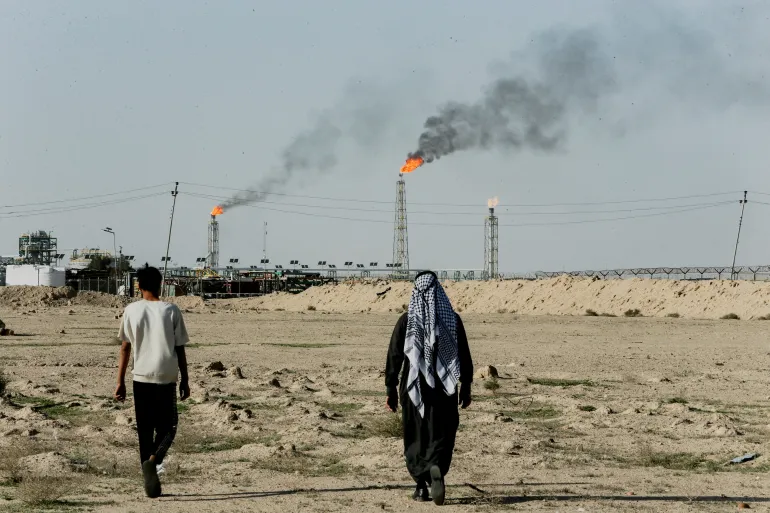
The war is also reshaping regional energy logistics. Iraq’s oil ministry says it is studying a new pipeline route from Basra through Kirkuk to Türkiye’s Ceyhan port, with a possible branch to Baniyas in Syria, as Baghdad looks to reduce its dependence on the Strait of Hormuz. A memorandum has already been signed with a consortium that includes Chevron, TE Capital, and Qatar’s UCC.
Kuwait, meanwhile, reported renewed Iranian strikes on Mangaf targeting a power generation and desalination plant, prompting officials to appeal for conservation of electricity. In Gaza, Israeli strikes continued to claim lives even as the wider region absorbs the shock of the widening US-Iran war, with funerals for the dead held in Gaza City and the Nuseirat refugee camp over the weekend.
The US State Department has renewed its warning for Americans traveling abroad to exercise increased caution, citing the risk of what it called “unforeseen escalation,” a warning issued even before this latest exchange of strikes.