Zafar Iqbal
The Numbers the Government Does Not Want You to See
There is a particular kind of dishonesty that does not lie outright but instead selects which truth to tell. Pakistan’s official poverty narrative has long practiced this art. The government says 28.9 percent of Pakistanis live below the poverty line. The Social Policy and Development Centre, working from the same households but with a sharper lens, puts that figure at 43.5 percent. This is not a rounding error. This is a chasm. And on one side of it live tens of millions of people whose suffering the state has chosen, whether by design or negligence, not to fully count.
The SPDC’s latest research draws on household-level data from the Household Integrated Economic Survey 2024-25. Its findings are not speculation. They are grounded in what low-income families actually eat, actually spend, and actually endure. According to its estimates, approximately 105 million Pakistanis were poor in FY25. In FY19, that number stood at 78 million. This means 27 million more people crossed into poverty in just six years. Twenty-seven million. That increase alone exceeds the total population of many sovereign nations. It is not a footnote in a policy document. It is a civilisational failure dressed up in the language of economic management.
The gap between official figures and SPDC’s findings begins with how poverty is measured. The government sets its poverty line at Rs8,484 per adult equivalent per month. SPDC, using a calorific method rooted in what low-income households actually consume, estimates that line should be Rs13,476 for urban households and Rs10,283 for rural ones. The government’s figure is not merely lower. It is structurally disconnected from lived experience. It is a number that makes the spreadsheet look better without changing what is on the plate.
The official Cost of Basic Needs method does not construct its poverty line fresh from household data each time. It takes an older benchmark and updates it using the Consumer Price Index. This sounds technical, but the consequences are anything but. The CPI reflects the spending patterns of relatively better-off households. It captures what the middle class buys, not what the poor survive on. It counts items that low-income families rarely purchase while omitting costs they cannot avoid, including informal healthcare, water access, and the daily transactional costs of poverty itself. In remote and underserved areas, where prices diverge sharply from national averages, the CPI becomes even less reliable as a guide. The result is a poverty line that drifts steadily away from reality, producing the appearance of progress where the ground tells a different story entirely.
This methodological failure is not merely academic. Official estimates, looking back to FY02, show poverty falling consistently, even in years of weak growth, repeated economic shocks, and visible mass hardship. That trajectory defies common sense. When a country endures crippling inflation, political instability, near-default conditions, and successive years of stagnating wages, the poverty line should not keep falling. When it does, the problem is not the economy. It is the measurement.
The SPDC data also reveals something that should unsettle the conventional wisdom about urban Pakistan. Between FY19 and FY25, urban poverty rose by ten percentage points. Rural poverty, by comparison, rose by five. The city, long imagined as the ladder out of deprivation, has become for many a trap of a different kind. Urban households have been hit by inflation, by unemployment, by the erosion of real wages and the collapse of whatever social cushion informal networks once provided. Families that were managing, barely but managing, have been pushed across the line. The informality that once served as a buffer has itself been strained. And the formal economy has offered no alternative.
Inequality has deepened alongside absolute poverty. The Gini coefficient has risen by approximately five percentage points over this period, which means the crisis has not been democratically distributed. It has fallen hardest on those who were already falling. The rich have not been untouched, but the poor have been devastated. The distance between the two ends of Pakistani society has grown wider at precisely the moment when state capacity to bridge it has been most compromised.
None of this happened in isolation. Pakistan passed through a near-debt-default crisis in early FY24. Political instability destabilised expectations and investments simultaneously. Global monetary tightening made external borrowing brutally expensive. Post-pandemic inflation eroded what little purchasing power low-income families had accumulated. These are not excuses. They are causes, and they require honest acknowledgement. A government that refuses to name what drove people into poverty cannot design policy to pull them back out.
This is where the SPDC’s findings carry their deepest significance. Policy is only as good as the picture it responds to. If that picture is distorted, if poverty is undercounted by fifteen percentage points, if tens of millions of people are systematically rendered invisible in official analysis, then the programmes designed to help them will be too small, too misdirected, and too late. Bisp will reach fewer families than need it. Fiscal allocations will be calibrated against a crisis smaller than the one that actually exists. The state will congratulate itself on poverty reduction while the poor grow in number.
There is nothing inevitable about the gap between what governments measure and what people experience. It is a choice. The choice to use a poverty line that flatters rather than informs. The choice to update benchmarks with indices that do not reflect the poor. The choice to project continuity rather than confront rupture.
Pakistan’s poverty crisis is real, it is large, and it is deepening. The question is not whether the government can afford to acknowledge it. The question is whether the country can afford another decade of pretending it is smaller than it is. Twenty-seven million people did not fall into poverty because the statistics were wrong. They fell because the policies built on those statistics were not designed for them. That is the cost of counting dishonestly. And it is a cost that is now being paid, not in budget lines, but in broken lives.
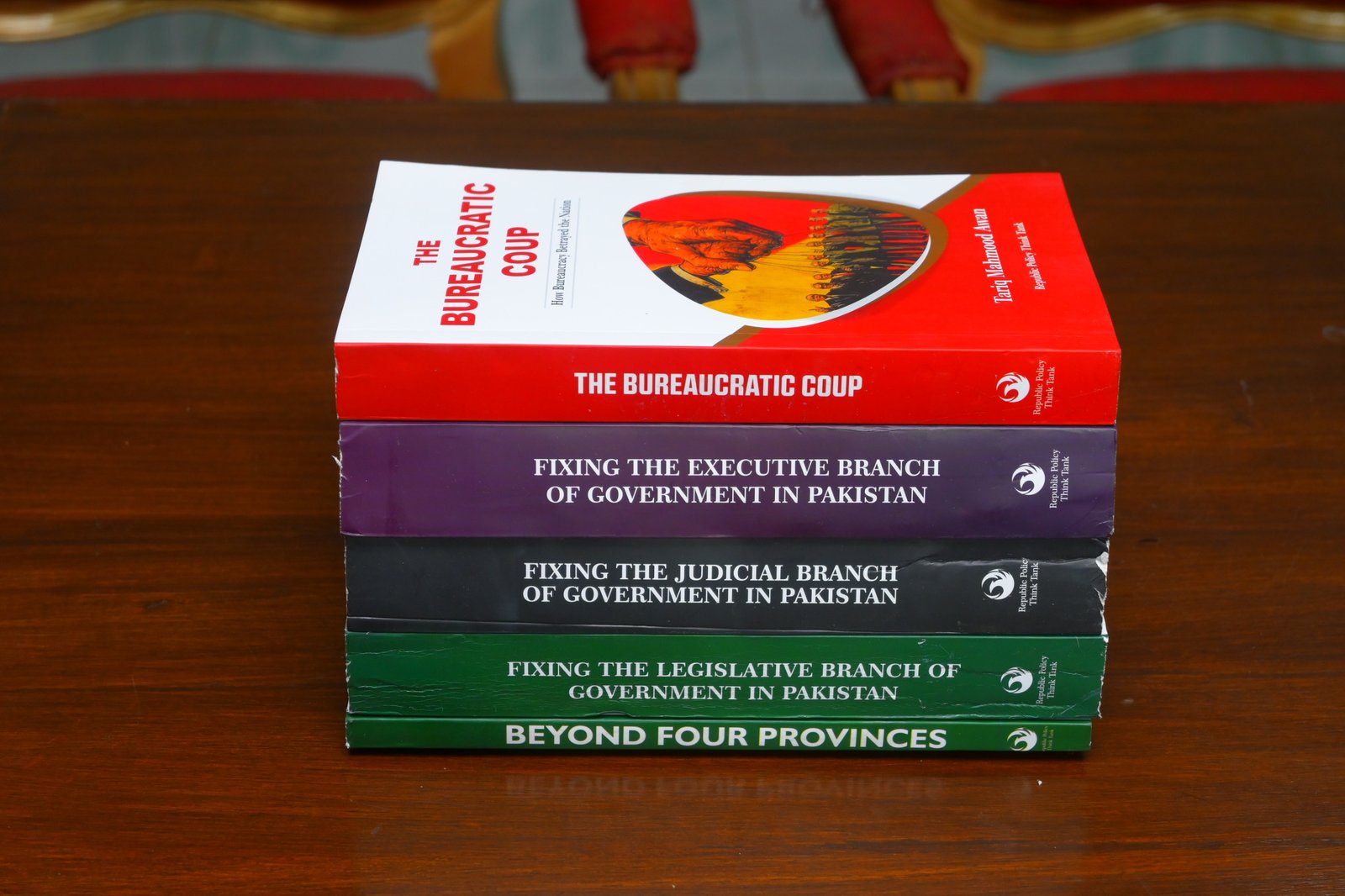
Republic Policy’s landmark book, The Bureaucratic Coup, is available for home delivery. This is the only book that provides a true account of how bureaucracy works in Pakistan.
It is a must-read for every reader.
For home delivery, please contact Mr. Ammar Alvi at 03362567031.