
Dr Bilawal Kamran
There are moments in history when a single decision by a single man can alter the course of global commerce, regional stability, and the lives of millions who will never hear his name spoken in the rooms where such decisions are made. Donald Trump’s order to the United States Central Command to impose a naval blockade on all traffic entering and exiting Iranian ports, effective Monday at 10am Eastern Time, is one such moment. Whether it holds, whether it succeeds, or whether it unravels in the face of its own contradictions, the world is already feeling its weight.
The President’s stated purpose is disarmingly simple. Iran, he declared on television, should not be allowed to sell oil selectively — to those it favours while denying others. The blockade, as envisioned, would operate on a binary principle: either all ships pass through the Strait of Hormuz, or none do. No exceptions, no negotiations, no quiet arrangements with preferred buyers. It is the kind of blunt instrument that appeals to a certain political temperament. Whether the real world accommodates such instruments is another matter entirely.
The first complication is military and geographical. American naval vessels are currently positioned well beyond the effective range of Iranian hypersonic ballistic missiles — a deliberate calculation, not an oversight. Enforcing a blockade in the strait itself, whether through mines or physical interception, would require those ships to move significantly closer to Iranian shores. That is not a logistical footnote. It is the central military dilemma of the entire directive. Any enforcement action that places American vessels within Iranian strike range transforms a show of economic pressure into the opening act of a shooting war.
The second complication is diplomatic, and it cuts even deeper. Several countries that the United States considers close allies — Japan, South Korea, France — have already concluded their own arrangements with Tehran, securing passage for their oil tankers through the strait. These are not rogue actors or hostile states. These are Washington’s partners. The question being asked in chancelleries from Tokyo to Paris is pointed and uncomfortable: what does the United States intend to do with a tanker flying a friendly flag, carrying oil for an allied economy, sailing through waters that Washington now claims authority over? And if the answer involves any kind of interdiction, what response should that ally be expected to muster?
These are not hypothetical concerns. China, which purchases substantial volumes of Iranian crude, will not accept interference with its energy supply quietly. The potential for escalation — economic, diplomatic, and ultimately military — is layered into the very design of the blockade order.
There is also the matter of internal consistency. President Trump had earlier moved to lift sanctions on both Iran and Russia, a decision framed around increasing global oil supply to bring fuel prices down. The blockade runs directly against that logic. You cannot simultaneously court supply expansion and strangle one of the world’s significant oil exporters. The two positions cannot coexist. Whether the President retreats from this maximalist posture, as he has done with certain other directives, remains to be seen. But the markets, the shipping lanes, and the governments of every energy-importing nation are watching for exactly that signal.
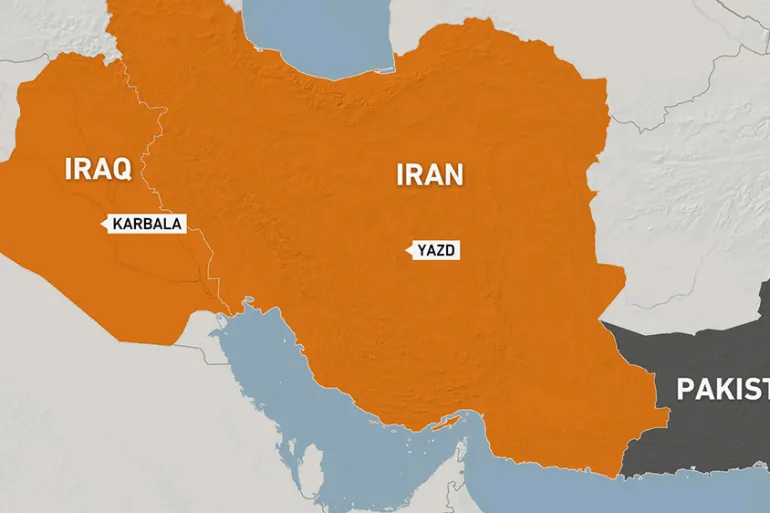
Iran’s Revolutionary Guard Corps has not left its position ambiguous. It has warned that any military vessel approaching the Strait of Hormuz will be treated as a violation of the two-week ceasefire currently in effect and will be met with decisive force. This warning arrives against a backdrop that offers little reassurance. Both parties have already permitted key elements of that ceasefire to erode. Israel continues its bombardment of Lebanon. Iran continues to exercise control over strait traffic. The agreement reached in Islamabad is already fraying at the seams. Should the blockade be enforced, the near-universal assessment among analysts is that the ceasefire would collapse entirely, with consequences extending far beyond the strait itself. The Gulf Cooperation Council states — with the singular exception of Oman — would be directly exposed to the resulting instability.
History offers some instructive parallels, though none of them is perfectly comforting. In 1973, Arab members of OPEC embargoed oil exports to the United States in direct retaliation for American arms supplies to Israel. The world economy convulsed. Henry Kissinger eventually negotiated a resolution, but the embargo left permanent marks. France responded by accelerating its pivot to nuclear energy, insulating itself from dependence on imported hydrocarbons in a manner that continues to define its energy profile today. When Fukushima’s reactors failed in 2011 following the Japanese earthquake and tsunami, several Western European nations drew the opposite conclusion and began dismantling nuclear capacity in favour of renewables. Two disruptions, two responses, both reshaping energy policy for decades. The lesson is not which path is correct. The lesson is that disruptions force decisions — and those decisions, once made, rarely reverse themselves.
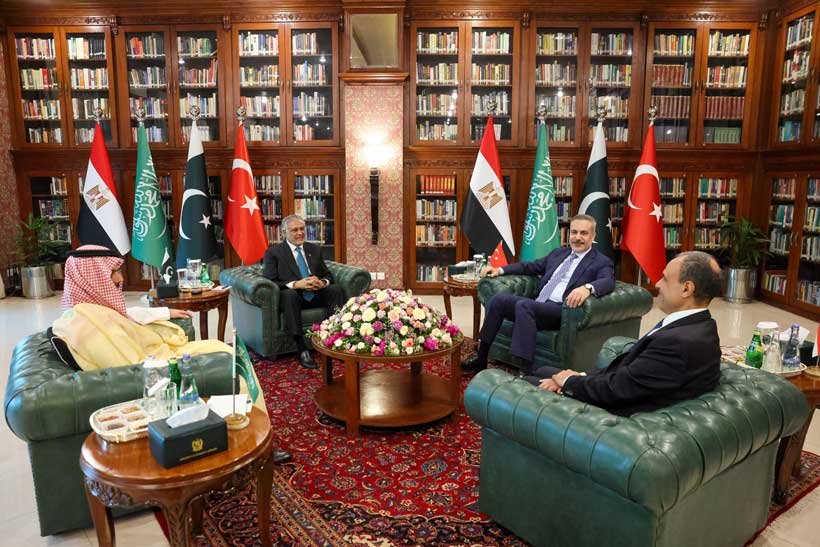
Pakistan finds itself at the intersection of all these pressures. The government has played a creditable and internationally recognised role in facilitating dialogue between Washington and Tehran, contributing to the ceasefire that now hangs in the balance. That engagement must continue. The world, and the region in particular, benefits from a Pakistan that remains actively present in these conversations rather than retreating to the sidelines.
But the more urgent domestic obligation is strategic and long-term. Pakistan cannot afford to remain structurally exposed to the volatility of global oil markets every time a crisis erupts in the Gulf. The recurrent disruptions — 1973, 2011, and now again — are not anomalies. They are the pattern. A government serious about energy security must treat the current moment as the catalyst it has always lacked to accelerate a genuine transition toward nuclear and renewable energy sources. The timeframe for such a transition is not arbitrary. It is bounded, most practically, by the expiry of existing contracts with Independent Power Producers that carry capacity payment clauses. That expiry window is the structural opportunity. It will not remain open indefinitely.
The Strait of Hormuz has always been more than a waterway. It is the throat through which a significant portion of the world’s energy flows. What happens there in the coming days will determine not just oil prices, but the architecture of alliances, the durability of ceasefires, and the courage of governments to finally build the energy independence they have long promised their people.