
Hafeez Ahmad Khan
What Makes Republic Policy’s The Bureaucratic Coup Different
An Analysis!
Pakistan has no shortage of books written by civil servants. Many of them make for absorbing reading. Former secretaries, commissioners, and district officers have committed their experiences to paper, producing memoirs that document the inner workings of the state. Yet almost without exception, these accounts share a common narrative thread: governance fails because politicians interfere. The civil servant, in this telling, is the capable professional who would deliver results if only the political class would step aside and let him work.
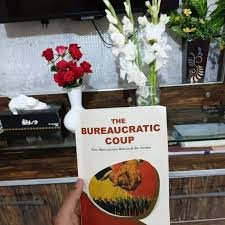
The Bureaucratic Coup, published by Republic Policy Think Tank and available through Vanguard Books, challenges this narrative at its root. Its author is himself a serving civil servant. He has spent fifteen years inside the system, not as an outside observer but as a participant. That insider vantage point is precisely what makes the argument so uncomfortable, and so important.
The central claim of the book is not that politicians are innocent. It is something more precise: that the standard explanation for Pakistan’s governance failures is incomplete, self-serving, and ultimately misleading. When bureaucrats write that political interference prevents good governance, they are offering a partial account that conveniently absolves their own institution of responsibility. The Bureaucratic Coup asks the question that almost nobody inside the establishment is willing to ask. If political interference is truly the source of all problems, what happened during the long stretches of Pakistani history when politicians were not in power at all?
This is not a rhetorical question. Pakistan has spent considerable portions of its existence under military rule, caretaker administrations, and other non-elected arrangements. These were precisely the conditions under which the bureaucracy operated with the greatest autonomy, the least political oversight, and the widest room to demonstrate its competence. The record of those periods, examined honestly, does not support the claim that bureaucratic independence produces good governance. Many of Pakistan’s deepest administrative, financial, and institutional problems did not develop under elected governments. They took root and hardened during periods when the civil service was most firmly in the driver’s seat.
The constitutional argument in the book is equally pointed. Pakistan’s Constitution locates sovereignty in the people, expressed through their elected representatives. A system in which unelected officials resist, circumvent, or effectively override the decisions of elected ministers is not a system defending good governance. It is a system inverting the constitutional order. The author argues that the narrative of bureaucratic victimhood, in which civil servants present themselves as professionals harassed by interfering politicians, is in fact a story about an administrative class that does not accept democratic accountability as legitimate. That is a serious charge. It is made seriously.
There is also the question of power as it actually operates within government. The conventional image of the bureaucrat as subordinate to the minister does not always match reality on the ground. Control over files, procedures, and institutional memory gives senior civil servants an enormous practical advantage over ministers who arrive without technical knowledge and leave before they can acquire it. The secretary who has spent decades in a ministry shapes what options the minister sees, what information reaches him, and what implementation actually occurs. Calling this arrangement one in which the bureaucracy is powerless before politics requires a selective reading of how government actually works.
The book does not ignore corruption in the political class. It acknowledges it directly. But it draws a distinction that is rarely made in Pakistani public discourse. Politicians who enter public life typically come with existing resources: land, business interests, family wealth. Their primary motivation is political power. The bureaucratic corruption the author documents follows a different pattern: individuals of modest origin who accumulate extraordinary wealth through the exercise of official authority, retiring with assets that bear no relationship to any known legitimate income. Systematic scrutiny of these patterns, the book suggests, would produce results that the conventional narrative about corruption would find very difficult to accommodate.
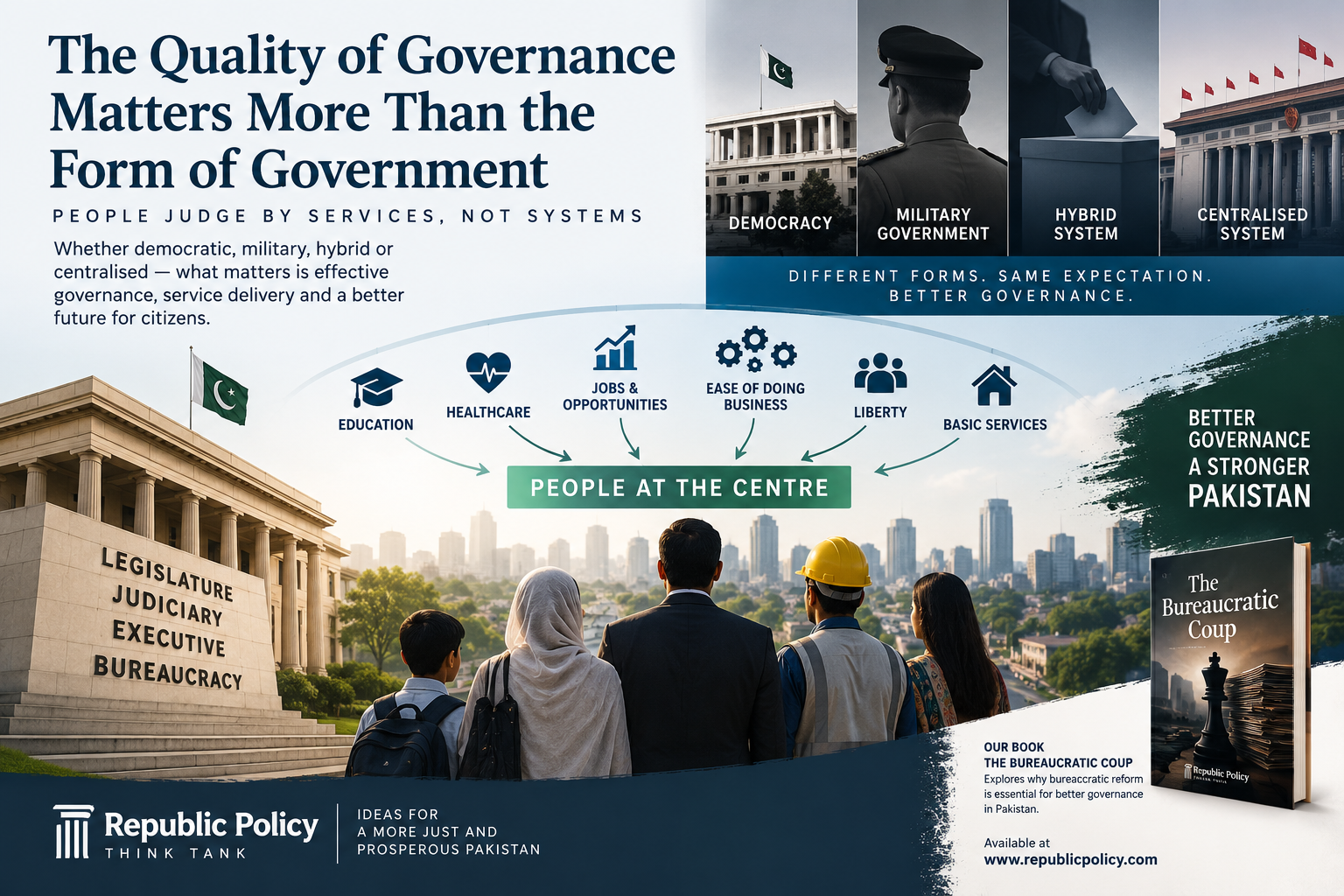
What distinguishes this work from most governance writing in Pakistan is that it does not treat institutional critique as betrayal. The author is not anti-state and he is not hostile to public administration as a vocation. The reform proposals developed across Republic Policy’s four-volume governance series, which also includes Fixing the Executive Branch, Fixing the Legislative Branch, and Fixing the Judicial Branch, proceed from a genuine belief that these institutions can be made to work. But they cannot be fixed until they are honestly diagnosed.
Pakistan has produced many books that tell the bureaucracy what it wants to hear. Republic Policy’s contribution is a book that tells it what it needs to hear. That distinction matters. It is what makes The Bureaucratic Coup genuinely different from everything that has come before it.
The Republic Policy governance reform series is available at Vanguard Books, Readings, Sang-e-Meel, Kitab Sarai, Syed Book Depot Islamabad, and leading bookstores across Pakistan.