
Hafeez Ahmed Advocate
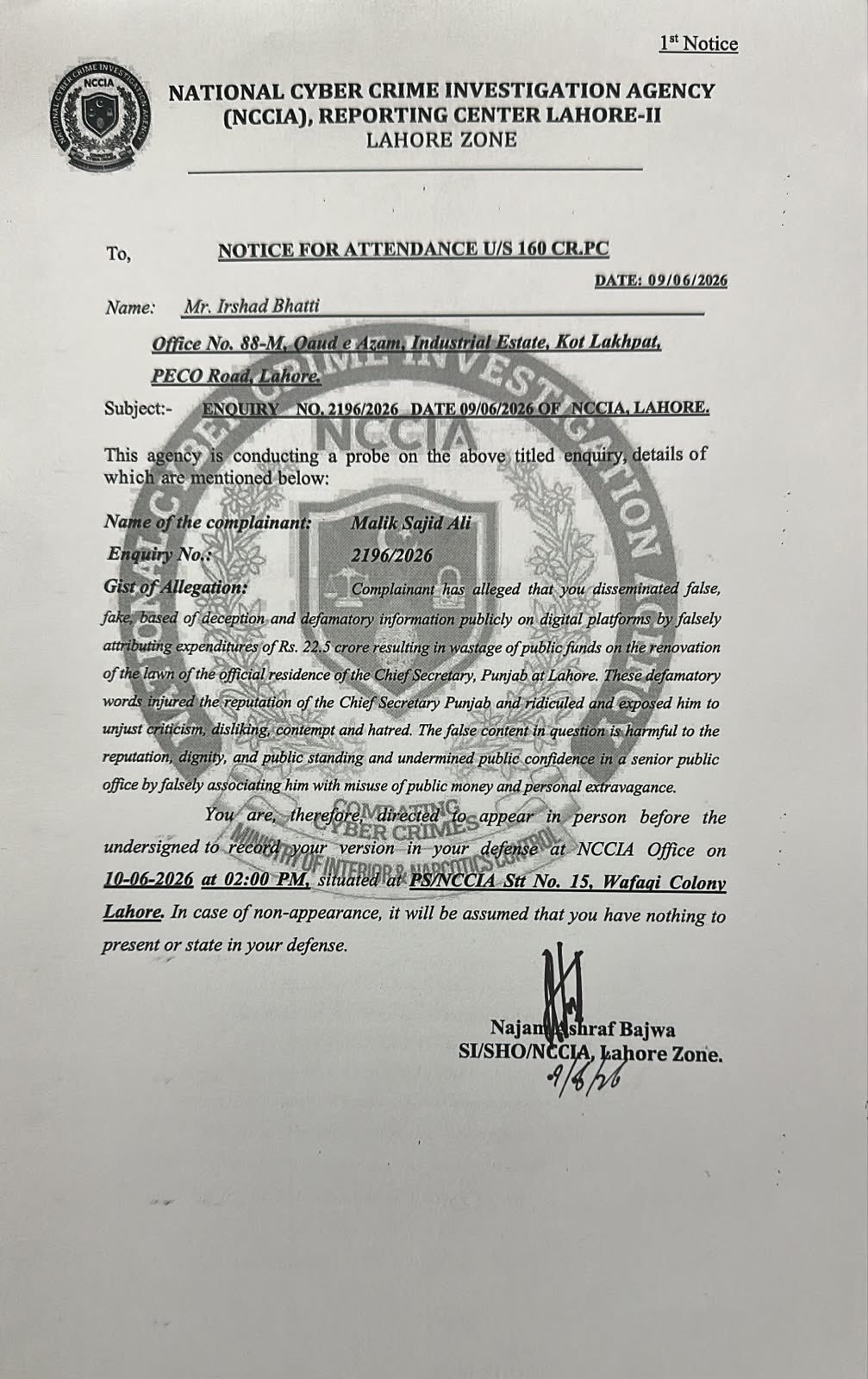
The dispute between Chief Secretary Punjab and senior journalists Anwar Hussain Samarra, Irshad Bhatti, and others is heading toward a quiet resolution. The journalists, it appears, will formally apologize. On the surface, this looks like a minor professional episode, a routine settling of scores between media personalities and a senior civil servant. But beneath this surface lies something far more significant, something that speaks directly to how power is distributed, protected, and questioned in Pakistan.
Two realities emerge from this episode. The first concerns the state of journalism itself. Pakistani journalists have increasingly drifted from the professional standards that give journalism its authority. When personal opinion, political allegiance, and institutional proximity begin to replace independent reporting, the credibility of the entire profession suffers. An apology extracted under pressure is not a correction of course. It is a symptom of a deeper institutional weakness, one that reduces journalists from watchdogs to participants in factional contests.
The second reality is more ironic, and more instructive. Politicians in Pakistan, so routinely condemned as arrogant and intolerant, have demonstrated in practice a remarkable capacity to absorb punishment. They endure years of character assassination, moral condemnation, allegations of corruption, religious attacks, and relentless media hostility, often without reaching for legal instruments or institutional leverage. They survive public ridicule, engineered narratives, and coordinated campaigns against their reputations. They forgive, absorb, and move on. This is not weakness. In a political culture as brutal as Pakistan’s, it is a form of institutional resilience that deserves acknowledgment.
Now consider the contrast. When journalists or commentators turn their attention toward the judiciary, the military establishment, or the civil bureaucracy, the response is rarely absorbed with the same patience. Legal notices arrive. Contempt proceedings begin. Careers are disrupted. Channels are pressured. The asymmetry is glaring, and it is not coincidental. It reflects a hierarchy of untouchability that has been carefully maintained over decades. Politicians sit at the bottom of that hierarchy, available for unlimited public criticism. Other institutions occupy a protected space where scrutiny is managed, discouraged, or punished.
This asymmetry has produced a distorted national consciousness. An entire generation of Pakistanis has grown up with a single, simplified explanation for the country’s failures: the politician did it. Corruption belongs to the elected class. Incompetence is the exclusive property of democratic governments. Institutional failure is the product of political interference. This narrative has been repeated so consistently, across media, judiciary, academia, and civil society, that it has acquired the force of common sense. Questioning it feels almost naive.
Yet it is precisely this narrative that Republic Policy’s book The Bureaucratic Coup interrogates with evidence, constitutional analysis, and historical documentation. The book’s central argument is that Pakistan’s federal civil services, particularly the Pakistan Administrative Service and its predecessor the Civil Service of Pakistan, have occupied provincial posts and exercised provincial powers without a legitimate constitutional foundation. The argument is grounded in Article 240 of the 1973 Constitution, the 1954 CSP Rules, and a body of administrative history that has never been seriously examined in public discourse. The bureaucracy did not simply serve the state. In important respects, it shaped the state, and shaped it in ways that have served its own institutional continuity at the expense of elected, accountable governance.
The political class has been made the face of Pakistan’s governance crisis. But governance is not delivered by politicians alone. It is delivered through institutions, and those institutions are staffed, managed, and in many cases controlled by an unelected civil bureaucracy whose historical record, whose resistance to accountability, and whose structural privileges have largely escaped the scrutiny they deserve. Every failed reform, every broken local government system, every stalled devolution measure, every province that cannot exercise its own constitutional powers, carries the fingerprints of this institutional resistance.
This is not an argument against accountability for politicians. They must be held accountable, fully and without exception. The argument is for consistency. If we demand accountability from elected representatives, we must demand it equally from those who wield unelected power. The standard cannot shift depending on the institution under examination. Corruption and incompetence do not wear only one kind of uniform.
For Pakistan’s public, intelligentsia, and media, the episode involving the Chief Secretary and the journalists is a small but telling moment. It is a reminder that some institutions apologize and some extract apologies. Understanding why that is so, and what it means for democratic governance, requires a more honest national conversation than we have yet been willing to have.
The Bureaucratic Coup invites that conversation. It is available at Vanguard Books, Readings, Sang-e-Meel, Kitab Saraye, Syed Book Depot Islamabad, and bookstores across Pakistan. Contact: +92 300 9552542.