
Dr Bilawal Kamran
The unprecedented student-led demonstrations unfolding across India represent far more than a reaction to examination scandals. They have evolved into a wider debate about governance, public accountability, democratic participation and the relationship between the state and a generation increasingly frustrated by shrinking opportunities. What began as outrage over irregularities in competitive examinations has transformed into one of the most significant political challenges facing Prime Minister Narendra Modi’s government since its return to power in 2024.
At the centre of the movement stands the social media-driven Cockroach Janta Party (CJP), an unconventional campaign that has successfully channelled public frustration into organised political expression. Although the name originated as satire after reports that senior judicial remarks compared young people to “cockroaches” and “parasites,” the movement has rapidly grown beyond symbolic protest. Today, it represents broader concerns about educational fairness, employment prospects, institutional transparency and democratic accountability.
The immediate trigger for the protests was a series of examination controversies that undermined public confidence in India’s educational system. The leak of question papers for the highly competitive medical entrance examination forced more than two million candidates to retake the test, causing widespread frustration among students and their families. Similar controversies surrounding the digital evaluation of high school examinations further deepened concerns regarding the credibility of public institutions responsible for conducting examinations that determine the future of millions of young Indians.
For students who spend years preparing for these highly competitive examinations, such irregularities are not merely administrative failures. They directly threaten careers, financial investments and personal aspirations. In a country where educational success often determines social mobility, any perception that merit has been compromised naturally generates intense public anger.
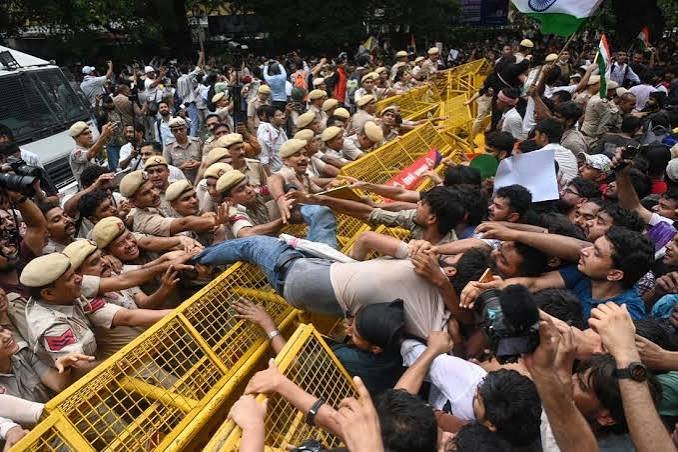
The demonstrations at New Delhi’s Jantar Mantar have therefore become a symbol of a wider struggle for fairness. Thousands of students have maintained their presence despite police action and repeated warnings to disperse. Their principal demand remains the resignation of Education Minister Dharmendra Pradhan, whom they hold politically responsible for repeated failures within the examination system. Whether or not such resignation ultimately occurs, the protests have already succeeded in forcing the government to publicly address issues that had previously received limited political attention.
The movement gained additional momentum when India’s opposition parties openly endorsed the demonstrations. Congress leader Rahul Gandhi accused the government of suppressing peaceful dissent after police used tear gas and batons against demonstrators attempting to march towards Parliament. Other opposition leaders, including Samajwadi Party chief Akhilesh Yadav, argued that the government could no longer ignore issues affecting millions of young citizens.
This political support has transformed what was initially viewed as a student movement into a broader national debate. Parliament itself has become an arena for discussing educational reforms, police conduct and governmental accountability. The opposition’s strategy seeks to present these protests not simply as isolated incidents but as evidence of deeper governance failures.
Equally significant has been the role of social media. Unlike earlier protest movements that relied heavily upon traditional political organisations, the CJP emerged almost entirely through digital platforms. Millions of followers across multiple social media networks have enabled organisers to coordinate demonstrations, circulate information and challenge official narratives with remarkable speed. Digital activism has effectively overcome many conventional barriers to political mobilisation.
However, social media also presents challenges. Online campaigns often spread information faster than it can be verified, increasing the risk of misinformation and emotional polarisation. Responsible digital activism therefore requires both transparency and commitment to factual accuracy if it is to sustain long-term public trust.
The government’s response has reflected a difficult balancing act. On one hand, maintaining public order remains a legitimate responsibility of any democratic government, particularly when demonstrations involve large crowds and occasional violence. On the other hand, international human rights standards require law enforcement agencies to exercise restraint, necessity and proportionality while policing peaceful assemblies.
Human rights organisations, including Amnesty International, have questioned whether police actions met these internationally recognised standards after officers used tear gas and force against protesters. At the same time, incidents in which some demonstrators threw stones at police complicate the public narrative by illustrating how quickly peaceful protests can escalate into confrontation.
Education Minister Dharmendra Pradhan has attempted to calm public anger by promising reforms and acknowledging that students deserve accountability and solutions. His public statement recognised that the government owes young people credible answers regarding examination failures. Whether these assurances translate into meaningful institutional reforms remains to be seen. Public confidence can only be restored through transparent investigations, stronger examination security, technological safeguards and independent oversight mechanisms.
Beyond examination reforms, the protests highlight a deeper structural challenge confronting India. The country possesses one of the world’s youngest populations, yet millions of educated young people continue to struggle with unemployment, underemployment and uncertainty regarding future opportunities. Educational controversies therefore resonate far beyond classrooms because they reinforce broader anxieties about economic mobility and social justice.
Democratic societies inevitably experience public protests, particularly when institutions fail to satisfy citizens’ expectations. The true measure of democratic resilience lies not in preventing dissent but in responding to it through dialogue, accountability and institutional reform. Governments that acknowledge legitimate grievances often strengthen public trust, while attempts to dismiss or suppress criticism frequently deepen political divisions.
India’s current student movement illustrates the growing political influence of its younger generation. Whether organised through university campuses or digital platforms, young citizens increasingly expect transparency, competence and fairness from public institutions. Their demands extend beyond examination papers to encompass broader questions about governance and opportunity.
The eventual outcome of these protests remains uncertain. The movement may gradually lose momentum, or it may evolve into a lasting platform for youth political engagement. Regardless of its future, it has already demonstrated that educational integrity is inseparable from democratic accountability. For any government, ensuring fair examinations is not merely an administrative obligation—it is a fundamental responsibility towards the aspirations of an entire generation.
The best-selling books of Republic Policy Think Tank, including the landmark book The Bureaucratic Coup, are available at Vanguard Books, Liberty Books, Readings, Kitab Sarai, Sang-e-Meel, Saeed Book Bank Islamabad, National Book Foundation, and others across Pakistan. Contact for home delivery: 0300 9552542.