
Hafeez Ahmed Khan
Any serious analysis of the crisis facing Pakistan’s current governing arrangement must begin with its foundational pillars. In every federal and democratic system, the durability of a government rests primarily on two factors: political legitimacy and economic performance. When either weakens, the system comes under pressure. When both collapse simultaneously, the survival of the governing arrangement becomes a genuinely open question. Pakistan today finds itself navigating exactly this convergence.
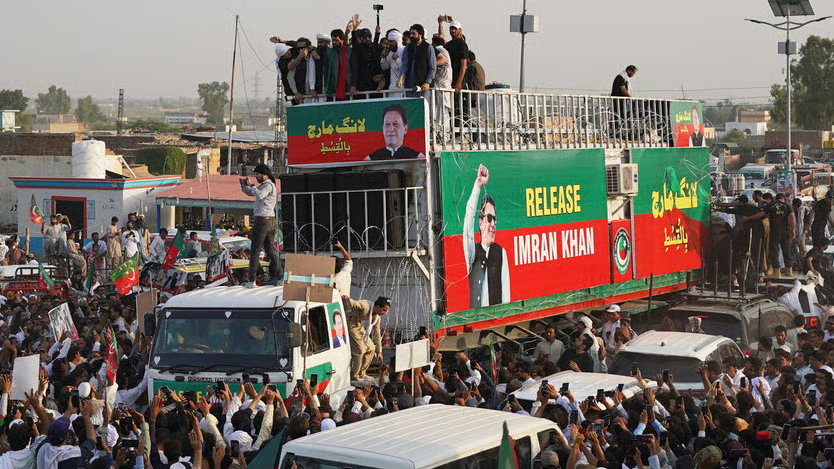
The current arrangement has faced a legitimacy problem from its very first day. A powerful and widespread public perception took hold that this government was assembled against the grain of popular will. Critics argued that despite the actual balance of electoral results and public support, power was transferred to a political coalition whose own parliamentary strength was limited. This perception alone was enough to burden the arrangement with a legitimacy deficit it has never fully escaped. Political science teaches us something unambiguous on this point: when the legal standing of a government is accompanied by contested public acceptance, sustained political resistance becomes inevitable. The question is never whether such resistance will come, but only when and with what intensity.
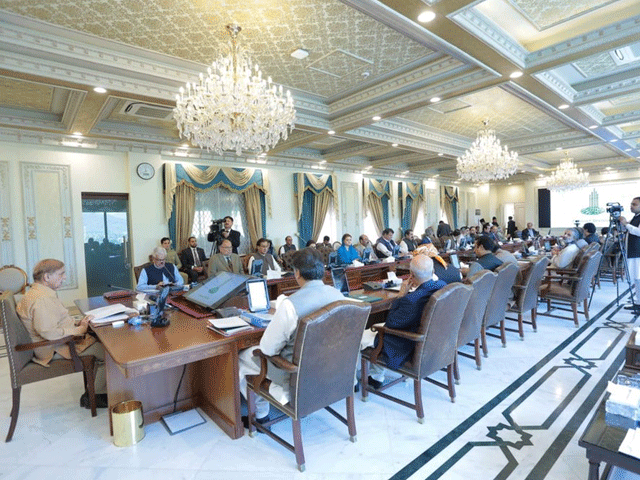
The government responded to this challenge through the instruments available to it. State power, administrative control, legal mechanisms, and constitutional manoeuvres were deployed to maintain order. The judicial and administrative structures were steadied, political opposition was constrained, and various instruments of the state were used to keep the governing machinery functional. These efforts were not without effect. Certain economic indicators showed temporary improvement. Inflation rates eased somewhat. International financial institutions signalled cautious confidence. The country’s diplomatic and military positioning during heightened tensions with India lent the arrangement a degree of national credibility. International support and diplomatic acceptance also contributed to an appearance of stability. None of this was trivial, and it would be dishonest to ignore it entirely.
Yet force and administrative control cannot permanently resolve a political legitimacy crisis. History and political theory converge on this uncomfortable truth. Coercion can suppress opposition for a period. It cannot extinguish it permanently. When a government must rely continuously on state power simply to sustain itself, that very dependence becomes the most compelling evidence that the legitimacy problem remains unresolved and active. The political wound does not heal simply because it is bandaged repeatedly.
This is precisely why economic performance becomes so decisive in such circumstances. Across the world, governments that have struggled with legitimacy questions have nonetheless survived by delivering tangible economic improvements to ordinary citizens. People are ultimately more interested in their daily lives, incomes, employment, and access to basic necessities than in abstract political debates. A government that cannot earn political love can sometimes earn political tolerance if it fills the refrigerator.
Pakistan’s current arrangement has failed this test. The government has now reached its fifth budget, and the economy has still not settled onto a path of sustainable growth. Exports have not registered meaningful increases. New employment opportunities remain scarce. The cost of production stays high, discouraging both local enterprise and foreign investment. Private sector investment is weak. State institutions have not demonstrated the improvement in performance that would register positively in the life of an ordinary citizen. The macroeconomic stabilisation that has occurred has benefited balance sheets more than it has benefited households. Stability at the top has not trickled down.
The government does hold one advantage that partially cushions its position. It currently faces no unified, credible, and politically organised opposition capable of immediately presenting itself as an alternative government. A divided opposition gives the arrangement breathing space that it would otherwise not enjoy. This matters in practical political terms and should not be dismissed.
But this advantage is contingent and conditional. It holds only as long as economic failure does not reach a point where public frustration overwhelms political fragmentation in the opposition. When a legitimacy crisis and an economic crisis intensify together, the absence of a visible alternative does not guarantee stability. It may simply delay the reckoning. Throughout history, governing arrangements have collapsed not because a ready alternative appeared first, but because the weight of their own contradictions became too great to sustain.
This is the essential contradiction driving the current arrangement toward decline. Political legitimacy was never consolidated. Economic performance has not compensated for that absence. State power has been used to manage what politics and economics could not resolve. And the longer this formula continues without genuine improvement in the lived experience of ordinary Pakistanis, the more fragile the entire structure becomes.
The real test for this government lies not in parliamentary arithmetic or international endorsements. It lies in whether it can produce economic results that people actually feel. A government that cannot deliver on that front, while already carrying a legitimacy deficit, is navigating on borrowed time.
The best-selling books of Republic Policy Think Tank, including the landmark book The Bureaucratic Coup, are available at Vanguard Books, Liberty Books, Readings, Kitab Sarai, Sang-e-Meel, Saeed Book Stores, and others across Pakistan. Contact for home delivery: 0300 9552542.