
Nadeem-ul-Haque
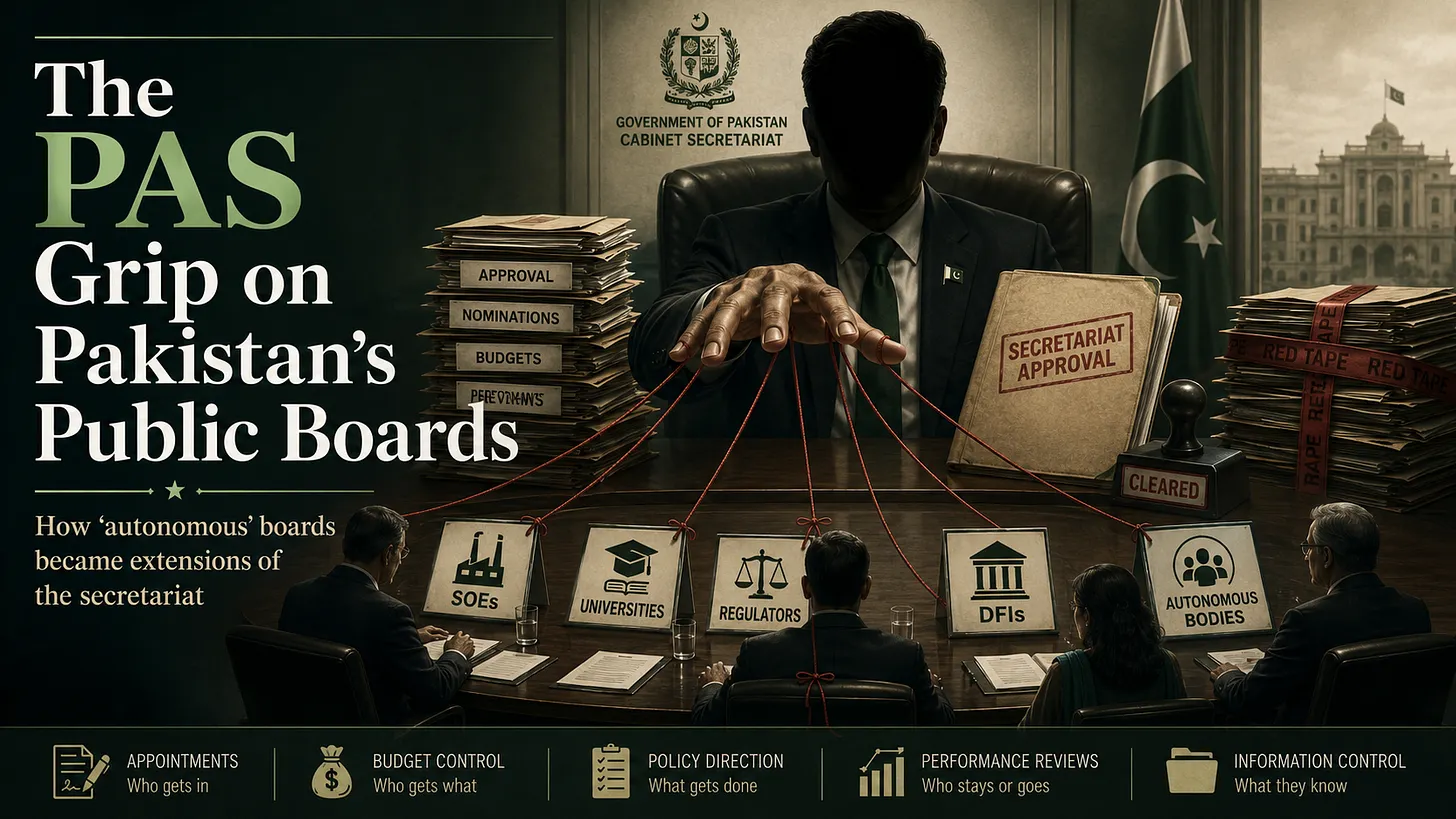
Pakistan’s “autonomous” boards are an extension of the secretariat. Losses are made, outcomes are poor, but PAS remains aloof yet in control. Ownership, regulation, and management must be separated.
Pakistan’s governance crisis is habitually narrated as a story of political interference: ministers meddling with appointments, distorting boards, and shielding favorites. That diagnosis is partly correct. But it is incomplete. The deeper problem is the architecture of the state itself — a design in which the senior bureaucracy, led by the Pakistan Administrative Service, remains embedded inside institutions formally designated as autonomous, corporate, statutory, regulatory or independent. This is not accidental. It is written into laws, rules, statutes, board structures, and budget procedures. The same officer class that controls ministry files also processes appointments, nominates board members, releases funds, supervises attached bodies, moves cabinet summaries, represents the government as shareholder and acts as Principal Accounting Officer. The result is not professional governance. It is administrative control exercised in the language of governance.
The ubiquity of PAS and senior bureaucratic presence on public boards is the clearest evidence of this grip. From SOEs and DISCOs to oil and gas companies, universities, regulators, autonomous bodies, Section 42 companies and donor-funded vehicles, the same pattern recurs: serving secretaries, additional secretaries, government nominees, retired PAS officers and career civil servants appear as directors, members, chairpersons or advisers. This is not an occasional oversight. It is a system of embedded control. The bureaucracy sits inside the institutions it is supposed to supervise from outside while simultaneously controlling budgets, appointments, summaries, approvals, and performance reviews. Almost no market, university, regulator, public enterprise, or even a government-owned NGO or a donor-inspired project or NGO can function autonomously without the PAS involvement. This is apart from their control in the rules of business as the Principal Accounting Officers of all government agencies, enterprises, etc.
The Scale of the Problem
The SOE portfolio makes the stakes concrete. Pakistan owns approximately 212 federal entities — 85 commercial SOEs, 83 subsidiaries and 44 non-commercial SOEs — operating across energy, transport, finance, infrastructure and industry. Their fiscal record is a chronicle of failure. In the first half of fiscal year 2024 alone, loss-making SOEs posted an aggregate deficit of Rs 408 billion. The National Highway Authority led with Rs 151.3 billion, followed by QESCO at Rs 56.2 billion and PIA at Rs 51.7 billion. To sustain these entities, the government extended Rs 436 billion in fiscal support in that single six-month window — Rs 120 billion in grants, Rs 231 billion in subsidies and Rs 85 billion in loans — equivalent to over seven percent of federal budget receipts on an annualised basis. By FY2024-25, taxpayers had pumped PKR 2.1 trillion into SOEs, largely through equity injections to shore up balance sheets and service circular debt rather than deliver new services. Across the decade since 2014, cumulative SOE losses have reached $20 billion (about 5% of current GDP).
These losses are not acts of God. They are, in significant part, a product of how these entities are governed. A board that cannot set strategy, choose management, control budgets, or demand performance is not a board in any meaningful sense.
What the International Norm Requires
The OECD’s Guidelines on Corporate Governance of State-Owned Enterprises — now in their 2024 revision, endorsed by the G20 — set the global benchmark. They require that boards be equipped with appropriate autonomy to add value and that SOEs be held to the same transparency standards as listed companies. On the civil servant question, the guidelines are unambiguous: independent board members must be free of any relationship with the state—no civil servants, public officials, or elected officials—selected on merit and free from material conflicts of interest. They further require mechanisms to prevent conflicts of interest and limit political interference; politicians who can materially influence an SOE’s operating conditions should not sit on its board. Pakistan routinely places MNAs and MPAs on boards in direct contradiction of this principle. The OECD’s practical corollary is institutional separation: ownership functions separated from policy functions, boards providing strategic direction rather than administrative management, and state representatives refraining from day-to-day interference.
Why the 2023 Reform Is Insufficient
Pakistan’s SOE (Governance and Operations) Act 2023 and accompanying Ownership and Management Policy represent genuine progress on paper. They require majority independent boards, separate chairman and CEO roles, and bar-serving officials from classification as independent directors. These are useful steps. But they do not dismantle the command system.
The Board Nominations Committee still includes the minister-in-charge, the Secretary of the relevant division, and the Finance Secretary. The search process in practice becomes a managed shortlist: names are filtered through the ministry, three are forwarded upward, and final selection rests with the political-secretariat apex — often the Prime Minister’s Office advised by the same administrative machinery through PSPM. The CEO, even when formally appointed through a board process, remains functionally dependent on the ministry for approvals, budgets, appointments, procurement space, and institutional survival. The board may endorse a business plan, but the Principal Accounting Officer controls the fiscal channel and can override autonomy through releases, objections, clearances and compliance requirements. Even the CEO’s travel requires ministry clearance.
The documented evidence confirms this. The Cabinet Committee on SOEs has repeatedly approved and reconstituted SOE boards on summaries moved by ministries — including boards for the National Highway Council, Printing Corporation, Fisheries Development Board and Pakistan Cotton Standards Institute. In First Women Bank’s case, reporting confirmed that the Cabinet Committee on SOEs (CCoSOEs) reappointed the existing board while adding a Finance Ministry deputy secretary specifically, in the words of the ministry, “to have a check on the independent directors.” HEC illustrates the same dynamic: the federal government removed Chairman Tariq Banuri through an ordinance reducing tenure, an action widely interpreted as a direct assault on institutional autonomy.
The DISCO cases are the most instructive. In 2024, the Board Nominations Committee headed by the Power Minister recommended removal of directors across all ten distribution companies. The Prime Minister approved the removals; the Cabinet Committee on SOEs then approved Power Division proposals for reconstitution of boards, including HESCO and SEPCO, subject to credential clearance and Prime Ministerial approval. Whatever the merits of particular directors, the process reveals where power actually resides. DISCO boards do not control their own continuity, composition or reform direction. They sit beneath the Power Division, the BNC, the CCoSOEs, the Cabinet and the PM Office. This is not autonomous corporate governance. It is administrative command exercised through board reshuffling.
The Wider Archipelago: Regulators, Universities, Donor Vehicles
SOEs are only the most visible layer. Around them sits a much wider public apparatus: 116 or more federal autonomous bodies, over 122 federal regulatory authorities, universities, examination bodies, accreditation councils and donor-supported delivery vehicles such as PPAF, Karandaaz and NDRMF. These bodies license, regulate, procure, certify, train and allocate public money. They too are governed through the same architecture: secretary seats, ministry nominees, ex-officio members, PAO authority, budget approvals and Rules of Business channels.
A review of public-sector university statutes reveals a consistent pattern. Quaid-i-Azam University’s Syndicate includes a National Assembly member, a Supreme Court judge nominee and the Federal Education Secretary. GC Women University Sialkot incorporates nominees from the Higher Education, Finance and Law secretaries. The University of Peshawar’s governing structure similarly includes Higher Education, Establishment and Finance department secretaries. The typical count runs between one and four senior bureaucratic seats, supplemented by lawmakers, judges or Chancellor nominees. This is not academic governance. It is control of money, appointments, land, discipline and approvals dressed in academic robes.
Board appointments across this entire archipelago suffer from the same opacity that makes patronage both possible and unverifiable. If appointments were genuinely merit-based, Pakistan would publish the search process, candidate pool, scoring criteria, conflicts of interest, board fees, attendance records, committee work and performance evaluation. Instead, appointments remain opaque, the same names circulate across SOEs, regulators, universities and donor vehicles, and a board selected through managed shortlists will not challenge the ministry that placed it there.
The Deeper Structural Harm
Bureaucratic enclosure generates three distinct pathologies.
First, accountability without authority: boards are blamed for performance they cannot control, while secretaries who hold the real levers bear no public accountability for losses, guarantees, subsidies or institutional failure. No one is genuinely responsible for outcomes.
Second, the foreclosure of professional discipline. A board operating as an administrative committee cannot apply the fiduciary logic corporate governance requires — risk assessment, audit independence, CEO accountability, capital allocation discipline. Boards become rubber stamps for decisions already made inside the secretariat.
Third, fiscal exposure without fiscal accountability. Around 70 percent of Pakistan’s SOEs operate at a loss, according to State Bank data. Those losses translate directly into higher taxes, reduced health and education expenditure, and an expanding debt burden. The secretariat that governs these entities through board dominance, budget control, and appointment authority bears no institutional cost. The citizen does.
What Genuine Reform Requires
Reform must follow authority, not slogans. Every SOE, regulator, autonomous body, donor vehicle and university should publish a machine-readable register of board members: service background, appointing authority, tenure, fees, committee memberships, attendance and declared conflicts. Independent directors must be genuinely independent—not retired officials recycled through token cooling-off periods.
Ex-officio secretary seats on boards should be discontinued immediately. Decades of bureaucratic presence have produced $20 billion in cumulative SOE losses, weak universities, captured regulators, and failing autonomous bodies. Government oversight should operate through objective-setting, published performance contracts, and outcome audits—not through secretaries sitting at the boardroom table.
Pakistan should establish a professional ownership entity — analogous to Norway’s ownership department or Singapore’s Temasek — centralising shareholder functions across commercial SOEs, separating them from sector ministries and publicly accountable for portfolio performance. And the PAO problem must be confronted directly: either boards receive genuine authority over strategy, management, appointments and finances, or secretaries must be held publicly accountable for losses, fiscal risks, guarantees and institutional failure. Pakistan cannot sustain bureaucratic control with corporate blame.
The bureaucracy did not leave the boards. It learned to govern through them. The fiscal cost of that arrangement stands at $20 billion in cumulative losses and is rising. The question is how long the country can afford a governance design it refuses to change.
A final Word
There is one final indictment that the research record itself delivers. Pakistan has a substantial body of scholarship on civil service dysfunction, bureaucratic politicization, and SOE losses. What it does not have is a single systematic academic study mapping PAS presence across public boards and measuring its effect on institutional performance. The mechanism this article describes — secretaries embedded inside boardrooms as the primary instrument of administrative control — has never been studied as a distinct governance phenomenon in Pakistani academic literature. This is not an oversight. It is a pattern. The same institutional silence that protects the arrangement in practice also protects it in scholarship.
The research agenda, like the reform agenda, stops precisely where the real power begins. Pakistan’s academic and policy community has diagnosed the symptoms — losses, inefficiency, captured regulators, failing universities — without naming the architecture that produces them. Until the boardroom is studied as a site of bureaucratic power rather than a mechanism of corporate governance, reform will remain a vocabulary exercise. The PAS grip on Pakistan’s public institutions has survived every reform wave not because it is invisible, but because it has never been confronted directly — in policy, in law, or in research.