
Naeem Afzal
A nation cannot power homes; it cannot sustain its ambition. In the words of Nadeem-ul-Haque, in the 21st century, energy is everything. Civilizations remind us that nations are undone not always by conquest but by slow attrition of failing infrastructure and depreciations of people driven by costly energy. The United Nations’ Sustainable Development Goal No. 7 stipulates that every person has a right to cheap and clean energy.
Pakistan’s energy sector is not just facing challenges; it is in a deep crisis. The seeds of this crisis were sowed in the policy choices made three decades ago. The crisis is very much visible, yet it’s badly understood. It’s the product of misaligned investment frameworks and poor governance. The remedy for the crisis lies in renegotiating IPP agreements and technology adoption.
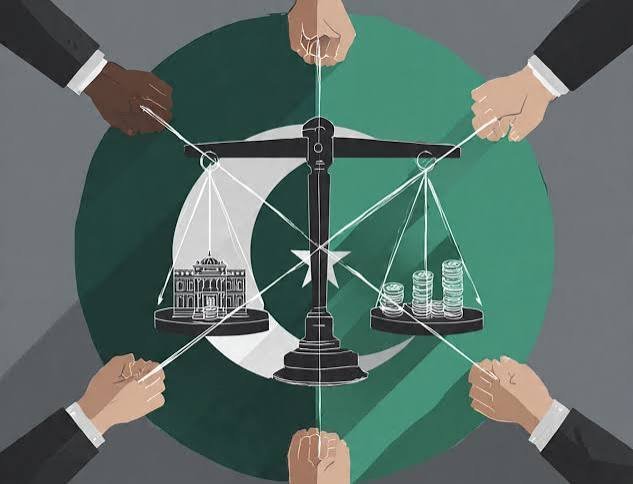
Pakistan’s energy crisis is neither purely structural nor purely a governance failure. It is rooted in a misaligned investment framework, an architecture that is designed for rent-seeking, not for efficient service delivery. At its core lies a governance failure, compounded by flawed forecasting and DISCOs’ losses.
Any rigorous analysis of Pakistan’s energy crisis must include the historical genealogy. Before 1992, WAPDA was the parent authority, responsible for the whole power infrastructure. By 1992, the Government of Pakistan, due to supply constraints, decided to unbundle WAPDA. In 1994, the GOP under the leadership of Benazir Bhutto introduced the first Independent Power Producers (IPPs) policy, with an underlying objective of attracting foreign direct investment in the power sector. Apparently, the rationale was fine, but its implementation proved wrong over time.
In 1998, under the PML(N) government, the process of competitive bidding was introduced, but not a single investor came. Therefore, the GOP went back to IPPs in 2002.
According to energy experts, Pakistan’s energy crisis stems from these flawed agreements. Basically, the power sector was divided into three main parts: Generation, Transmission, and Distribution. For power generation, the GOP signed contracts with IPPs, spanning twenty-five to thirty years. These contracts were dollar-denominated, and sovereign guarantees were provided to investors. The GOP was obligated to pay for the idle capacity irrespective of the power produced.
At that time, the rationale seemed appropriate. Our bureaucracy in the power division predicted that excessive capacity would generate commensurate increases in economic growth, and vice versa, thereby managing the capacity payments by recoveries. However, that prediction proved wrong. The idle capacity became a burden on the financial capacity of the country.
In 2024, the government of Pakistan paid Rs2.1 trillion in capacity payments. According to the 2020 audit report, 19 IPPs had invested Rs52 billion and extracted Rs 450 billion since then till 2020. Ironically, the government is obliged to pay for every megawatt it could not use.
Pakistan’s energy sector is financially unviable. It has excessive capacity but doesn’t know where to use it. As of FY2025, Pakistan has a generation capacity of 46,605 MW, while peak demand in summer is about 35,000 MW. Winter’s demand is 17,000 MW. According to the agreements, the government is obliged to pay for the 35,000 MW, not for the actual power supplied.
It leads to a more serious problem: circular debt, a bundle of unpaid obligations. For the first time, the circular debt emerged in 2006 and has ballooned to Rs2.1 trillion. According to Afia Malik, a researcher in energy at PIDE, the sources of the circular debt are distorted tariffs, low rates of recoveries of billed amounts, and high transmission and distribution losses (T&D).
Pakistan’s grid structure is characterized by aging infrastructure, unreliable supply, and governance pathologies. After generation, power is transmitted from power houses to the grid under the control of the state-run National Transmission Distribution Company (NTDC). From the grid to homes, power is supplied through 12 state-owned distribution companies (DISCOs).
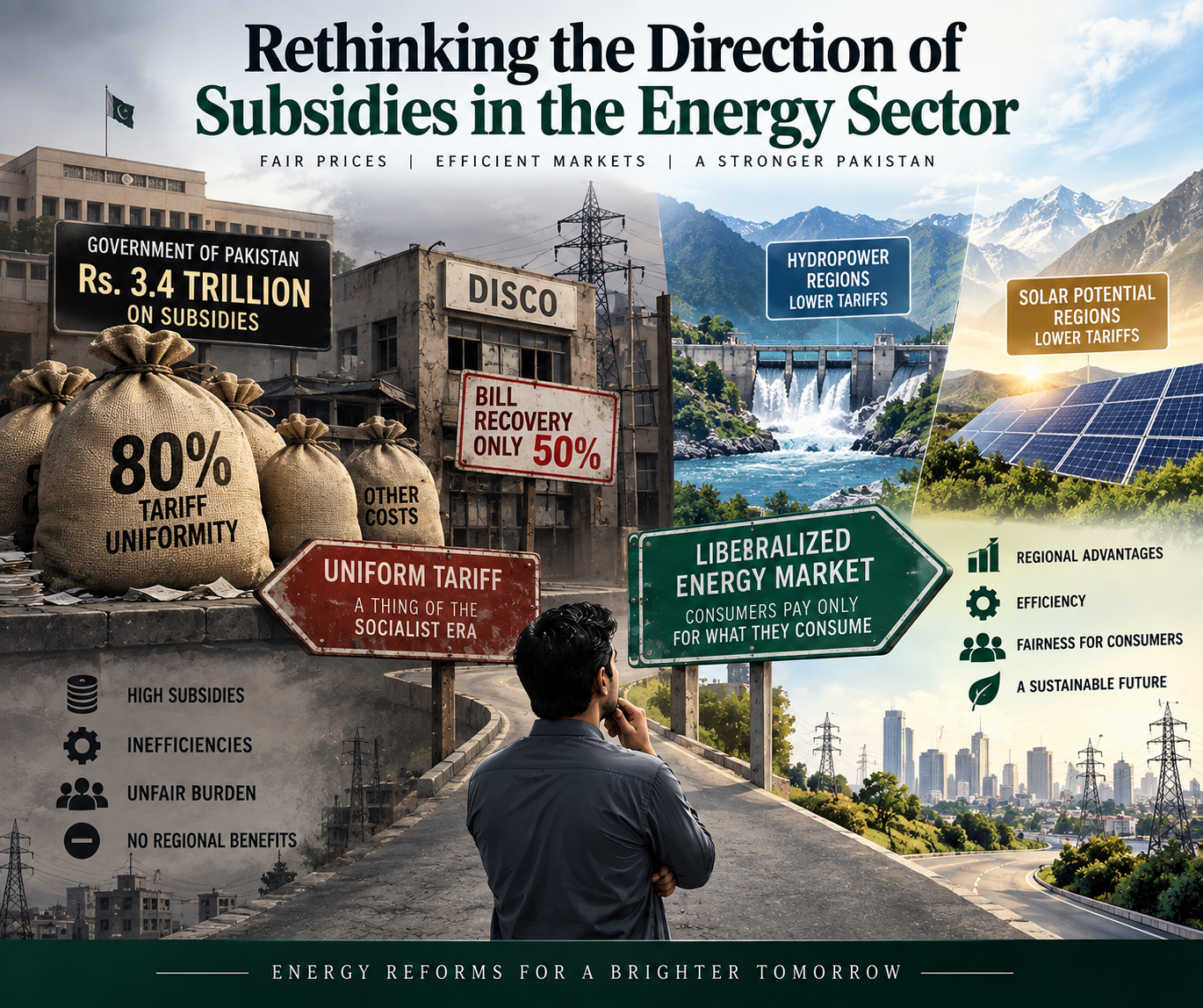
In 2025, DISCOs reported aggregate losses of 20% of the total power supplied, far beyond the global benchmark of 8%. In 2024 alone, DISCOs lost Rs397 billion due to inefficient recoveries and theft, among other factors. However, a stark inequality exists among DISCOs as well: LESCO and IESCO recover 90% of the billed amount, while companies in Peshawar and Quetta can’t even recover 60% of the total billed amount.
The infrastructure is developed without geographical proximity. For example, the per-unit cost of generation in the North is Rs35, while it is Rs17 per unit in the South. The demand in the North is 77%, and in the South it is 23%. There is no adequate infrastructure to transport power from the cheap power houses in the South to the demand sectors in the North.
Pakistan’s energy sector is also very vulnerable to the geopolitical situation and global commodity markets. First and foremost, the energy mix is dominated by expensive fuel, coal, and RLNG, all imported items. However, the GOP, under the Integrated Expansion Plan, decided to increase the share of renewable sources in the energy mix to more than 60% by 2030.
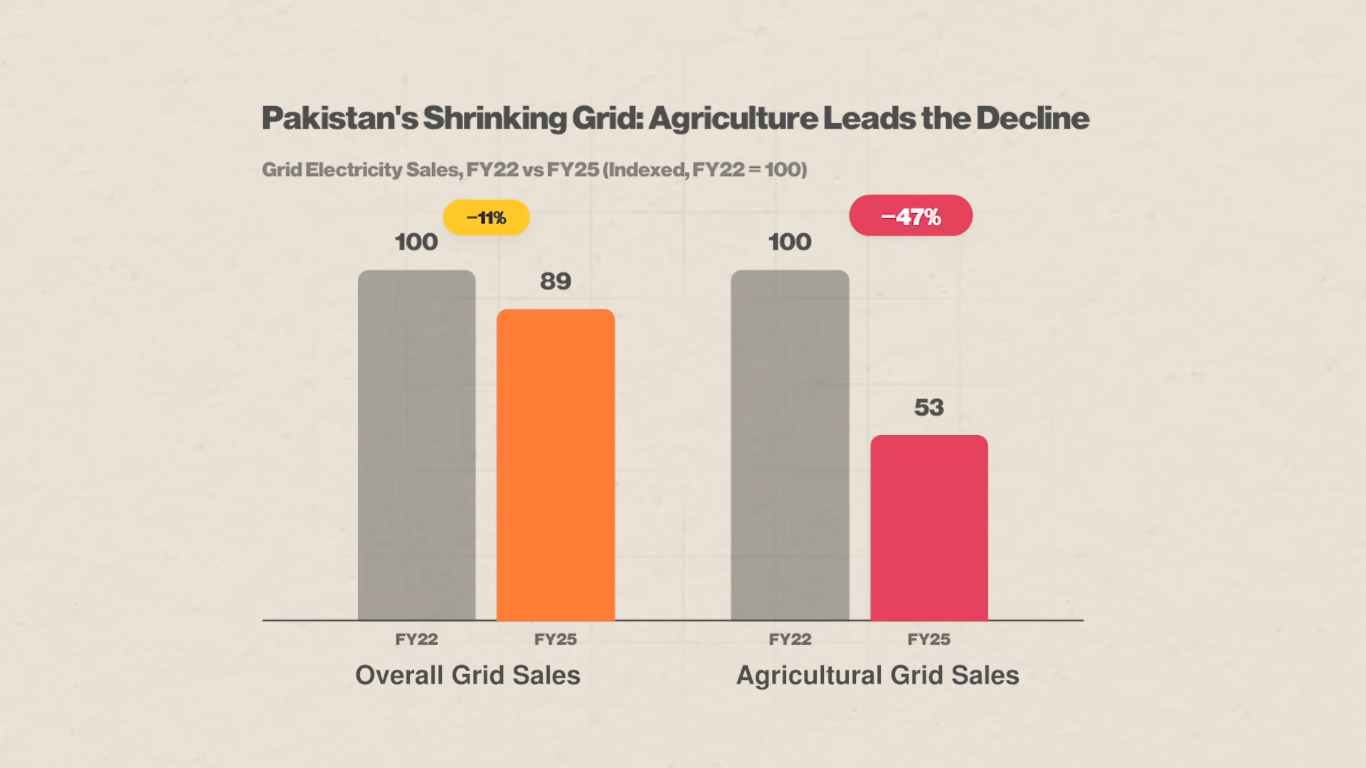
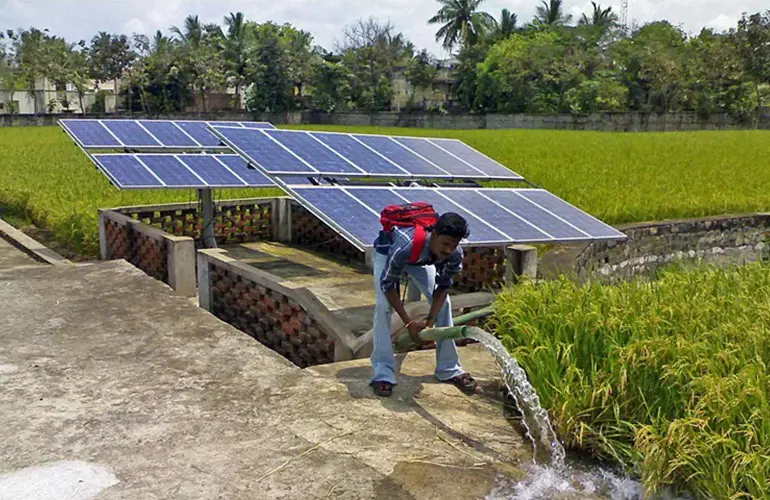
The most important development in Pakistan’s history is the explosive adoption of solar photovoltaic technology (PVs) in the country. It’s a testament to Pakistani entrepreneurial resilience and ingenuity. Also, it shows the institutional failure of energy-related institutions. In 2018, the on-grid capacity of solar energy was about 1,800 MW. By 2024, it had reached 3,500 MW. As of FY2025, Pakistan has imported 17 GWh of solar panels from China, making it the world’s largest (sixth) solar market and single largest importer of solar. Anticipating grid defection, the GOP has imposed a 10% GST on solar PVs, which risks slowing solar adoption among low-income quintiles.
To remedy the energy crisis, Pakistan must take four steps as a priority. Firstly, the footprint of government must be reduced to merely productive oversight. Secondly, the regulatory capacity of NEPRA and OGRA must be enhanced, and these bodies must work independently. Thirdly, the privatization of inefficient DISCOs must be streamlined. Lastly, the energy mix must be focused on local and environmentally safe resources.
To conclude, Pakistan’s energy sector is not just facing challenges; it is in a deep crisis. The seeds of this crisis were sowed in the policy choices made three decades ago. The crisis is very much visible, yet it’s badly understood. It’s the product of misaligned investment frameworks and poor governance. The remedy lies in technology adoption and renewables.
The Writer is the Researcher at the Republic Policy