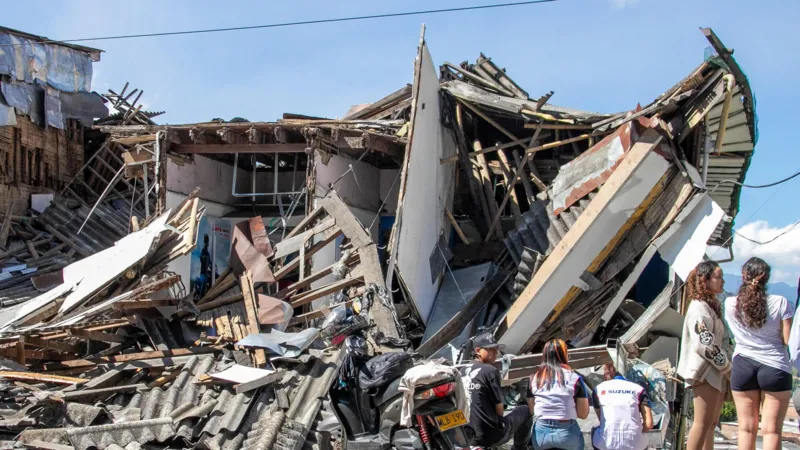

At least 132 people are dead and a state of emergency has been declared after Colombia was struck by one of its largest earthquakes in years, with the death toll expected to rise as more people remain feared trapped under collapsed buildings.
The magnitude 7.4 quake struck at 07:34 local time (12:34 GMT) at a depth of 103km in Chocó province, according to the country’s geological service. It was felt across an enormous area, spanning hundreds of miles across western Colombia. More than 480 people were injured, according to a statement from Colombia’s Association of Capital Cities.
Many of the deaths have been concentrated in Pereira, in Colombia’s coffee-growing region, with surrounding cities and the wider Valle del Cauca region also hit hard. The epicentre was near the village of San José del Palmar in Chocó province, though local mayor León Fabio Marín Moncada said there had miraculously been no deaths or injuries there, despite the roads in and out of the village being damaged.
Pereira and Cali Among Worst Hit
Roughly 55km from the epicenter, Pereira saw some of the most severe damage. Videos verified by the BBC show at least one building collapsing in Plaza Bolívar, the city’s main square, scattering debris and dust across the open space where many people had gathered. Local authorities have reported at least 40 deaths in the city’s metropolitan area, with 65 buildings collapsed and people believed trapped in 15 of them. A curfew has been imposed in parts of the city until 05:00 local time on Tuesday.
In Cali, located about 160km south of Pereira and roughly 200km from the epicenter, 32 buildings collapsed. Dan Cutler, a 29-year-old from London currently travelling in Colombia with his partner, was in Cali when the quake struck. “I’ve never experienced anything like it,” he told the BBC, describing being woken by the tremor. “We sprinted outside in our pajamas. There’s no major structural damage to the hotel, but there are surface cracks in the walls, and paint and plaster have peeled off,” he said.
Further deaths have also been reported in Manizales, Quibdó, Medellín, and across the wider Chocó and Valle del Cauca regions.