
Interest from Barrick and Ivanhoe Mines signals growing international attention towards Pakistan’s mineral potential, but translating investor interest into lasting economic gains will depend on security, infrastructure, regulatory certainty and local participation.
ISLAMABAD: International interest in Pakistan’s mineral sector has gained further momentum as Barrick Mining Corporation expressed strong interest in establishing mineral processing industries in Karachi and Gwadar, potentially expanding its engagement with Pakistan beyond the Reko Diq copper-gold project.
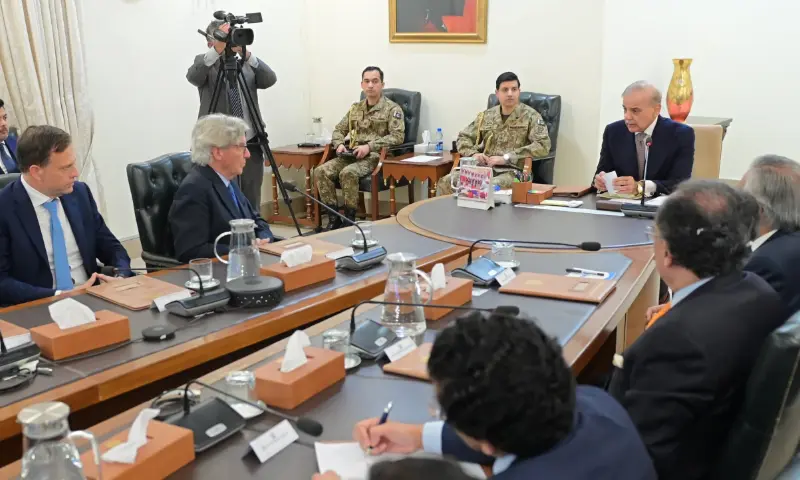
A delegation led by Barrick Mining Chairman John Thornton conveyed its interest during a meeting with Prime Minister Shehbaz Sharif in Islamabad on Friday, according to a statement issued by the Prime Minister’s Office (PMO).
The delegation welcomed the government’s decision to organise the Pakistan Minerals Investment Forum 2026, describing it as an important step towards developing the country’s mineral sector. It also discussed the policy, regulatory and infrastructure frameworks required to support investment in mining and mineral processing.
Prime Minister Shehbaz Sharif said Pakistan possessed substantial natural resources and mineral wealth, adding that their development was a government priority. He emphasised that mineral projects should generate employment, improve local skills and contribute to the economic prosperity of resource-rich regions, particularly Balochistan.
The prime minister described Reko Diq as a significant milestone for investment in Pakistan’s mineral sector, expressing confidence that its success could establish a benchmark for future projects. He also said the government intended to draw on Barrick’s technical expertise and international experience to develop the sector beyond the existing project.
Mineral processing in Karachi and Gwadar
Barrick’s interest in establishing mineral processing industries in Karachi and Gwadar carries significance beyond the extraction of mineral resources. Processing facilities could potentially help Pakistan move towards higher-value activities within the mineral supply chain rather than relying primarily on the extraction and export of raw materials.
Karachi and Gwadar offer potential strategic locations for industrial and export-oriented activity. Their development as mineral processing centres, however, would require reliable energy supplies, transport connectivity, port infrastructure, water availability, skilled labour and a predictable regulatory environment.
The proposal also raises a broader question about Pakistan’s mineral development strategy: whether the country can build an integrated industrial ecosystem around its natural resources. Mining investment can create substantial economic opportunities, but the long-term benefits depend on the capacity to develop associated industries, technical expertise and domestic supply chains.
The PMO statement did not disclose the proposed scale, investment value, timeline or specific minerals associated with Barrick’s interest in Karachi and Gwadar.
Reko Diq remains central to Pakistan’s mineral ambitions
The Reko Diq copper-gold project remains at the centre of Pakistan’s efforts to attract international investment in the mining sector. Located in Balochistan, the deposit is regarded as one of the world’s largest underdeveloped copper-gold resources.
The project is jointly owned by Canadian mining company Barrick Mining Corporation and the federal and Balochistan governments. It is expected to generate substantial economic returns, with estimates cited in the report projecting approximately $70 billion in free cash flow and $90 billion in operating cash flow over its life.
Prime Minister Shehbaz Sharif said the project could create employment, support skills development and contribute to economic growth in Balochistan. He also stressed that local communities should directly benefit from mineral development through employment opportunities, professional training and improvements in surrounding areas.
However, the project’s progress remains linked to the security environment. Government sources and industry insiders have indicated that production could face a delay of approximately two years, potentially shifting the expected start to 2030. The reported delay is linked to security concerns in Balochistan and the need for de-escalation in the Middle East.
The development highlights the importance of addressing security and operational challenges if Pakistan is to establish itself as a reliable destination for long-term mineral investment.
Ivanhoe Mines also signals interest
In a separate meeting, Prime Minister Shehbaz Sharif received a delegation led by Robert Friedland, founder and executive co-chairman of Ivanhoe Mines.
The prime minister reiterated that Pakistan possessed substantial reserves of copper, gold and other critical minerals and expressed the government’s willingness to work with international partners to develop these resources.
According to the PMO, the designation of Pakistan as a “priority destination” for mineral investment reflected growing international confidence in the country’s geological potential and investment environment.
Shehbaz Sharif welcomed Ivanhoe Mines’ interest in Pakistan and its cooperation with local partners. He also referred to the exchange of memorandums of understanding during the Pakistan Minerals Investment Forum 2026 as a positive development.
The government assured the delegation of full facilitation through the Special Investment Facilitation Council (SIFC), which has been positioned as a mechanism for coordinating and facilitating investment in key sectors.
The meeting was attended by Deputy Prime Minister and Foreign Minister Ishaq Dar, federal ministers Muhammad Aurangzeb and Ali Pervaiz Malik, Special Assistants Tariq Fatemi and Lieutenant General (Retd.) Muhammad Zafar Iqbal, along with other senior officials.
Converting investor interest into sustainable development
The interest shown by Barrick and Ivanhoe Mines offers an opportunity to strengthen Pakistan’s position in the international mineral economy. Yet investor interest and memorandums of understanding are only the initial stages of a much longer process. The real test will be whether these expressions of interest translate into operational projects, industrial capacity, employment and measurable benefits for local communities.
Pakistan will need to provide transparent and consistent regulatory arrangements, strengthen coordination between federal and provincial authorities, improve infrastructure and establish credible mechanisms for environmental protection. In a sector involving substantial capital investment and long project timelines, policy predictability and institutional continuity are particularly important.
The distribution of economic benefits will also be critical. Balochistan, which hosts major mineral deposits, must receive meaningful opportunities through local employment, skills development, infrastructure and community investment. Mineral development cannot be considered successful if the regions supplying the resources remain disconnected from the resulting economic gains.
Similarly, proposals for processing industries in Karachi and Gwadar should be assessed as part of a wider national industrial strategy. The objective should be to develop domestic technical capabilities, encourage value addition and create stronger links between mineral extraction, manufacturing and international trade.
Pakistan’s mineral wealth offers considerable economic potential, but natural resources alone do not guarantee prosperity. The outcome will depend on the quality of institutions, the credibility of public policy and the ability to ensure that investment serves broader national and regional development objectives.