
Editorial
For more than six decades, the Indus Waters Treaty has survived wars, military crises, diplomatic breakdowns and prolonged periods of distrust between Pakistan and India. That endurance is not a minor diplomatic achievement. It reflects a fundamental reality of geography: whatever the state of bilateral relations, the two countries remain connected by a river system on which the lives and livelihoods of millions depend.
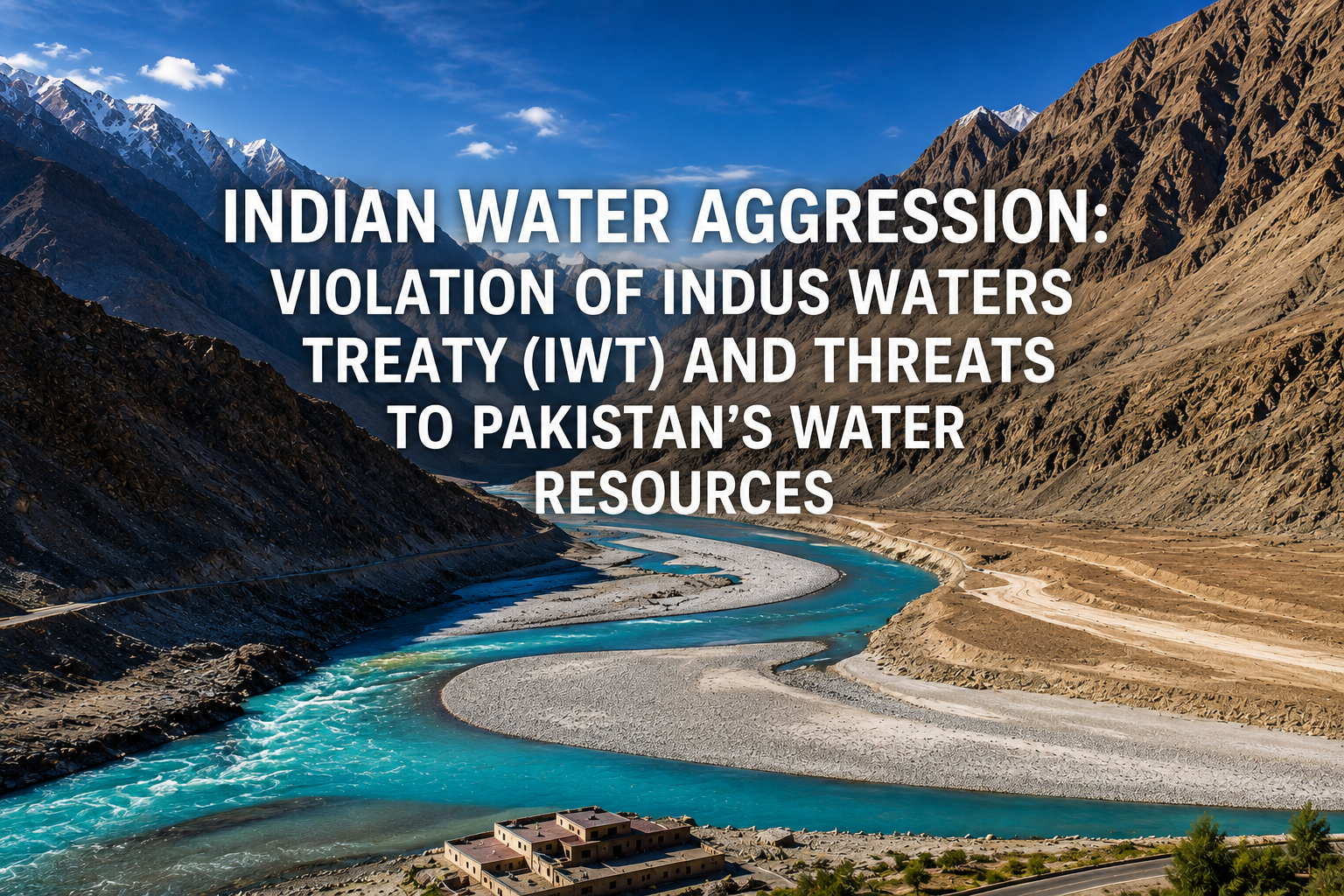
The study Indian Water Aggression: Violation of Indus Waters Treaty (IWT) and Threats to Pakistan’s Water Resources, published by the Islamabad Policy Research Institute, draws attention to the growing strain on this framework and to Pakistan’s concerns over Indian hydropower development on the western rivers. Its broader message deserves serious consideration. Water relations between Pakistan and India should not be allowed to drift from a difficult technical dispute into an open-ended instrument of geopolitical pressure.
The Indus Waters Treaty was signed in 1960 after years of negotiations facilitated by the World Bank. Its essential bargain was practical rather than sentimental. The eastern rivers—Ravi, Beas and Sutlej—were allocated principally to India, while Pakistan received rights over the waters of the western rivers—Indus, Jhelum and Chenab—subject to specified Indian uses. The arrangement did not eliminate disagreement. It created rules through which disagreement could be managed.
That distinction matters today.
Pakistan’s concerns are not based simply on the fact that India constructs hydropower projects. The treaty permits India certain uses of the western rivers, including run-of-river hydroelectric generation within defined conditions. The real dispute concerns design, storage, operational flexibility and cumulative upstream capacity.
The study catalogues a substantial number of Indian hydropower projects on the Jhelum, Chenab and Indus systems. Its table includes major projects such as Kishanganga, Uri-I and Uri-II on the Jhelum; Salal, Dulhasti, Baglihar, Ratle and Pakal Dul on the Chenab; and Nimoo Bazgo and Chutak on the Indus. Some are operational, others under construction or proposed. The significance lies not merely in counting dams. It lies in understanding how a growing network of upstream infrastructure can affect the confidence of a downstream state in the timing, predictability and management of river flows. The project inventory presented on pages 13–14 of the study illustrates the scale of this concern.
This is where the debate must remain technically precise. A dam does not automatically constitute a treaty violation, and every Indian hydropower project cannot reasonably be described as an attempt to deprive Pakistan of water. But neither should Pakistan’s concerns about design parameters and cumulative upstream control be dismissed as paranoia. In a river basin shared by nuclear-armed neighbours, even the perception that one side may acquire excessive operational control over water flows can become strategically destabilising.
The history of the Baglihar and Kishanganga disputes demonstrates precisely why the treaty’s dispute-resolution architecture matters. Technical disagreements over pondage, spillways, drawdown levels, diversion and minimum flows are extraordinarily complex. They cannot responsibly be settled through political slogans. They require hydrological evidence, engineering analysis, treaty interpretation and independent adjudicatory mechanisms.
Kishanganga is particularly instructive. The dispute concerned India’s diversion of water from the Kishanganga/Neelum river for hydropower generation and Pakistan’s downstream interests. The case eventually went before international arbitration. Whatever one’s interpretation of individual findings, the episode demonstrated something valuable: even a deeply contentious water dispute could be taken out of the realm of political confrontation and subjected to legal and technical examination.
That institutional discipline is now under greater pressure.
Holding the Treaty in Abeyance Is a Dangerous Precedent
The most consequential development is India’s announcement in April 2025 that the Indus Waters Treaty would be held in abeyance following the Pahalgam attack. The study records the development in the context of India’s growing dissatisfaction with the treaty and its dispute-resolution mechanisms.
Terrorism is an extraordinarily serious matter, and legitimate security concerns must be addressed. But the Indus Waters Treaty is a water-sharing agreement. Transforming a river treaty into an instrument of retaliation for disputes originating outside its substantive scope creates a dangerous precedent.
Water treaties exist precisely because rivers cannot be switched on and off according to the diplomatic temperature between states.
The treaty was designed to provide predictability even when political relations deteriorated. If every major security crisis can suspend the operation of an international water arrangement, the value of such agreements is fundamentally weakened.
There is another reason for restraint. Pakistan’s dependence on the Indus basin is structural. Its irrigated agriculture, food production, rural economy and large population centres are intimately connected with the river system. Water insecurity therefore cannot be treated as an ordinary bilateral bargaining issue.
At the same time, Pakistan should resist overstating what India can physically do. Geography and engineering impose constraints. The study itself acknowledges that large-scale diversion of western-river waters is technically challenging and would require substantial infrastructure. That qualification strengthens rather than weakens Pakistan’s argument. A credible water policy should distinguish between immediate hydrological capability, longer-term infrastructure development and political signalling.
Pakistan’s case will be strongest when it is technically rigorous rather than rhetorically maximalist.
The Larger Crisis Is Pakistan’s Own Water Vulnerability
There is also an uncomfortable truth that Pakistan must confront.
India is not the source of every Pakistani water problem.
Pakistan’s water insecurity is being intensified by population growth, groundwater depletion, inefficient irrigation, sedimentation of major reservoirs, inadequate storage, climate variability, weak urban water management and institutional fragmentation. The study draws attention to declining reservoir capacity and increasing dependence on groundwater. These domestic weaknesses magnify the strategic consequences of any upstream uncertainty.
This should fundamentally shape Pakistan’s response.
Diplomacy over the Indus Waters Treaty is necessary, but it cannot substitute for water reform at home. A country that considers water an existential resource must manage that resource accordingly.
Pakistan therefore needs to strengthen its technical capacity for continuous monitoring of Indian projects; invest in hydrological modelling and satellite-based observation; improve coordination among water, climate, agriculture and foreign-policy institutions; modernise irrigation; reduce conveyance losses; regulate groundwater extraction; expand storage where environmentally and economically justified; and improve water productivity in agriculture.
The strongest defence of Pakistan’s water rights is a combination of international law, technical competence and domestic water governance.
Climate Change Makes Cooperation More Necessary, Not Less
The Indus basin is entering an era for which the geopolitical assumptions of the twentieth century are increasingly inadequate.
Glacial change, extreme rainfall, floods, droughts, rising temperatures and changing seasonal patterns are altering the hydrology on which both countries depend. Climate change does not respect the Line of Control, international borders or diplomatic hostility.
This means India and Pakistan face an uncomfortable paradox: political relations may make cooperation increasingly difficult at precisely the moment ecological change makes cooperation increasingly necessary.
The future of the Indus therefore cannot be reduced simply to the division of river volumes established in 1960. The basin increasingly requires better exchange of hydrological information, flood warning, climate-risk assessment, transparent project data and credible mechanisms for resolving technical disputes before they become political crises.
The treaty may need adaptation over time. But adaptation is fundamentally different from unilateral abandonment. Any serious reconsideration should occur through negotiation, mutual consent and the legal mechanisms available to the parties—not through coercive suspension.
Pakistan Must Build Its Case Around Law, Not Anger
Pakistan’s response should remain firm but measured.
It should insist on its treaty rights, pursue available legal and diplomatic remedies, scrutinise upstream projects rigorously and resist any attempt to normalise unilateral alteration of established water arrangements. But it should do so through evidence rather than alarmism.
The language of “water war” may attract attention, but Pakistan’s strongest argument is considerably more sophisticated: international river systems require predictable rules because upstream power and downstream vulnerability are inherently unequal. The purpose of a treaty is to prevent that physical asymmetry from becoming political coercion.
India, too, has a long-term interest in preserving this principle. It is itself a downstream state in other transboundary river systems. A doctrine under which an upstream country may disregard established water arrangements whenever political relations deteriorate would hardly serve India’s wider strategic interests.
The Indus Waters Treaty should therefore be viewed not as a favour that one country grants another, but as an institutional restraint accepted by both sides in recognition of geographical interdependence.
Pakistan and India may disagree over Kashmir, security, terrorism, regional influence and almost every dimension of their bilateral relationship. Rivers, however, obey none of these political divisions.
The achievement of the Indus Waters Treaty was never that it created trust between Pakistan and India. Its achievement was that it created rules where trust did not exist.
That is precisely why it remains valuable—and precisely why it should be preserved.