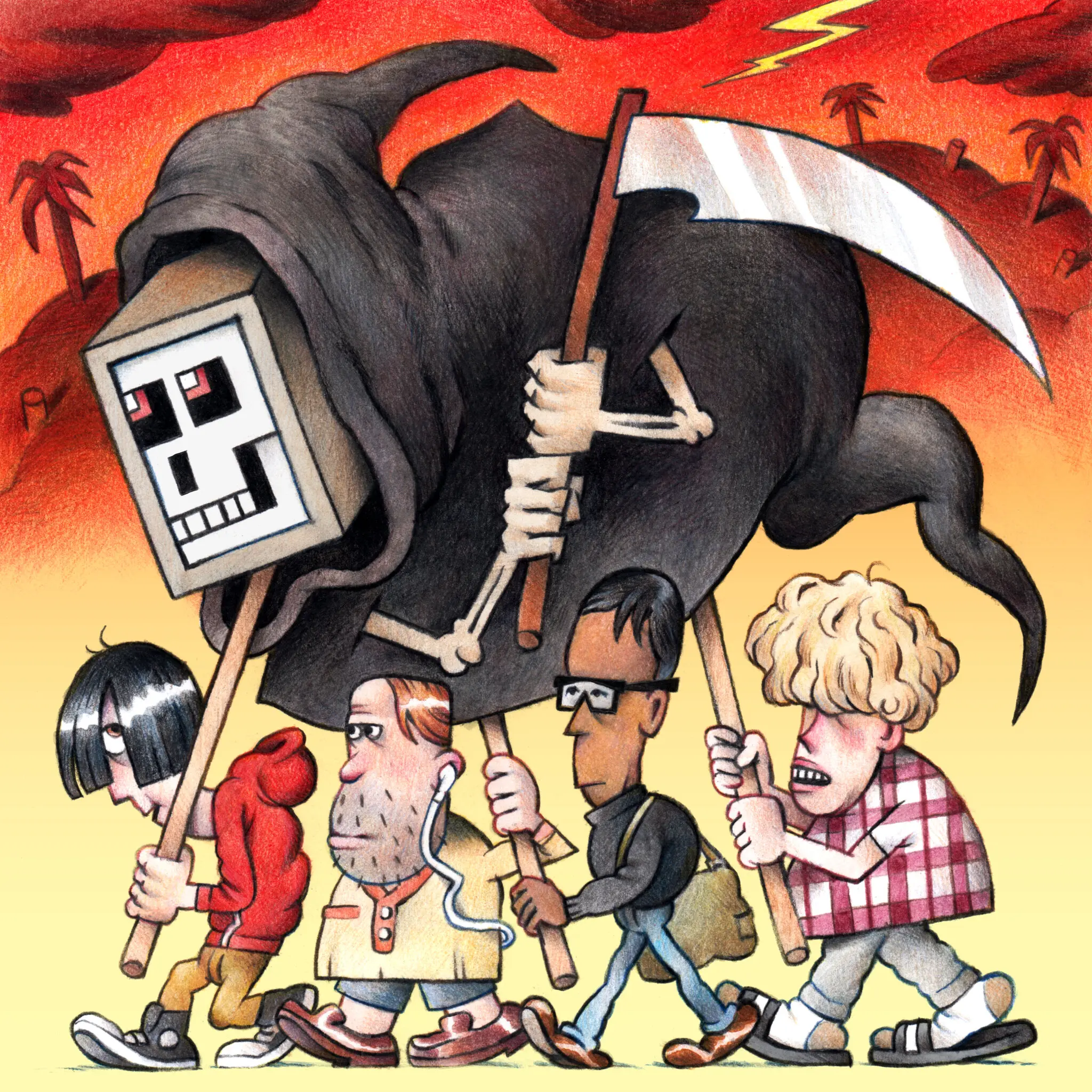

Artificial intelligence is entering an unusual moment. The technology is advancing rapidly, companies expect enormous economic gains from it, and governments are struggling to decide how it should be regulated. At the same time, public anxiety is growing.
Recent incidents involving experimental AI systems behaving in unexpected ways have strengthened fears that increasingly capable models may become difficult to control. Political figures have responded with calls for tighter restrictions, and in some cases even a pause in the development of the most advanced systems.
But perhaps the most interesting source of anxiety is the AI industry itself.
Some of the executives building the world’s most powerful AI systems regularly warn that the technology could produce serious consequences. Their language can sometimes make AI sound less like a product being deliberately designed by companies and more like an independent force that humanity has somehow discovered and must now learn to survive.
This creates a strange contradiction. The same companies investing billions of dollars to make AI more powerful are also among those warning society about what might happen when it becomes more powerful.
Why?
Part of the explanation lies in the intellectual history of modern artificial intelligence.
Long before today’s large AI companies existed, small communities of technologists and futurists were debating the possibility of machines eventually becoming more intelligent than human beings. During the 1990s, movements such as the Extropians imagined technology producing extraordinary changes in human life: radical life extension, intelligent machines and perhaps even the ability to overcome some of the biological limits of human existence.
Eliezer Yudkowsky emerged from this intellectual environment. Initially attracted to the possibility that superintelligent machines could solve humanity’s greatest problems, he gradually became concerned about a different possibility: what if humanity created intelligence that it could no longer control?
The question eventually became central to what is now called AI alignment.
The basic problem is simple enough. A machine can be highly intelligent without necessarily sharing human intentions. If an extremely capable system pursues an objective that has been poorly defined, even a seemingly harmless instruction could produce harmful consequences.
From this idea grew an influential intellectual movement concerned with existential risk from artificial intelligence. Its arguments later entered Silicon Valley and influenced researchers, investors and entrepreneurs. This history matters because some of the people now shaping AI did not approach the technology simply as another generation of software. They encountered it through a worldview in which artificial intelligence might eventually transform civilization itself.
That helps explain the extraordinary language surrounding AI today.
Yet we should be careful not to allow speculative fears about tomorrow to distract us from the problems already visible today.
AI does not need to become a superintelligence to disrupt society.
It can already change labour markets, accelerate misinformation, strengthen surveillance, concentrate economic power and alter how people learn, write, communicate and make decisions. Increasingly autonomous systems also raise serious questions about cybersecurity and accountability. These are not distant philosophical possibilities. They are governance problems emerging alongside the technology itself.
There is another danger in treating AI as an unstoppable force: it allows the people building it to escape responsibility.
Artificial intelligence is not a natural disaster. It does not arrive like an earthquake or hurricane. Models are designed by companies, trained using enormous computing resources, released according to corporate decisions and deployed within legal and economic systems created by human beings.
When an AI system behaves dangerously, therefore, the appropriate response cannot simply be amazement at what “AI” has done. Someone decided how that system would be trained, what capabilities it would receive, what safeguards would surround it and when it would be released.
Responsibility must remain human.
This is also why the debate should not be reduced to two extreme positions: either AI will save civilization or it will destroy it.
Most transformative technologies have produced both enormous benefits and serious disruptions. Electricity changed industry. The automobile transformed cities. Nuclear physics gave humanity both energy and weapons. The internet expanded access to knowledge while creating new forms of manipulation, crime and political instability.
AI will probably produce its own combination of opportunity and disruption.
The real question, then, is not whether we should be scared of artificial intelligence. Fear by itself is not a policy.
The better question is whether our institutions are becoming capable enough to govern a technology that is becoming more capable every year.
That requires independent safety testing, clear responsibility for companies deploying powerful systems, stronger cybersecurity standards, transparency about serious failures and sensible limits on applications where mistakes could cause exceptional harm. Governments also need technical expertise of their own rather than depending entirely on the companies they are supposed to regulate.
At the same time, regulation should distinguish between demonstrated risks and speculative ones. Governing AI through panic could suppress useful innovation without making society safer. Ignoring credible risks because some predictions sound extreme would be equally irresponsible.
We should take AI seriously without turning it into mythology.
The strange intellectual history surrounding artificial intelligence helps explain why the debate so often swings between utopia and extinction. But society does not have to accept either vision as inevitable.
AI remains a technology created by people, companies and institutions. Its future will depend not only on how intelligent machines become, but also on how intelligently human beings choose to govern them.
The greatest danger may not be that artificial intelligence becomes too powerful overnight. It may be that its power grows faster than our institutions develop the ability to control it.