
Opinion | Republic Policy
Police reform in Pakistan is not merely a question of improving law enforcement efficiency, providing modern equipment, or strengthening operational capabilities. It is fundamentally a question of constitutional governance, institutional design, professional specialization, legal modernization, and the rights of police personnel. Despite decades of administrative changes, Pakistan’s policing system continues to reflect structural arrangements inherited from the colonial era. Meaningful reform, therefore, requires a comprehensive reconsideration of how the police service is constituted, organized, regulated, and administered.
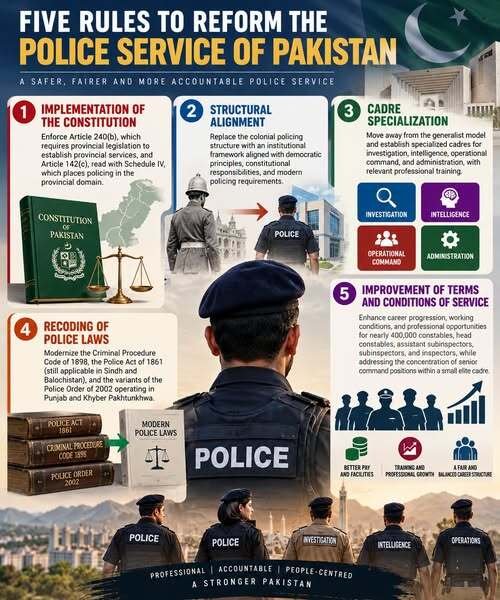
The central challenge is to transform policing from a predominantly command-oriented administrative structure into a professional, constitutionally aligned, and publicly accountable institution. Five fundamental principles provide a framework for achieving this transformation.
1. Implementing the Constitutional Framework
The first requirement of police reform is the implementation of Pakistan’s constitutional provisions concerning provincial authority and public services.
Article 240(b) provides for the regulation of appointments and conditions of service in provincial services through legislation enacted by the respective provincial assemblies. Similarly, Article 142(c), read with the Fourth Schedule, establishes the constitutional basis for provincial legislative authority over matters such as policing.
These provisions are significant because they establish the legal foundation for provincial responsibility in organizing and regulating police services.
However, the continued influence of centrally structured service arrangements raises important questions about the practical implementation of provincial autonomy in police administration.
Reform must begin by bringing the organization, recruitment, management, and career structures of provincial police services into alignment with the constitutional distribution of authority.
Provincial governments should exercise their legislative responsibilities by developing police service frameworks that reflect their constitutional powers and administrative requirements.
Without constitutional alignment, other reform initiatives risk remaining temporary administrative adjustments rather than lasting institutional changes.
2. Replacing Colonial Structures with Democratic Institutions
The second principle concerns the institutional structure of policing.
Pakistan inherited a police system largely designed to maintain colonial authority and enforce administrative control. Its organizational culture, hierarchical arrangements, and concentration of command powers were shaped by the priorities of colonial governance rather than the requirements of a modern democratic society.
Although the political and constitutional environment has changed, important features of that institutional inheritance continue to influence policing.
A democratic police service must operate according to constitutional responsibilities, legal accountability, professional independence, and public service obligations.
Structural reform should therefore reconsider the distribution of authority, command arrangements, administrative oversight, and institutional responsibilities within police organizations.
The objective should not simply be to rename existing institutions or introduce additional administrative positions. It should be to establish an organizational framework appropriate to a constitutional democracy.
Such a framework must distinguish professional police functions from political interference while ensuring that police institutions remain accountable to the law and legitimate civilian authority.
Modern policing requires institutions designed for public protection, crime prevention, investigation, and lawful enforcement rather than the preservation of an outdated administrative hierarchy.
3. Establishing Specialized Police Cadres
The third principle is professional specialization.
Modern policing involves a wide range of technically demanding responsibilities, including criminal investigation, intelligence gathering, operational command, public security, and institutional administration.
Yet Pakistan’s police service continues to rely substantially on a generalist career structure in which officers may move across fundamentally different professional responsibilities.
This arrangement limits the development of specialized expertise and weakens the institutional continuity necessary for complex police functions.
A modern police service should establish distinct professional cadres for investigation, intelligence, operational command, and administration.
Each cadre should have its own recruitment requirements, professional qualifications, training programmes, performance standards, and career progression mechanisms.
Criminal investigation, for example, requires knowledge of evidence, forensic procedures, investigative methods, and criminal law. Intelligence work demands different analytical and operational capabilities. Administrative management requires expertise in personnel systems, budgeting, institutional planning, and organizational development.
These functions cannot be treated as interchangeable responsibilities requiring identical professional preparation.
Specialization would allow officers to develop expertise throughout their careers while enabling police institutions to build professional capacity in their respective areas.
The transition from generalist administration to specialized policing is therefore essential for improving institutional effectiveness and professional standards.
4. Modernizing and Recodifying Police Laws
The fourth principle concerns the legal framework governing policing.
Pakistan continues to operate under a combination of colonial-era legislation and subsequent legal reforms that have produced different policing arrangements across the provinces.
The Criminal Procedure Code of 1898 remains a foundational component of the criminal justice system. The Police Act of 1861 continues to influence policing arrangements, including in Sindh and Balochistan, while Punjab and Khyber Pakhtunkhwa operate under legal frameworks developed through the Police Order of 2002 and subsequent provincial modifications.
These arrangements reflect different historical periods, administrative philosophies, and legislative approaches.
Modern police reform requires a comprehensive review and recodification of the relevant laws to ensure consistency with constitutional principles, contemporary criminal justice requirements, and the operational realities of policing.
Legal modernization should address institutional responsibilities, investigative procedures, accountability mechanisms, professional standards, and the relationship between police organizations and other components of the criminal justice system.
It must also establish clear distinctions between the functions of investigation, prosecution, public order management, and administrative supervision.
Reforming police institutions without updating the legislation governing their operations would leave important structural weaknesses unresolved.
Legal reform is therefore not a supplementary exercise. It is a central requirement of institutional transformation.
5. Improving Service Conditions and Career Progression
The fifth principle addresses the personnel who perform the overwhelming majority of policing responsibilities.
Pakistan’s police organizations include nearly 400,000 personnel serving in ranks such as constable, head constable, assistant subinspector, subinspector, and inspector.
These officers constitute the operational foundation of policing. They interact directly with citizens, respond to emergencies, conduct investigations, maintain public order, and perform essential law enforcement duties.
Yet their professional advancement, working conditions, and institutional opportunities remain major concerns.
An effective police reform programme must improve remuneration, workplace conditions, professional training, career progression, and opportunities for advancement across these ranks.
Particular attention should be given to the concentration of senior command positions within a comparatively small elite cadre.
A professional police service should provide credible pathways through which qualified and experienced personnel can advance on the basis of competence, performance, and relevant professional expertise.
Institutional arrangements that restrict career progression for large sections of the police workforce can weaken morale and discourage professional development.
Improving service conditions is not simply a matter of employee welfare. It is directly connected to organizational performance, institutional integrity, and the quality of policing delivered to citizens.
Police personnel who receive appropriate training, professional recognition, fair treatment, and realistic career opportunities are better positioned to fulfil their responsibilities effectively.
Police Reform Must Be Institutional, Not Cosmetic
Pakistan’s police reform debate has too often concentrated on individual appointments, transfers, operational interventions, and short-term administrative measures.
Such initiatives may address immediate concerns, but they cannot resolve weaknesses rooted in constitutional arrangements, institutional structures, professional organization, outdated legislation, and service conditions.
The five principles outlined above should therefore be understood as interconnected elements of a single reform programme.
Constitutional implementation establishes the legal foundation. Structural alignment creates institutions suitable for democratic governance. Cadre specialization develops professional competence. Legal recodification modernizes the regulatory framework. Improved service conditions strengthen the personnel responsible for implementing the system.
None of these reforms can achieve its full purpose in isolation.
A specialized police service operating under outdated laws would remain institutionally constrained. Better service conditions without career restructuring would leave fundamental inequalities unresolved. Similarly, structural reforms that disregard constitutional authority would lack a coherent legal foundation.
Pakistan consequently requires an integrated approach that addresses the police service as a constitutional, legal, administrative, and professional institution.
The ultimate objective must be to establish a police service that protects citizens, upholds the rule of law, respects constitutional authority, and performs its responsibilities through professional competence rather than inherited administrative privilege.
Police reform cannot succeed merely by changing the individuals who command the institution. It requires changing the constitutional, legal, and professional arrangements through which the institution itself operates.
These five principles provide the foundation for a broader discussion of police service reform in Pakistan and form part of Republic Policy’s forthcoming publication on the subject.