
Nadeem-ul-Haque
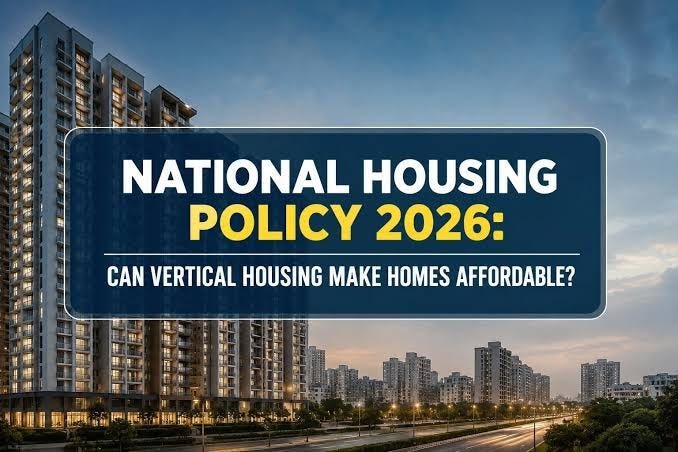
Pakistan’s National Housing Policy 2026 arrives with an ambitious vocabulary of affordable housing, climate resilience, social inclusion and sustainable urban development. Yet beneath these commitments lies a fundamental weakness: the policy offers an extensive catalogue of proposed interventions without adequately examining the institutional, economic and constitutional questions that have shaped Pakistan’s housing crisis for decades.
Issued by the Ministry of Housing and Works in August, the 90-page document reflects many of the priorities commonly associated with contemporary international development frameworks. It advocates public-private partnerships, improved urban planning and greater access to housing. However, the central question is not whether these objectives are desirable. It is whether the proposed policy addresses the structural constraints that prevent Pakistan’s cities from providing affordable, accessible and adequate housing.
A meaningful national housing policy must begin by defining the responsibilities of the state, identifying the institutional barriers to housing development and establishing a credible relationship between policy commitments and the resources required to implement them. On these essential questions, the new policy remains insufficiently clear.
The first difficulty concerns the constitutional distribution of authority. Following the 18th Constitutional Amendment, housing, land administration, urban planning, building regulation and property taxation largely fall within provincial jurisdiction. This raises an important question about the purpose and practical authority of a comprehensive federal housing policy.
The document draws upon international examples, including Canada, Australia and India, where federal governments play significant roles in housing development. However, these comparisons overlook an important institutional distinction. Federal involvement in those countries is frequently supported by substantial financial resources, intergovernmental funding arrangements and established administrative mechanisms.
Pakistan’s federal government, constrained by fiscal pressures and commitments under an International Monetary Fund programme, possesses limited financial capacity to undertake comparable interventions. A policy that assigns responsibilities to provincial institutions without providing the necessary financing, legislative instruments or enforcement arrangements risks becoming an aspirational document rather than an operational framework.
This does not mean that the federal government has no legitimate role in housing. Its responsibilities could be concentrated in areas where national intervention offers clear institutional and economic advantages.
Strengthening mortgage foreclosure and recovery mechanisms, improving the legal security of property transactions, developing reliable national housing statistics and ensuring transparency in real estate markets would provide a more coherent federal agenda. Equally important is the productive utilisation of valuable urban land controlled by federal ministries, railway authorities, cantonments and other public institutions.
These interventions would address identifiable market failures and institutional deficiencies without unnecessarily duplicating provincial responsibilities.
A second weakness is the policy’s reluctance to reconsider the existing relationship between the state and the housing market.
Pakistan’s housing sector is not characterised simply by inadequate government involvement. In several important respects, it is shaped by extensive administrative control over land development, construction permissions, zoning regulations and property transactions.
Development authorities, government housing schemes, defence housing institutions and state-approved residential societies occupy influential positions within the country’s urban property markets. Public institutions also allocate residential plots and housing benefits to government employees, creating a complicated relationship between regulatory authority and participation in real estate development.
This arrangement raises a fundamental governance concern: how can institutions responsible for regulating urban development simultaneously operate as major participants in the same market?
The National Housing Policy largely approaches these institutions through the language of administrative coordination. It gives insufficient attention to the conflicts of interest, market distortions and institutional incentives that may arise when public authorities combine regulatory and commercial functions.
An effective reform agenda should therefore examine not only how these institutions cooperate but also whether their existing responsibilities and privileges serve the broader public interest.
The constitutional dimension of housing policy requires equally serious consideration.
Pakistan’s Constitution contains provisions that reflect different understandings of property rights, social welfare and state responsibility. Articles 23 and 24 protect the ownership and security of private property, while Articles 3 and 38 establish broader principles concerning the elimination of exploitation, social justice and the welfare of vulnerable citizens.
Article 253 permits Parliament to impose limits on property ownership, while Article 30 establishes the non-justiciable character of the Principles of Policy.
These provisions reflect a constitutional framework in which private property protections coexist with social and economic responsibilities assigned to the state.
Yet Pakistan has never fully resolved the policy implications of this relationship. The nationalisation policies of the 1970s and the subsequent movement towards privatisation transformed the country’s economic arrangements without producing a comprehensive public debate about the appropriate boundaries of state intervention.
Housing policy has consequently remained vulnerable to ambitious political promises, ranging from subsidised residential schemes to commitments involving millions of new homes.
The National Housing Policy 2026 continues this tendency by proposing, under Section 3.7.2, the recognition of adequate and affordable housing as a legal right for every citizen.
The objective may appear socially desirable, but its legal and fiscal implications demand careful examination.
What constitutes affordable housing? Should affordability be measured as a percentage of household income, the cost of purchasing a dwelling, rental expenditure or access to essential services? How should differences between cities, income groups and household circumstances be incorporated into such a definition?
The policy considers the conventional benchmark of housing expenditure amounting to 30 percent of household income, questions its adequacy and identifies alternative approaches without establishing a consistent operational standard.
This ambiguity becomes particularly consequential when affordability is proposed as an enforceable legal entitlement.
Housing affordability is not an inherent characteristic of a residential building. It emerges from the relationship between household incomes, land prices, construction costs, financing conditions and regulatory restrictions.
If housing prices in Lahore increase substantially faster than wages, the resulting affordability crisis cannot be resolved merely by declaring housing a legal right. Such a commitment would require clearly defined obligations, financing mechanisms and institutional responsibilities.
The distinction between constitutional welfare objectives and enforceable legal rights must therefore be addressed through parliamentary deliberation rather than left unresolved within an administrative policy document.
Perhaps the most consequential omission, however, concerns the physical and economic structure of Pakistan’s cities.
For decades, urban development has been dominated by low-density residential schemes, extensive land subdivision and outward geographical expansion. Instead of accommodating population growth through greater density and mixed-use construction, major cities have increasingly expanded into surrounding agricultural and peri-urban areas.
This development pattern raises infrastructure costs, increases commuting distances and places additional pressure on urban services.
The National Housing Policy recognises some of these challenges. It endorses compact urban development, mixed land use and medium- to high-rise construction. It also advocates moving towards form-based planning regulations.
However, recognising the desirability of urban density is not equivalent to removing the regulatory obstacles that prevent it.
The policy does not adequately confront restrictive floor-area ratios, building height limitations, compulsory parking requirements, setbacks and conversion charges that can discourage the construction of additional residential and commercial floor space.
These restrictions affect the economic viability of urban development by limiting the amount of usable space that can be constructed on valuable land.
Where land prices are high, allowing greater density can distribute land costs across a larger number of residential units. Conversely, maintaining restrictive building regulations can increase per-unit costs and limit the supply of housing in areas where demand is strongest.
The policy’s proposed incentives for developers also raise questions about commercial feasibility. Offering regulatory concessions where 80 percent of floor space is reserved for low-income apartments may appear progressive, but such requirements could prove unattractive in high-value urban locations unless accompanied by credible financial and planning incentives.
Similarly, proposals involving urban growth boundaries, green belts, repeated master planning exercises, additional permissions for land transactions and occupational licensing require careful evaluation of their economic consequences.
Regulation is necessary to protect public safety, environmental quality and property rights. Nevertheless, regulatory measures should be assessed against their effects on construction costs, housing supply and market entry.
The objective should not be deregulation without safeguards, but a regulatory system that enables development while protecting legitimate public interests.
A particularly troubling contradiction emerges in the policy’s treatment of public land and government employee housing.
While Pakistan’s cities face rising land costs and increasing pressure for more efficient urban development, valuable centrally located public estates remain reserved for relatively low-density official accommodation.
The policy’s support for additional government employee housing does not adequately consider the opportunity cost of retaining prime urban land for exclusive residential purposes.
A more economically coherent approach would examine whether portions of such land could be released for mixed-use development, public infrastructure or housing projects that serve a wider population.
The question is not simply how much land the government owns, but whether its allocation produces the greatest possible social and economic benefit.
The treatment of informal settlements presents another inconsistency.
The policy envisages higher-density redevelopment of katchi abadis, including multistorey residential structures with commercial facilities at lower levels. Yet comparable opportunities for increased density are not systematically extended to established low-density residential neighbourhoods.
This creates the possibility of an unequal urban development framework in which poorer communities face substantial redevelopment pressures while more privileged residential areas retain restrictive planning protections.
Urban density should instead be governed by transparent, consistent and economically defensible planning principles that account for infrastructure capacity, environmental conditions and residents’ rights.
Beyond these institutional and regulatory questions lies another fundamental weakness: the measurement of Pakistan’s housing shortage.
The policy relies on estimates suggesting a national deficit of approximately 10 million to 13 million housing units. However, the methodological foundations of these figures remain insufficiently established.
Research conducted by Durr-e-Nayab at the Pakistan Institute of Development Economics in 2022 questioned the widely repeated estimate of a 10-million-unit housing shortage, tracing its citation history without identifying a reliable original calculation.
Her research instead estimated that approximately 4.37 million households experienced congested living conditions, with roughly two-thirds located in rural areas.
The distinction is critically important.
A household experiencing overcrowding, inadequate sanitation or poor housing quality does not necessarily require an entirely new dwelling. Its needs may be addressed through improved infrastructure, housing extensions, secure tenure, better rental arrangements or access to essential services.
The policy’s own census figures, indicating home ownership of approximately 82 percent, further complicate the assumption that Pakistan’s principal housing problem is simply an absence of residential units.
High ownership rates do not establish that housing conditions are adequate. They do, however, suggest that the nature of the housing challenge must be examined more carefully.
A credible housing assessment should distinguish among homelessness, overcrowding, structural inadequacy, insecure tenure, inadequate municipal services and financial unaffordability.
Treating these different problems as a single numerical shortage risks producing inappropriate policy responses and misallocating scarce public resources.
Pakistan’s housing challenge is therefore inseparable from the broader question of urban governance.
The country needs reliable property records, enforceable contracts, functioning mortgage markets, transparent land transactions, adequate infrastructure and planning regulations that respond to economic realities.
It also requires targeted public assistance for households genuinely unable to secure adequate accommodation through the market.
However, these responsibilities should not be confused with an unlimited mandate for the state to control housing production, dominate urban land markets or impose additional administrative restrictions on development.
The National Housing Policy 2026 contains several worthwhile objectives, but its effectiveness will ultimately depend on whether those objectives are translated into institutional reforms, legally coherent responsibilities and financially realistic implementation mechanisms.
The deeper problem is not the absence of policy documents. It is the repeated tendency to substitute policy declarations for difficult decisions about property rights, administrative authority, market competition and the organisation of cities.
Pakistan cannot resolve its housing difficulties merely by announcing additional construction targets or expanding the vocabulary of urban development.
It must first confront the regulations and institutional arrangements that constrain housing supply, increase land costs and prevent cities from adapting to changing economic and demographic demands.
A serious housing policy would begin by asking what the government must do, what it should stop doing and how cities can accommodate more people without continuously expanding outward.
Until these questions receive convincing answers, even an ambitious national housing policy risks becoming another document that describes the housing crisis without addressing the conditions that sustain it.