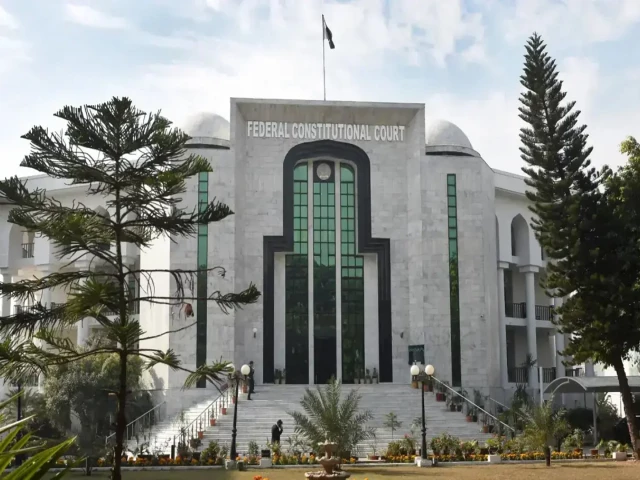

The Federal Constitutional Court (FCC) has upheld a Lahore High Court decision endorsing a Punjab government notification that banned the publication of a book concerning the religion of the Ahmadiyya community.
In a 14-page judgment authored by Justice Aamir Farooq, the court observed that the Constitution guarantees freedom of religion, but that right remains subject to law, public order and morality.
The petitioners had argued that the restrictions violated their religious freedom under Article 20 of the Constitution. The court said such a claim required careful examination of the legal basis and justification for the restrictions imposed under the Code of Criminal Procedure and the relevant ordinance.
However, the FCC held that the necessary material was not properly before it because the petitioners had failed to pursue the remedies available under the relevant laws. In the absence of that material, the court said it could not determine the constitutional question merely on assumptions.
The division bench, headed by Justice Aamir Farooq, also criticised the petitioners’ counsel for making general arguments about fundamental rights and religious freedom without adequately demonstrating the contents of the prohibited material and their legal significance.
The court consequently concluded that, in the circumstances of the case, no violation of the petitioners’ fundamental rights had been established.
The judgment also rejected the argument that the restrictions could simply be characterised as an unlawful exercise of executive authority. According to the FCC, courts must first identify the precise legal source from which a challenged government action derives its authority — whether a statute, delegated legislation or another legal instrument — before determining whether it violates fundamental rights.
It drew a distinction between actions based purely on executive discretion and those taken under statutory authority, observing that the measures challenged in this case fell within the latter category.
The FCC further discussed the constitutional significance of Article 4, which guarantees the right of individuals to be dealt with in accordance with law. The court described Article 4 as a foundational constitutional guarantee underpinning the broader framework of fundamental rights, including religious freedom.
The judgment noted that a judicial forum empowered to decide questions of law can also consider questions involving fundamental rights. However, the petitioners had not challenged the Punjab government’s notifications and actions through the remedies available under Section 99-B of the Code of Criminal Procedure and Section 20 of the relevant ordinance within the prescribed limitation period.
Instead, they approached the Lahore High Court through petitions under Article 199 of the Constitution after what the FCC described as a considerable delay.
The court said no convincing explanation had been provided for that delay, either in the petitions or during the proceedings. It therefore upheld the Lahore High Court’s decision and the Punjab government’s notification restricting publication of the material.