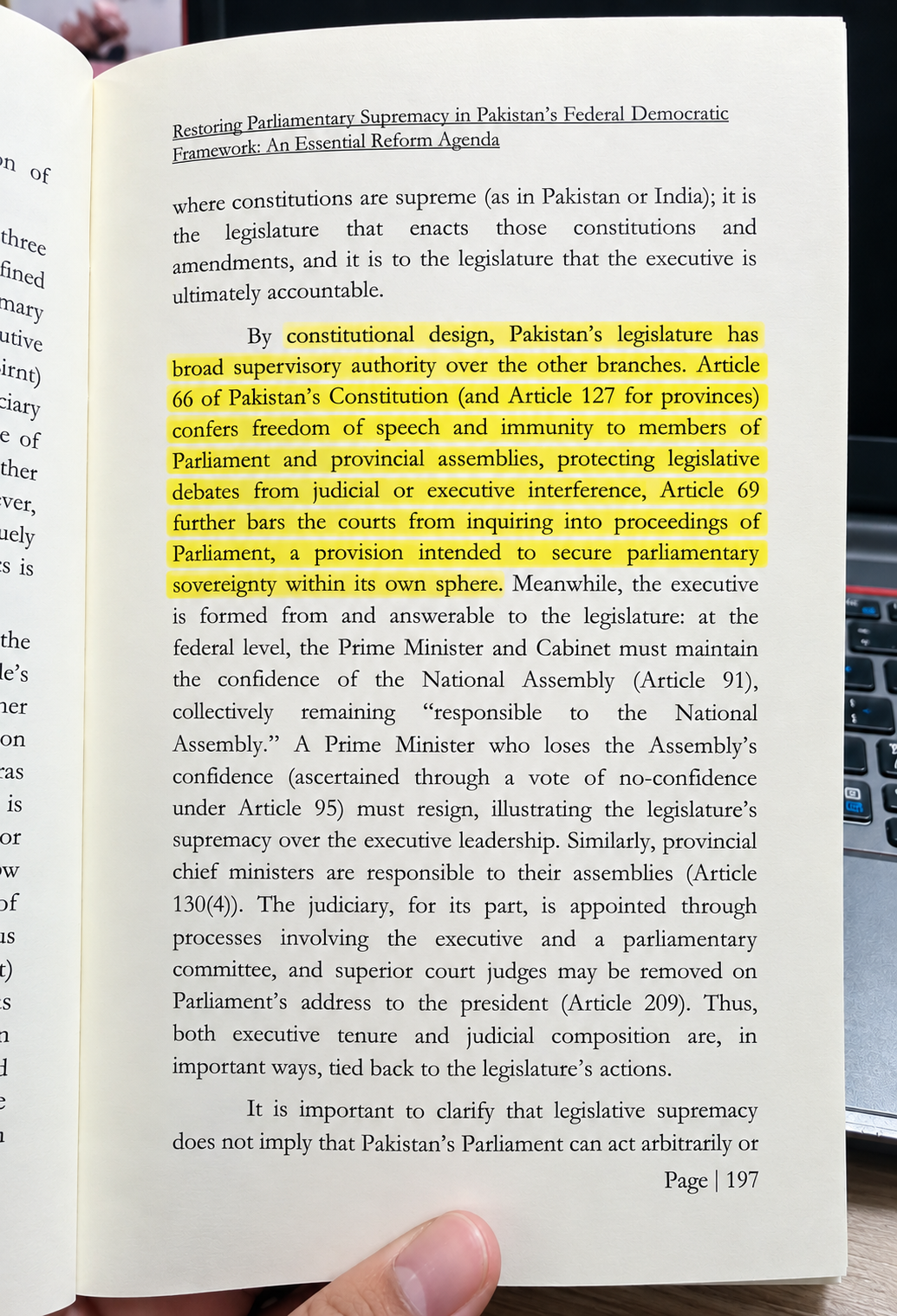

A democracy cannot function effectively if its elected representatives lack the institutional capacity to exercise the authority entrusted to them. Pakistan’s debate on democratic reform has often focused on elections, political parties, governments and constitutional crises. Yet one equally important question receives far less attention: How capable are our legislators of performing their constitutional role?
Legislators are not elected merely to occupy seats in assemblies or vote on government bills. Their responsibilities are much broader. They make laws, represent citizens, approve public expenditure, scrutinise government policies and, most importantly, hold the Executive accountable. If legislators cannot effectively perform these functions, parliamentary democracy becomes weaker regardless of how regularly elections are held.
This is why Pakistan needs to move from simply electing legislators to empowering legislators.
The challenge is partly institutional. The Executive possesses ministries, departments, civil servants, technical experts, official data and an enormous administrative machinery. A legislator, on the other hand, often has comparatively limited access to independent research and technical assistance. This creates an imbalance. The institution responsible for scrutinising the Executive may depend heavily on the Executive itself for the information required to perform that scrutiny.
Legislative empowerment should begin by correcting this imbalance.
Legislators Must Become Legislators
The first principle is simple: legislators must be equipped to perform their actual constitutional responsibilities.
Their primary role should be legislation, representation and oversight rather than involvement in routine administrative matters. They should be capable of examining a proposed law not merely as a political document but through its constitutional basis, financial implications, administrative feasibility and likely impact on citizens.
The same principle applies to executive accountability. Parliamentary questions, motions, resolutions and committee proceedings should not be treated merely as procedural formalities. They are constitutional and parliamentary instruments through which elected representatives can demand explanations from the government.
An effective legislator must know how to ask the right question, obtain the relevant record, examine the evidence and pursue the matter until an adequate institutional response is provided.
Standing Committees Should Become the Engine of Accountability
Perhaps the greatest opportunity for strengthening legislators lies in parliamentary committees.
The floor of an assembly is essential for political debate, but detailed scrutiny requires time, evidence and specialised attention. Standing Committees can provide exactly that. They can examine departmental performance, summon officials, study expenditure, review implementation of laws and investigate why government programmes fail to achieve their stated objectives.
A strong committee should be able to ask basic but consequential questions: What was the department supposed to achieve? How much money was allocated? How much was spent? What results were produced? Why were targets missed? Who was responsible? What corrective action followed?
When committees consistently ask such questions, parliamentary oversight moves from rhetoric to measurable accountability.
Parliament Must Follow the Money
Financial oversight is another fundamental responsibility of legislators. Passing a budget should not mark the end of parliamentary involvement in public expenditure; it should mark the beginning of scrutiny.
Legislators need the capacity to understand budgets, development expenditure, audit observations and departmental financial performance. They should be able to determine whether public money has produced the results for which it was authorised.
This is particularly important in a country facing persistent fiscal constraints. Every rupee spent by the government represents public resources. Legislators therefore have a responsibility not only to approve expenditure but also to ask whether it delivered value to citizens.
Public Accounts Committees, audit reports and departmental expenditure records can become powerful accountability mechanisms when legislators have the knowledge and research support required to use them effectively.
Political Authority and Administrative Expertise
Legislators must also understand the relationship between the political Executive and the permanent bureaucracy.
Civil servants provide institutional continuity, professional expertise and administrative implementation. These functions are indispensable. But administrative expertise should support democratic authority rather than replace it.
The elected political Executive must determine policy and remain accountable for government performance, while the bureaucracy should implement lawful policy professionally and impartially. Legislatures, meanwhile, must scrutinise both policy outcomes and executive performance.
This relationship requires balance. Political interference in routine administration can damage professionalism, but bureaucratic dominance over policymaking can weaken democratic accountability. Strong legislative institutions provide an important mechanism for maintaining that balance.
Legislators Need Independent Knowledge
Modern governance has become increasingly technical. Legislators are expected to consider questions involving taxation, artificial intelligence, climate change, energy, healthcare, public finance, digital regulation, policing and economic policy. No individual legislator can personally become an expert in every field.
The solution is not to expect legislators to know everything. It is to provide them with the institutional capacity to obtain reliable knowledge.
Assemblies need strong research services, legislative drafting assistance, budget analysis and access to independent experts. Committee members should receive concise research briefs before important hearings. Proposed legislation should be accompanied by serious analysis of its financial, administrative and social implications.
Knowledge strengthens oversight. Without independent information, legislators may remain dependent on the bureaucracy they are supposed to scrutinise.
From Training to Institutional Empowerment
Capacity-building should therefore become a continuous part of parliamentary development rather than an occasional workshop.
New and returning legislators should receive practical training in legislative procedure, constitutional powers, committee oversight, budget scrutiny, parliamentary questions and evidence-based policymaking. Training should involve real bills, budgets, audit reports and simulated committee hearings rather than relying exclusively on lectures.
The objective is not academic knowledge for its own sake. It is to enable legislators to use knowledge inside the legislature.
But training alone is insufficient. Individual capacity must be supported by institutional reform. Stronger research wings, professional committee staff, accessible government data, systematic tracking of committee recommendations and greater use of expert testimony can substantially improve legislative performance.
Such reforms should also remain non-partisan. Government and opposition legislators may disagree politically, but both have an institutional interest in protecting the authority and effectiveness of the legislature.
A Strong Legislature Produces Better Government
Pakistan does not need a legislature that attempts to perform the functions of the Executive. Nor does it need legislators acting as administrators. It needs elected representatives who are exceptionally capable at what democratic government actually requires them to do: legislate, represent and oversee.
The quality of a legislature should therefore not be measured simply by the number of bills it passes or the length of its sessions. A more meaningful test is whether it improves laws, scrutinises expenditure, questions government performance, represents citizens effectively and ensures that executive authority remains accountable.
This is the deeper meaning of legislators’ empowerment. It is not about increasing the personal power or privileges of parliamentarians. It is about strengthening their institutional ability to exercise the authority citizens have already given them.
Pakistan will have a more accountable Executive when it has a more capable Legislature. And it will have a stronger democracy when its legislators possess the knowledge, tools and institutional support to perform the job for which they were elected.