
NEW DELHI: India has objected to a newly formalised Pakistan-China boundary mechanism covering a disputed stretch of the Himalayas, arguing that the two countries cannot make arrangements concerning territory New Delhi claims as its own.
Pakistan and China announced the Pakistan-China Boundary Joint Commission last week, describing it as an important step towards closer cooperation on border management, trade and regional connectivity.
India rejected the development, maintaining that it does not recognise a Pakistan-China boundary in the disputed territory.
The announcement comes as India and China attempt to improve relations following years of military tensions along the Line of Actual Control, which separates their forces across much of their Himalayan frontier.
At the same time, Beijing and Islamabad are strengthening cooperation along an adjoining border that India also claims.
Indian foreign ministry spokesperson Randhir Jaiswal said New Delhi rejected the commission and maintained that it had no legal foundation.
Why the Shaksgam Valley Is Central to the Dispute
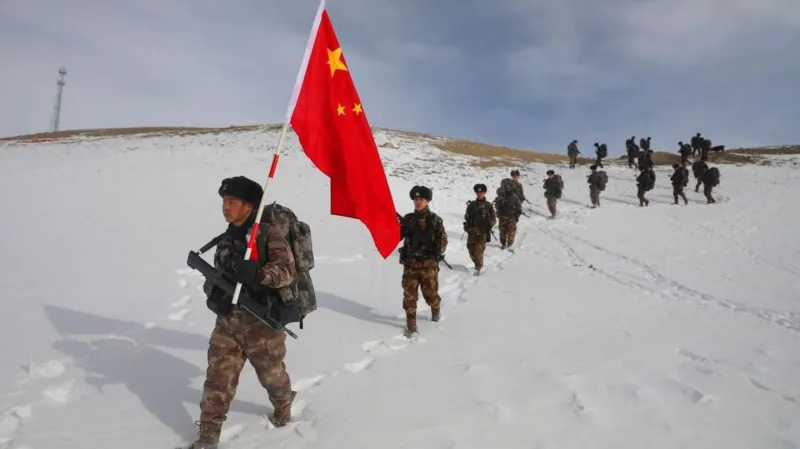
The commission covers the Pakistan-China frontier, including the Shaksgam Valley, a mountainous area of approximately 5,180 square kilometres.
Under a boundary agreement signed in 1963, Pakistan transferred control of the territory to China. India has never accepted that arrangement and claims Shaksgam as part of Ladakh.
New Delhi argues that the valley belonged to the former princely state of Jammu and Kashmir and was under Pakistan’s unlawful occupation before the 1963 agreement.
Pakistan maintains that Jammu and Kashmir remains disputed and considers its boundary agreement with China valid.
These competing territorial positions explain why the latest announcement has generated a diplomatic dispute.
India’s foreign ministry reiterated that Pakistan had no authority to enter into agreements concerning territory New Delhi considers Indian.
Experts Say the Commission Revives an Existing Arrangement
Jabin T. Jacob, a professor in the Department of International Relations and Governance Studies at Shiv Nadar University in Delhi, told the BBC that the development should be understood as the activation of an existing mechanism rather than the creation of an entirely new border arrangement.
He noted that the 1963 Pakistan-China agreement already provided for a joint boundary commission.
According to Jacob, the more significant question concerns why Pakistan and China have chosen to operationalise the mechanism now.
He suggested that the timing could reflect China’s wider efforts to clarify its boundaries and both countries’ interest in formalising movement and cooperation along the frontier.
Instability along Pakistan’s other borders may also have increased the importance of managing its boundary with China, he said.
Jacob drew attention to Article 6 of the 1963 agreement, which provides for renegotiation of the boundary arrangement with the authority that ultimately controls the territory following a settlement of the Kashmir dispute.
He also argued that China’s international media presence gives Beijing greater capacity to circulate its territorial position and maps, while India faces difficulties in securing comparable attention for its objections.
Border Management and Strategic Signalling
Pakistan and China already maintain substantial transport and infrastructure links through the region, including the Karakoram Highway and projects associated with the China-Pakistan Economic Corridor (CPEC).
Husain Haqqani, Pakistan’s former ambassador to the United States and a senior fellow at the Anwar Gargash Diplomatic Academy and Hudson Institute, told the BBC that the commission had both practical and political dimensions.
On the administrative side, he said, it could improve coordination over border crossings, discourage unauthorised movement and strengthen protection for infrastructure linked to CPEC.
He also interpreted the move as a diplomatic signal that China continues to approach the Kashmir dispute in a manner consistent with Pakistan’s position.
Haqqani said Beijing does not accept India’s territorial claims over Kashmir and views Gilgit-Baltistan through its relationship with Pakistan.
Kashmir’s Changed Political Status Adds to the Context
Haqqani linked Pakistan’s approach to changes made by India in the part of Kashmir under New Delhi’s administration.
In 2019, the Indian government revoked Article 370 of its constitution, ending the special constitutional status previously granted to Jammu and Kashmir.
Pakistan continues to maintain that the territory’s final status has not been determined.
Haqqani argued that, following India’s constitutional changes, Islamabad sees little reason not to formalise border arrangements with China that have operated in practice since 1963.
For Beijing, he said, cooperation with Pakistan on the boundary also carries strategic value by reinforcing its relationship with Islamabad and signalling its position on the wider Kashmir dispute.
The latest disagreement therefore extends beyond the administration of a remote mountain frontier. It reflects the unresolved territorial claims involving India, Pakistan and China, as well as the growing importance of border infrastructure and regional connectivity in their diplomatic relationships.