
Editorial
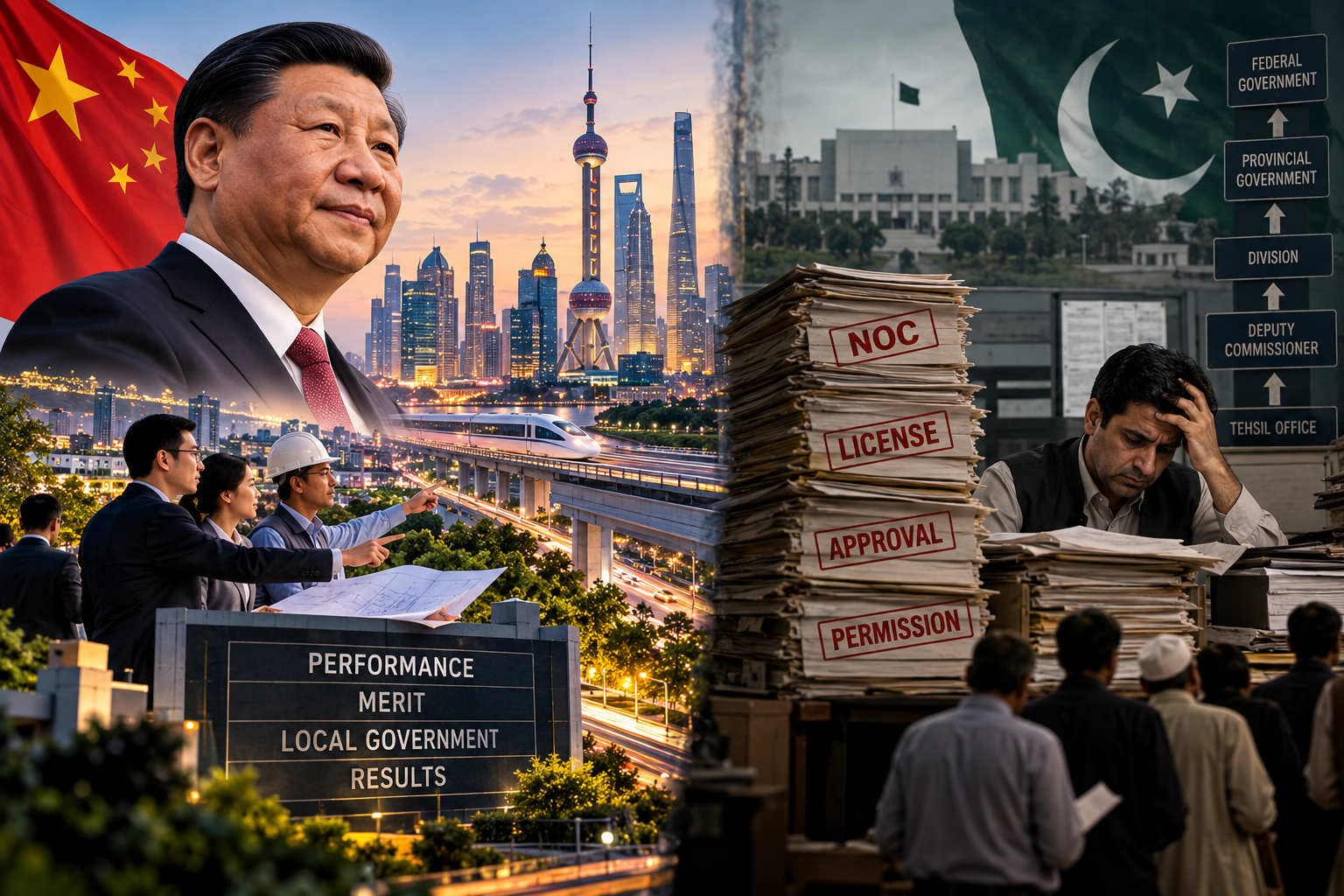
Pakistan’s political and administrative leadership frequently invokes China as a model of economic development, institutional efficiency and national transformation. Politicians visit Beijing, celebrate its infrastructure, admire its economic achievements and promise to replicate its success. Yet their admiration often overlooks the fundamental question: what makes China’s governance system capable of delivering results while Pakistan’s administrative machinery remains trapped in bureaucratic controls, political patronage and institutional paralysis?
The answer lies not merely in political centralisation but in the organisation of administrative authority, institutional capacity and performance-based governance.
China operates under a highly centralised political structure dominated by the Communist Party. Nevertheless, much of its economic development and administrative implementation depends on provincial, municipal and local institutions. Local governments exercise substantial responsibilities in infrastructure development, investment facilitation, urban management and economic planning. Their performance has historically influenced the career advancement of officials within the party-state hierarchy.
China’s system is not a pure meritocracy. Political loyalty, party discipline and personal networks influence appointments and promotions. However, its administrative structure has also developed mechanisms through which experience, organisational competence and measurable performance matter. This combination of political centralisation and decentralised economic administration distinguishes China’s governance arrangements from Pakistan’s bureaucratic model.
President Xi Jinping’s political career illustrates the significance of administrative experience within this system. His father, Xi Zhongxun, was persecuted during Mao Zedong’s Cultural Revolution but survived and was subsequently politically rehabilitated. Xi Jinping himself experienced rural hardship before progressing through local and provincial leadership positions, eventually reaching the highest offices of the Chinese state.
His political ascent cannot be understood independently of Communist Party structures, but it demonstrates the importance attached to experience across different administrative levels.
Pakistan presents a striking contrast.
Its administrative framework remains heavily dependent on hierarchical permissions, centralised decision-making and bureaucratic supervision. District and local officials frequently operate within institutional arrangements that restrict their financial autonomy, administrative discretion and capacity to respond independently to public needs.
The district administration, despite its proximity to citizens, remains deeply embedded in provincial and federal bureaucratic hierarchies. Even routine administrative and development matters can require approvals from authorities far removed from the communities affected.
This is the enduring legacy of the NOC culture, licensing controls and permission-based governance.
Rather than enabling institutions to perform clearly defined responsibilities, Pakistan’s administrative system frequently makes bureaucratic approval the precondition for economic and civic activity. Consequently, officials become gatekeepers, businesses encounter unnecessary procedural obstacles, and citizens remain dependent on administrative discretion.
The distinction becomes particularly evident in urban governance.
In China’s major cities, municipal institutions play substantial roles in economic management, infrastructure provision and urban development. Citizens experience government primarily through the institutions responsible for their immediate surroundings, not through direct interaction with the country’s national leadership.
In Pakistan, by contrast, cities remain administratively fragmented, financially dependent and politically subordinate. Municipal institutions often lack the authority and resources necessary to manage expanding urban populations.
Pakistan’s problem is therefore not simply that its government is centralised. It is that authority is concentrated without establishing sufficiently capable, accountable and empowered institutions at the levels where governance actually occurs.
China’s experience offers no justification for authoritarianism or the uncritical transplantation of its political model. Its genuine institutional lesson concerns the importance of administrative capacity, local implementation and accountability for results.
Pakistan must move beyond ceremonial admiration for Chinese development and confront the structural weaknesses of its own governance system.
A country cannot reproduce China’s economic achievements while preserving a bureaucratic order that rewards permissions over performance, patronage over competence and central control over institutional responsibility.
The real reform is not to imitate Beijing’s political authority, but to empower Pakistan’s cities, professionalise its institutions and replace administrative gatekeeping with effective public governance.