
Republic Policy | International Affairs | October 28, 2026
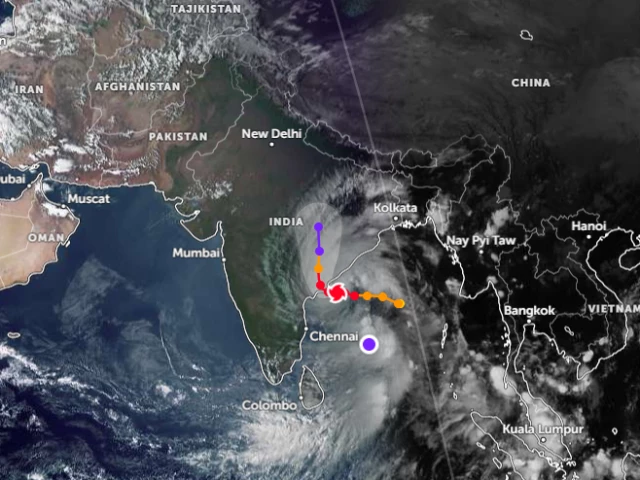
NEW DELHI: Indian authorities have launched large-scale evacuations, suspended railway services and closed educational institutions along the country’s eastern coastline as Cyclone Arnab approaches Andhra Pradesh, threatening destructive winds, torrential rainfall and widespread damage to infrastructure and agricultural land.
The severe cyclonic storm, which developed over the Bay of Bengal and intensified on Monday, was forecast to make landfall along the Andhra Pradesh coast by Wednesday morning. India’s Meteorological Department warned that the cyclone could cause extensive destruction in vulnerable coastal settlements, particularly those with weak housing and inadequate flood protection.
Emergency preparations have been concentrated in Andhra Pradesh, while neighbouring Odisha has also introduced precautionary measures amid forecasts of heavy rainfall and dangerous weather conditions.
The approaching cyclone has raised concerns about the capacity of coastal communities to withstand increasingly severe weather emergencies, particularly in areas where livelihoods depend heavily on agriculture, fishing and small businesses.
Mass Evacuations Underway in Andhra Pradesh
Authorities in Andhra Pradesh have begun relocating residents from low-lying coastal settlements to designated emergency shelters.
Prakhar Jain, Managing Director of the Andhra Pradesh State Disaster Management Authority, told Reuters that approximately 50,000 people had been moved to safer locations by Monday night.
Officials estimated that around 400,000 residents could require evacuation as the storm approached.
Jain confirmed that evacuation operations were continuing, with emergency personnel prioritising communities considered particularly vulnerable to flooding, storm surges and structural damage.
Special arrangements have also been made for pregnant women living in high-risk areas. According to The Indian Express, more than 4,700 pregnant women were transferred to hospitals as part of preventive measures.
The relocation reflects concerns that severe weather could disrupt transportation and access to emergency medical services during the cyclone.
Andhra Pradesh Chief Minister Nara Chandrababu Naidu directed government departments to maintain continuous surveillance of the storm and implement precautionary measures ahead of its expected landfall.
His office said on Monday that authorities had been instructed to closely monitor developments and take necessary steps to protect vulnerable populations.
Local reports indicated that educational institutions in several affected districts had been ordered to remain closed from Tuesday until Saturday.
Meteorological Department Warns of Extensive Damage
India’s weather authorities issued warnings of destructive winds, intense rainfall and flooding across coastal districts.
The Meteorological Department cautioned that the cyclone could cause the complete destruction of thatched houses, damage electricity and communication infrastructure, uproot utility poles and severely affect standing crops.
Low-lying areas face particular risks from accumulated rainfall and coastal flooding.
Television footage from affected locations showed powerful waves striking largely deserted beaches, while businesses remained closed as residents prepared for deteriorating weather conditions.
The warnings have heightened concerns for agricultural communities, where damage to crops and rural infrastructure could produce economic consequences extending beyond the immediate emergency.
The Bay of Bengal is among the world’s most cyclone-prone regions, exposing India’s eastern coastline to recurring tropical storms and associated flooding.
Railway Services Suspended and Schools Closed
Transport authorities have introduced extensive restrictions to reduce the risks associated with the approaching cyclone.
Regional railway officials announced the cancellation of at least 12 trains in eastern India, while services on 53 routes along the southern coastline were suspended for Tuesday and Wednesday.
The disruptions are expected to affect passenger movement and regional connectivity during the emergency.
In Odisha, authorities ordered schools and colleges in five districts to close on Tuesday and Wednesday.
Rajesh Prabhakar Patil, Odisha’s Special Relief Commissioner, told Reuters that no evacuations had been undertaken in the state at the time of his statement.
Nevertheless, officials remained alert to the possibility of heavy rainfall and other weather-related emergencies as the cyclone moved towards the coastline.
Sri Lanka Also Issues Severe Weather Warnings
The cyclone-related weather disturbance has prompted precautionary measures beyond India.
Neighbouring Sri Lanka closed schools amid warnings of torrential rainfall, flash floods and landslides.
The country’s Department of Meteorology warned that severe weather conditions could trigger sudden flooding and mudslides, particularly in vulnerable areas.
Sri Lankan disaster management authorities also placed the military on alert as part of emergency preparedness arrangements.
The developments demonstrate the wider regional implications of severe weather systems originating over the northern Indian Ocean.
Climate Risks and Disaster Preparedness
Tropical cyclones are recurring hazards in the Bay of Bengal and northern Indian Ocean. Similar storms are known as hurricanes in the North Atlantic and typhoons in parts of the Pacific.
The supplied report also identifies El Niño-related warming as a factor contributing to heightened weather concerns, although the precise relationship between an individual cyclone and broader climate patterns requires separate scientific assessment.
For India, the immediate challenge is to complete evacuations, maintain essential services and minimise civilian casualties before the storm reaches land.
The longer-term governance challenge concerns the resilience of coastal infrastructure, early-warning systems, emergency healthcare and disaster-response institutions.
Effective disaster management depends on coordination between national and state authorities, timely public communication and the availability of adequately equipped evacuation facilities.
Cyclone Arnab represents another major test of India’s emergency preparedness as authorities attempt to protect vulnerable communities from a potentially destructive coastal disaster.
With large populations exposed to flooding and infrastructure damage, the effectiveness of preventive measures will be critical in determining the storm’s humanitarian and economic consequences.
The best-selling books of Republic Policy Think Tank, including the landmark book The Bureaucratic Coup, are available at Vanguard Books, Liberty Books, Readings, Kitab Sarai, Sang-e-Meel, Saeed Book Bank Islamabad, National Book Foundation, and others across Pakistan. Contact for home delivery: 0341-4222501 (WhatsApp).